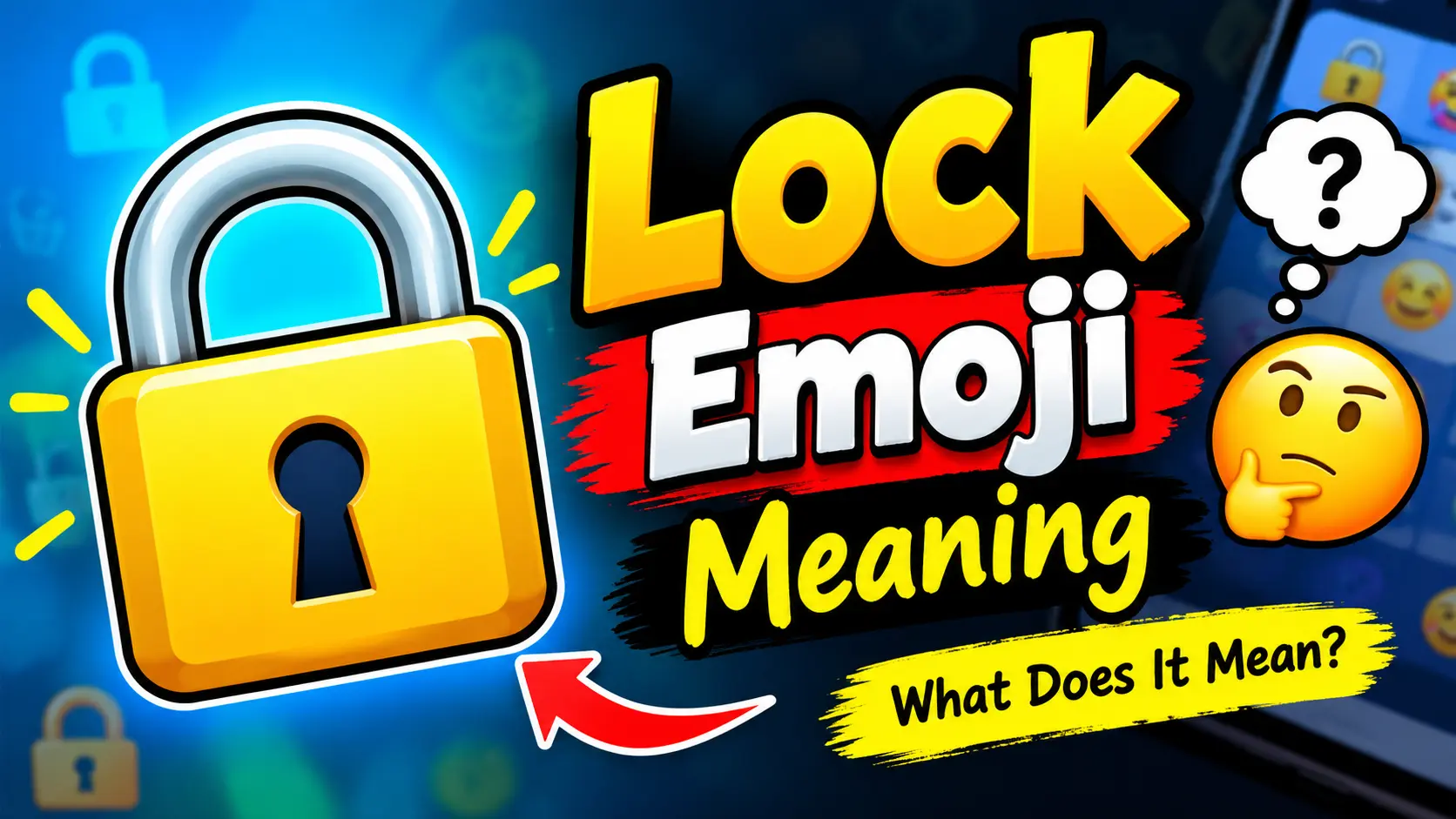
Think about the last time you saw 🔒 in a message. Did the person mean privacy, security, trust, or something more personal? The Lock Emoji Meaning can depend heavily on the situation and the words that come with it.
In its most common use, 🔒 represents something that is protected, private, secure, closed, or unavailable. People may use it when talking about passwords, accounts, secrets, relationships, or personal information.
On social media, the lock emoji can also suggest that someone wants to keep something private or exclusive. For example, a person might use 🔒 in a caption to show that their relationship or personal life is “locked down.”
Meaning & Definition
At its core, the lock emoji represents security, privacy, or restricted access. The closed padlock (🔒) is the most common version, and its primary meaning is simple: this is protected, private, or off-limits.
Primary meaning in texting/social media:
- Something is locked down, private, or exclusive
- A relationship, secret, or piece of information that’s “sealed”
- A signal that access is restricted (like a locked Instagram or TikTok account)
Secondary/alternative meanings:
- In tech contexts, it can literally represent a locked device, file, or app
- In gaming, it can mean a locked level or achievement not yet unlocked
- Informally, some use it to mean “loyal” or “committed” (as in, locked in with someone)
Example messages:
- “My page’s private now, sent you a follow request 🔒”
- “We’re locked in for Friday, no backing out now 🔒”
Background & Origin
The lock emoji isn’t slang that started on social media , it began as a straightforward Unicode symbol representing security, first added in early emoji sets to mirror real-world padlocks and browser “secure connection” icons. Long before it became a texting habit, the padlock symbol was already familiar from website security indicators, the little icon browsers show next to HTTPS URLs.
As emojis moved from purely functional symbols into everyday conversation, users began borrowing the padlock’s literal meaning , “protected” or “closed off” , and applying it emotionally and socially. It picked up traction on platforms like Instagram and TikTok as private accounts became more common, and creators started using 🔒 as shorthand to flag privacy settings, secrets, or loyalty in captions and bios.
Usage in Different Contexts
Texting or Chat Messages
In one-on-one chats, the lock emoji usually signals confidentiality or commitment.
- “This stays between us 🔒”
- “Locked in on the plan, see you at 8”
Social Media Platforms
On Instagram, TikTok, and Twitter/X, 🔒 often appears next to usernames or in bios to indicate a private/locked account.
- “Account’s 🔒 now, request to follow!”
Professional or Technical Settings
In work chats, emails, or tech documentation, the lock emoji reinforces security or restricted access.
- “File is 🔒 , you’ll need admin approval to edit.”
Platform-Specific Meanings
| Platform | Common Meaning | Example Use |
| End-to-end encryption / privacy | “Chat’s encrypted 🔒 don’t worry” | |
| Private account indicator | “Went private 🔒 link in bio to follow” | |
| TikTok | Locked/private profile or “locked in” commitment | “Locked in 🔒 posting daily now” |
| Snapchat | Privacy or a “locked” friendship/streak | “Our streak is locked 🔒 don’t break it” |
| Twitter/X | Protected tweets (private account) | “Went 🔒 for a bit, DM to follow” |
Other Fields Using the Lock Symbol
Beyond casual texting, the padlock icon shows up across several professional and technical fields:
- Cybersecurity: Represents encryption, secure connections, or restricted files
- Software/UX design: Used as a literal icon for locked settings, screens, or premium features
- Gaming: Marks locked levels, characters, or content not yet unlocked
- Real estate/property listings: Occasionally used informally to signal a “locked-in” deal or price
Common Misconceptions & Mistakes
A few mix-ups happen often with the lock emoji:
- Confusing “private” with “secret”: A locked account just means restricted visibility, not necessarily hidden or scandalous content.
- Assuming it always means romance: “Locked in” doesn’t automatically mean commitment to a person , it’s often used for plans, goals, or projects too.
- Overreading tone: Because it’s a neutral symbol, people sometimes assume hostility (“locked out”) when the sender simply means “protected” or “settled.”
Similar Terms & Alternatives
| Term/Emoji | Meaning | Example Use |
| 🔓 (Open lock) | Unlocked, accessible, revealed | “Account’s 🔓 now, feel free to follow” |
| 🔐 (Lock with key) | Secured with extra emphasis on access control | “Vault’s 🔐 tight” |
| 🤐 (Zipper mouth) | Secrecy, promise not to tell | “I won’t say a word 🤐” |
| 🙊 (See-no-evil monkey) | Playful secrecy | “Can’t tell you yet 🙊” |
How to Respond , Chat Examples
With a friend:
Friend: “This is 🔒 between us, okay?” You: “Say less, my lips are sealed 🤐”
With a crush:
Crush: “Feeling pretty locked in on you lately 🔒” You: “That’s cute… locked in right back 😊”
With a colleague:
Colleague: “I’ve 🔒 the document so no one edits it by mistake.” You: “Perfect, thanks for locking it down before the meeting.”
Differences from Similar Words
The lock emoji overlaps with words like secret, private, and confidential, but each carries a slightly different nuance:
- Secret implies something hidden entirely from others.
- Private suggests limited access, not necessarily secrecy.
- Confidential is more formal, often used in professional or legal contexts.
- Locked (🔒) sits in between , it signals restricted access without always implying total secrecy.
Relevance in Online Conversations & Dating Apps
On dating apps and casual social platforms, the lock emoji has taken on an emotional shorthand for commitment or exclusivity. Saying you’re “locked in” with someone can mean you’re focused on that connection and not entertaining other options.
Example:
“Not talking to anyone else, I’m locked in 🔒”
It’s also common in bios to flag a private account, which subtly signals selectivity , only approved followers get access, which can add a layer of intrigue in the dating-app world of curated profiles.
Popularity & Trends Over Time
Interest in emoji meanings, including the lock emoji, tends to spike alongside broader conversations about online privacy and relationship slang trends. Google Trends data shows recurring interest around “locked in” as a phrase gained traction through gaming and motivational content on TikTok, while the literal padlock use around private accounts has stayed steady as more users adjust privacy settings on social platforms.
FAQs
1. What does the lock emoji mean in a text? It usually signals privacy, security, or commitment , something is “sealed” or restricted.
2. Does the lock emoji mean someone likes you? Not directly, but “locked in 🔒” used romantically can suggest focus or commitment to that person.
3. What’s the difference between 🔒 and 🔓? 🔒 means locked/private/restricted, while 🔓 means unlocked/open/accessible.
4. Why do people use the lock emoji on Instagram? It often indicates a private account, meaning only approved followers can see posts.
5. Is the lock emoji used in professional messages? Yes , it’s commonly used to indicate a secured file, restricted document, or confidential information.
Conclusion
The lock emoji meaning ultimately comes down to context , it can represent privacy, security, secrecy, or commitment depending on where and how it’s used.
Whether you spot it in a private Instagram bio, a work email about a locked file, or a flirty text about being “locked in,” the padlock 🔒 is a small symbol that carries a lot of nuance. Next time you see it, take a second to read the conversation around it , that’s where the real meaning is hiding.

I am Daniel Scott, a passionate writer dedicated to creating meaningful and engaging content that informs, inspires, and connects with readers worldwide. I am passionate about exploring ideas, sharing knowledge, and presenting stories with clarity and creativity. My writing focuses on delivering valuable insights through well-researched articles and thoughtful perspectives. I am committed to maintaining accuracy, originality, and a reader-first approach in every piece I create.