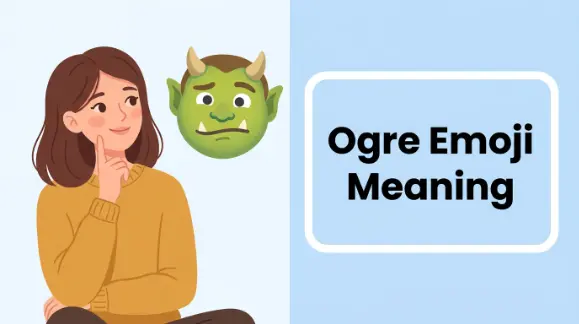
You might spot 👹 in a message and instantly wonder why someone sent an ogre instead of using a regular smiley. The ogre emoji has a strong and slightly mysterious appearance, so its meaning can depend on the situation and the person using it.
It is often connected with anger, mischief, scary or unusual behavior, but people may also use it simply because they find the character funny or expressive.
If you’re searching for the ogre emoji meaning, you’ll want to look beyond its appearance. In texting and social media, 👹 can express different emotions, from playful teasing to frustration or a fierce mood. Its meaning can also change depending on whether someone sends it alone or alongside other emojis and words.
In this guide, you’ll learn what 👹 means, how people use the ogre emoji in text, and what it can mean on platforms such as WhatsApp, Instagram, Snapchat, and TikTok. We’ll also look at common examples so you can understand the intended message more easily.
Meaning & Definition
The ogre emoji 👹 is officially named “Japanese Ogre” in the Unicode Standard, and it’s modeled after a namahage , a traditional Japanese folklore demon-like figure with a red face, sharp teeth, and horns, historically used to scare children into good behavior.
In everyday texting and social media, the primary meaning of 👹 is playful monstrousness , it’s used to represent something scary, angry, mischievous, or “unhinged” in a fun, exaggerated way, not literal horror.
Secondary/alternative meanings include:
- Expressing mock-anger or being “triggered” in a joking way
- Representing a villain, troublemaker, or someone being extra or dramatic
- Halloween and folklore-themed posts
- Gaming and fantasy contexts (RPGs, monster-hunting games, tabletop games)
Example messages:
- “Bro ate my leftovers again 👹👹” (mock fury, not real anger)
- “Me trying to survive Monday mornings 👹”
Background & Origin
The ogre emoji traces back to Japanese folklore rather than Western pop culture. The namahage tradition, especially associated with Akita Prefecture in Japan, involves masked figures visiting homes on New Year’s Eve to warn children against laziness and bad behavior.
Over time, its meaning shifted from strictly “scary folklore demon” to a flexible, humor-driven symbol used to dramatize everyday frustration, chaos, or spookiness , a common pattern where emojis lose their literal cultural roots as they go global.
Usage in Different Contexts
Texting or chat messages: Used to exaggerate a reaction. Example: “You canceled on me again? 👹” (playful betrayal, not real anger).
Social media platforms: Common in captions for Halloween costumes, gym “beast mode” posts, or comedic villain-arc content. Example: “New week, new villain era 👹🔥”
Professional or technical settings: Rare, but occasionally used informally in casual work chats (like Slack) to indicate a hard deadline stress or a joking “monster workload” moment. Example: “This client feedback turned me into 👹 today.”
Platform-Specific Meanings
| Platform | Common Meaning | Example Use |
| Playful anger or teasing between friends | “You ate the last slice?? 👹” | |
| Halloween, spooky aesthetic, or “villain era” captions | “Feeling myself lately 👹✨” | |
| TikTok | Comedic overreaction or “unhinged” humor trend | “POV: it’s 6am and the alarm goes off 👹” |
| Snapchat | Silly, exaggerated facial-expression pairing | Sent with a goofy selfie caption |
| Twitter/X | Sarcastic outrage or joking “rage mode” | “Me reading the group chat drama 👹” |
Other Fields Using the Ogre Emoji
Beyond casual chat, the ogre emoji appears in a few niche spaces:
- Gaming communities: Used to represent monster-type enemies, boss battles, or “tank” characters in RPGs and fantasy games.
- Folklore and cultural content: Referenced in posts about Japanese traditions, mythology threads, or educational content about namahage.
- Halloween marketing: Brands and creators use it in seasonal promotions themed around monsters and costumes.
- Fan fiction and roleplay communities: Used to tag “villain” or “beast” characters in creative writing threads.
Common Misconceptions & Mistakes
A few mix-ups happen often with this emoji:
- Confusing it with the “troll” or “goblin” emoji , while all three represent mythical creatures, the ogre emoji specifically has a red face with visible horns and a snarling expression, distinct from the green troll face.
- Reading it as literal aggression , most modern usage is comedic, not a genuine expression of hostility.
Similar Terms & Alternatives
| Emoji/Term | Meaning | Example Use |
| 👺 Goblin/Tengu mask | Similar folklore-based mischievous energy | “Chaotic Friday plans 👺” |
| 😈 Smiling Devil | Playful mischief or flirty troublemaking | “Sending this at 2am 😈” |
| 👿 Angry/Imp face | More intense frustration or “evil” mood | “When the wifi cuts out 👿” |
| 🧌 Troll | Internet mischief, trolling behavior, or gaming monster | “Bro really trolled me 🧌” |
Curious about related symbols? Check out our devil emoji meaning guide and troll emoji meaning breakdown for more context.
How to Respond , Chat Examples
With a friend: Friend: “You seriously ate my fries?! 👹” You: “Guilty 😭 I’ll buy you a whole meal, don’t come for me”
With a crush: Crush: “You left me on read for 3 hours 👹” You: “In my defense, I was staring at your text trying to think of something smooth to say 👀”
With a colleague: Colleague: “This deadline turned me into 👹 today” You: “Same honestly, coffee run in 10?”
Differences from Similar Words
People sometimes lump the ogre emoji in with words like secret, private, or confidential, especially when it’s used to hint at drama or gossip (“👹 tea incoming”). But the nuance matters:
- Secret implies information being withheld.
- Private implies restricted access, not necessarily dramatic.
- Confidential is a formal, often professional term about sensitive information.
- The ogre emoji, by contrast, isn’t about secrecy at all , it’s about tone and mood, signaling chaos, exaggeration, or playful menace rather than withheld information.
Relevance in Online Conversations & Dating Apps
On dating apps and in flirty texting, the ogre emoji is often used ironically , someone might call themselves an “ogre” to self-deprecate humorously before a date, or use it to react to a bold, cheeky message. Example: “I promise I don’t actually look like 👹 in real life, here’s a real pic.” It works well because Gen Z and millennial humor leans heavily on self-aware, exaggerated irony rather than literal statements, and the emoji fits that tone perfectly.
Popularity & Trends Over Time
Search interest and usage of monster-themed emojis, including the ogre emoji, tends to spike seasonally around Halloween, alongside “villain era” and “unhinged” meme trends that circulate heavily on TikTok and Instagram Reels. While it’s not among the most-used emojis overall, it consistently resurfaces in meme culture whenever creators lean into exaggerated, chaotic-energy humor.
FAQs
1. What does the ogre emoji mean in texting? It usually signals playful anger, mock frustration, or exaggerated chaos rather than literal hostility.
2. Is the ogre emoji the same as the troll emoji? No , they’re visually and culturally different. The ogre emoji is red with horns and rooted in Japanese folklore, while the troll emoji (🧌) is a separate figure tied more to internet “trolling” behavior.
3. Can I use the ogre emoji flirtatiously? Yes, it’s commonly used in a self-deprecating or teasing way in casual and dating conversations.
4. Is the ogre emoji appropriate for professional messages? It’s best kept casual , informal team chats are fine, but avoid it in formal client or business communication.
5. Where does the ogre emoji actually come from? It’s based on the Japanese namahage folklore figure, not Western fairy-tale ogres.
Conclusion
At its core, the ogre emoji 👹 is less about literal monsters and more about tone , it’s the internet’s go-to way of dramatizing frustration, chaos, or playful villain energy without sounding genuinely upset.
Whether you’re texting a friend, posting a Halloween caption, or teasing a crush, understanding the context behind this emoji helps you use it (and read it) exactly the way it’s meant. Next time someone sends you 👹, you’ll know it’s probably not an attack , it’s just a little chaotic fun.

I am Daniel Scott, a passionate writer dedicated to creating meaningful and engaging content that informs, inspires, and connects with readers worldwide. I am passionate about exploring ideas, sharing knowledge, and presenting stories with clarity and creativity. My writing focuses on delivering valuable insights through well-researched articles and thoughtful perspectives. I am committed to maintaining accuracy, originality, and a reader-first approach in every piece I create.