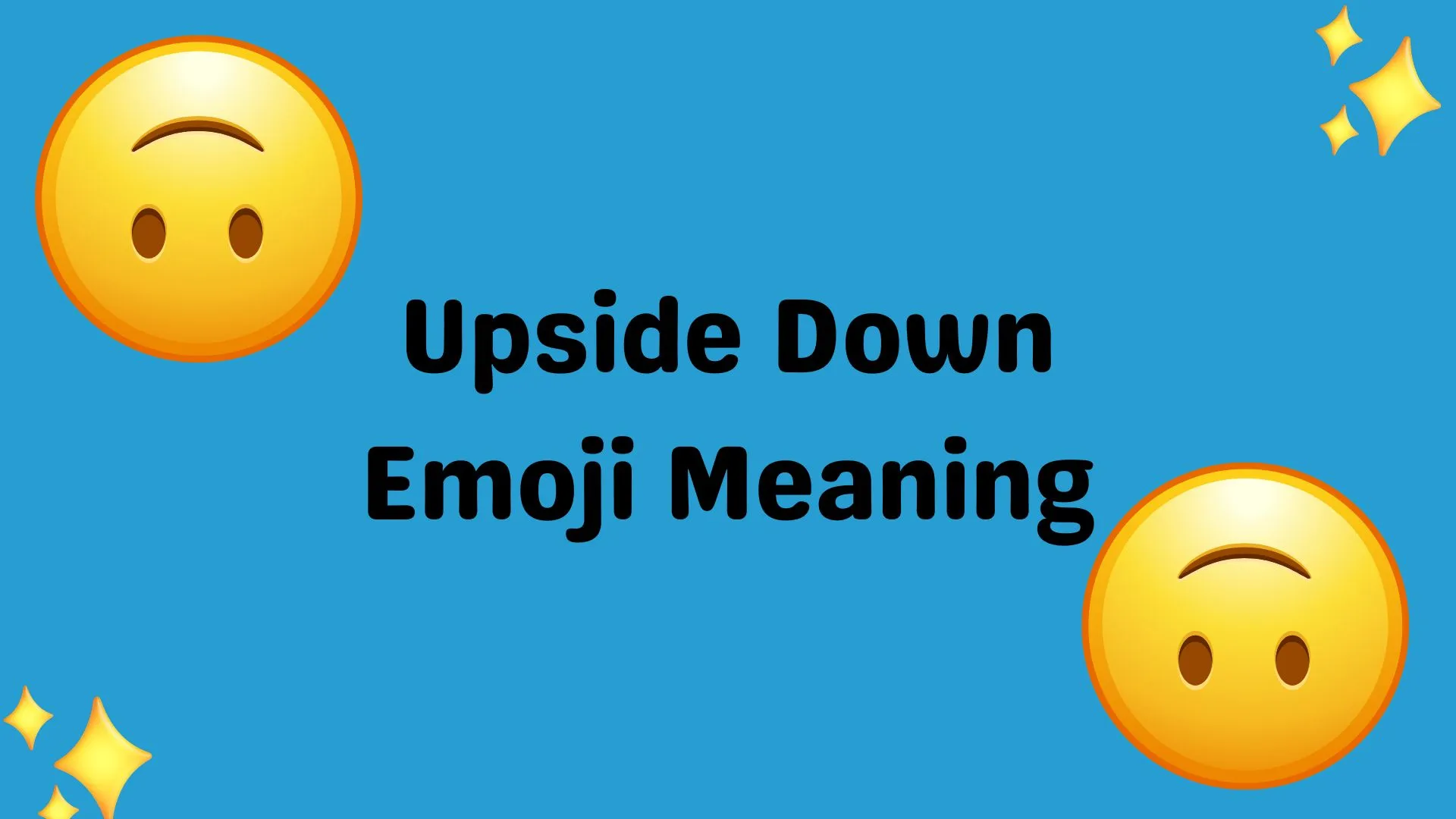
Have you ever received the 🙃 Upside Down Emoji and wondered what the sender was really trying to say? The Upside Down Emoji Meaning can be surprisingly interesting because this simple emoji often carries a deeper tone than its cheerful appearance suggests.
Depending on the conversation, it can express sarcasm, awkwardness, playful humor, mild frustration, embarrassment, or a feeling of “I’m fine… but not really.” It is commonly used when someone wants to make a funny or slightly uncomfortable situation feel lighter without explaining everything directly.
The meaning can also change based on who sends it, whether it is a friend, partner, boy, or girl, and what was said before it.
Meaning & Definition
The upside down emoji 🙃 (officially called “Upside-Down Face” in the Unicode standard) is primarily used to express sarcasm, irony, silliness, or passive-aggressive humor. It’s the emoji version of saying something with a wink and a smirk , you mean the opposite of what your words say, or you’re being lightly playful about an awkward situation.
Secondary and alternative meanings include:
- Mild frustration hidden behind a smile , “I’m fine, everything’s great 🙃” (translation: it is not great)
- Silliness or goofiness , used just to be playful, with no deeper meaning
- Awkward acceptance , acknowledging something bad happened, but shrugging it off
Example messages:
- “Studied all night and still failed the quiz 🙃”
- “Sure, I’ll just reschedule my whole weekend for you 🙃”
Background & Origin
The upside-down face emoji was added to Unicode 8.0 in 2015, joining the broader family of “smiley face” emojis meant to add emotional nuance beyond the basic 🙂 and 😊. Because a literal upside-down smile doesn’t map to any single real-world facial expression, users were free to project their own meaning onto it , and that ambiguity is exactly what made it explode in popularity.
Over the following years, especially as platforms like Twitter (now X) and Tumblr embraced ironic, deadpan humor, 🙃 became the unofficial emoji of “I’m not okay but I’m going to say I am with a smile.” It evolved from a niche Unicode addition into a full-blown internet personality , the face of sarcastic resignation.
Usage in Different Contexts
Texting or chat messages: Most commonly used to soften bad news or add a sarcastic tone. Example: “Lost my job today 🙃”
Social media platforms: Used in captions, comments, and tweets to convey ironic humor or relatable chaos. Example: “Adulting is going great 🙃 #help”
Professional or technical settings: Rarely appropriate in formal work communication, though some casual workplace chats (like Slack) use it to lightly vent. Example: “The deadline moved up again 🙃”
Platform-Specific Meanings
| Platform | Common Meaning | Example Use |
| Sarcasm or awkward humor between friends | “Yeah, that went well 🙃” | |
| Ironic captions, self-deprecating jokes | “Living my best life 🙃” | |
| TikTok | Relatable chaos, comedic irony in captions/comments | “POV: your Monday 🙃” |
| Snapchat | Playful teasing or masking annoyance | “Thanks for nothing 🙃” |
| Twitter/X | Deadpan sarcasm, venting with a smile | “Great, another update broke everything 🙃” |
Other Fields Using the Abbreviation
While 🙃 is purely an emoji (not a text abbreviation), people often search alongside similar-looking shorthand terms that get confused with each other, such as:
- DL , can mean “Download” or “Driver’s License” depending on context
- IC , used in medical shorthand for “Informed Consent” or in gaming for “In Character”
- UD , sometimes used informally for “Upside Down” in casual texting shorthand
These unrelated meanings show why context always matters when decoding any short symbol or abbreviation online.
Common Misconceptions & Mistakes
A common mistake is assuming 🙃 always means genuine happiness , it usually doesn’t. People also confuse it with 🙂 (a neutral, polite smile), when in reality 🙃 carries a very different, more ironic tone.
Another pitfall: reading too much negativity into it. Sometimes 🙃 is used purely for silliness, not sarcasm, so tone and relationship context matter more than the emoji alone.
Similar Terms & Alternatives
| Term/Emoji | Meaning | Example Use |
| 🙂 | Neutral, polite smile | “Sounds good 🙂” |
| 😊 | Genuine warmth or happiness | “So excited for this! 😊” |
| 😏 | Smug or flirty sarcasm | “Oh really? 😏” |
| 🙄 | Eye-roll, annoyance | “Sure, whatever 🙄” |
| 🙃 | Ironic, awkward, or masked sarcasm | “Great, love that for me 🙃” |
How to Respond , Chat Examples
With a friend: Friend: “Failed my driving test again 🙃” You: “Nooo 😭 next time for sure, want to vent about it?”
With a crush: Crush: “Guess who got stood up 🙃” You: “Wait what?! Their loss honestly, are you okay?”
With a colleague: Colleague: “Meeting got moved up two hours 🙃” You: “Classic. Want me to grab you a coffee before it starts?”
Differences from Similar Words
Unlike Secret, Private, or Confidential , which describe information that is intentionally withheld , 🙃 doesn’t hide information at all. It hides tone. The words or facts are usually right there in the message; what’s disguised is the emotional intent behind them. That’s the key nuance: 🙃 is an emotional mask, not an information mask.
Relevance in Online Conversations & Dating Apps
On dating apps, 🙃 is often used to keep things light while testing the waters. It softens rejection, adds playful sarcasm to a joke, or signals “I’m being cheeky, don’t take this too seriously.” Example: “You’re trouble, aren’t you 🙃” This ambiguity is part of its charm in flirty conversations , it invites the other person to read between the lines without committing to a clear emotional statement.
Popularity & Trends Over Time
Since its 2015 release, 🙃 has remained a consistently searched and used emoji, with regular spikes in usage tied to meme culture, viral “relatable” content, and its frequent appearance in ironic captions across Gen Z and Millennial social media. Google Trends data shows steady interest in its meaning, particularly among younger users trying to decode texts from friends or romantic interests.
FAQs
1. Does 🙃 always mean sarcasm? Not always , it can also express playful silliness, so context and relationship matter.
2. Is 🙃 the same as 🙂? No, 🙂 is a neutral smile, while 🙃 usually implies irony or hidden emotion.
3. Can I use 🙃 in professional messages? It’s best avoided in formal settings, but acceptable in casual workplace chats among close coworkers.
4. Why do people use 🙃 instead of just saying they’re upset? It softens the message, making frustration feel lighter or more humorous.
5. Is 🙃 flirty on dating apps? Yes, it’s often used to add playful, teasing energy to a conversation.
Conclusion
The upside down emoji meaning boils down to one core idea: things aren’t quite what they seem.
Whether it’s masking frustration, adding sarcasm, or just being goofy, 🙃 gives texters a way to say more than words alone can. Next time you see it pop up in a chat, pause and read the context , that’s where the real meaning lives.

I am James Carter, a passionate writer dedicated to creating informative, engaging, and valuable content for readers. I enjoy exploring different topics, researching new ideas, and sharing knowledge through clear and meaningful writing. I am committed to providing accurate information, helpful insights, and well-crafted articles that inspire and educate audiences. With a strong focus on quality and creativity, I aim to connect with readers and deliver content that adds real value.