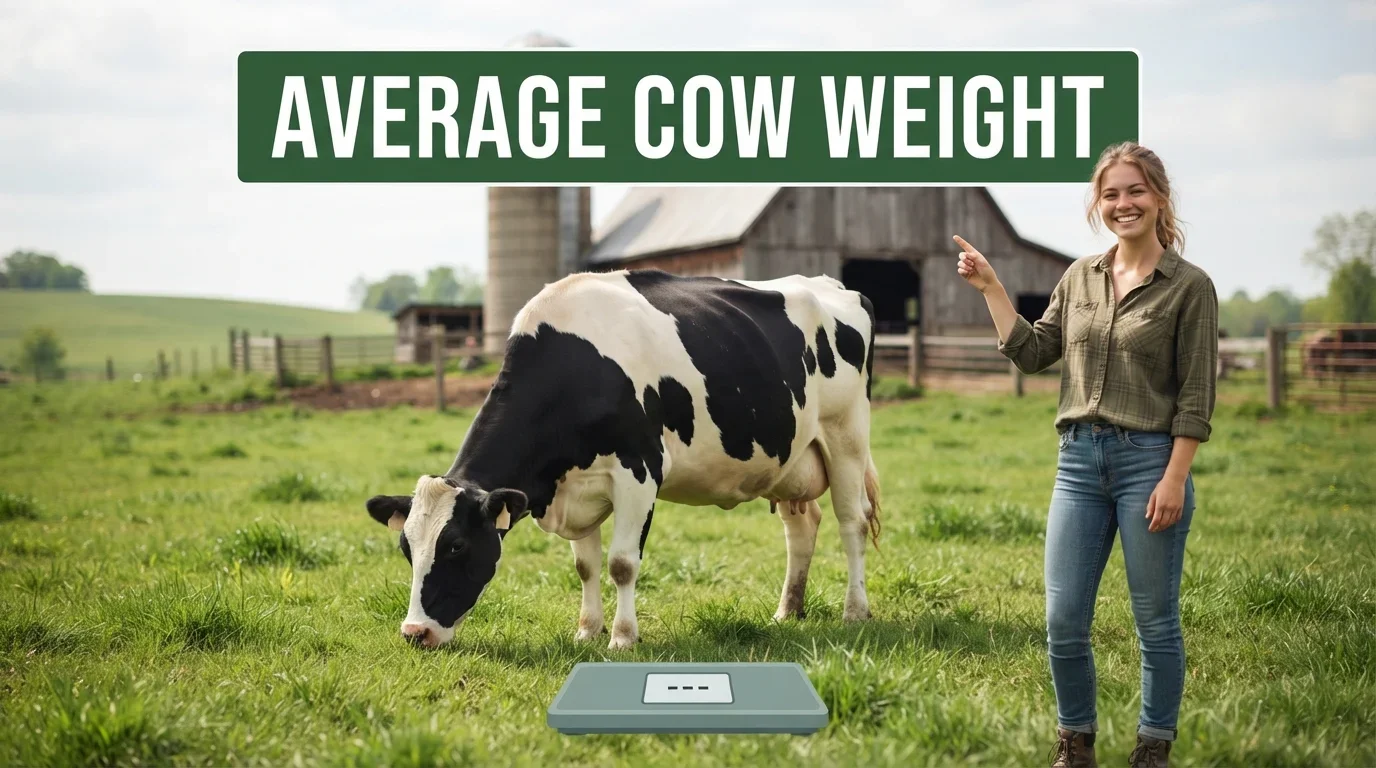
The average cow weight depends on its breed, age, gender, genetics, nutrition, and overall body condition. A small dairy cow may weigh around 900 pounds, while a large beef cow can weigh 1,600 pounds or more. Bulls generally weigh considerably more than female cattle because they develop larger frames and more muscle.
So, how much does an average cow weigh? A useful general estimate for a mature female cow is 1,000 to 1,500 pounds (454 to 680 kilograms). However, this is not a universal standard. Holstein, Jersey, Angus, Hereford, Sahiwal, and other cattle breeds have different mature body sizes.
Cow weight is an important measurement in livestock farming. Farmers use it to plan feeding programs, monitor animal growth, evaluate breeding readiness, estimate market value, and manage beef production. It also helps identify unexpected weight loss that may indicate nutritional or health problems.
In this guide, you’ll find average cow weight charts by breed, age, and gender, along with information about beef and dairy cattle, Pakistani cattle breeds, weight measurement methods, feeding requirements, and meat yield. You’ll also learn how to estimate cow weight without a weighing scale.
Quick answer: A mature cow commonly weighs 1,000–1,500 pounds (454–680 kg). The exact weight depends on its breed, age, genetics, and management.
What Is the Average Weight of a Cow?

The average weight of a mature cow is approximately 1,000–1,500 pounds (454–680 kilograms). Some smaller breeds weigh less, while larger cattle may exceed this range.
It is important to distinguish between a cow, heifer, bull, and steer. A cow is a female that has given birth, while a heifer is a young female that has not yet calved. A bull is an intact adult male, and a steer is a castrated male.
These animals have different growth patterns and weight expectations.
| Cattle category | Approximate weight |
| Newborn calf | 60–100 lb (27–45 kg) |
| 6-month-old calf | 300–450 lb (136–204 kg) |
| 12-month-old heifer | 450–750 lb (204–340 kg) |
| Mature dairy cow | 900–1,500 lb (408–680 kg) |
| Mature beef cow | 1,000–1,500 lb (454–680 kg) |
| Mature bull | 1,600–2,400 lb (726–1,089 kg) |
| Finished beef steer | 1,100–1,500 lb (499–680 kg) |
These are broad working estimates, not official limits or guaranteed weights. Breed, production system, genetics, age, and body condition can produce substantial differences.
A cow’s live weight also differs from its carcass weight. Live weight includes the entire animal before slaughter, while carcass weight is measured after slaughter and dressing. These figures should never be treated as interchangeable.
Average Cow Weight by Breed
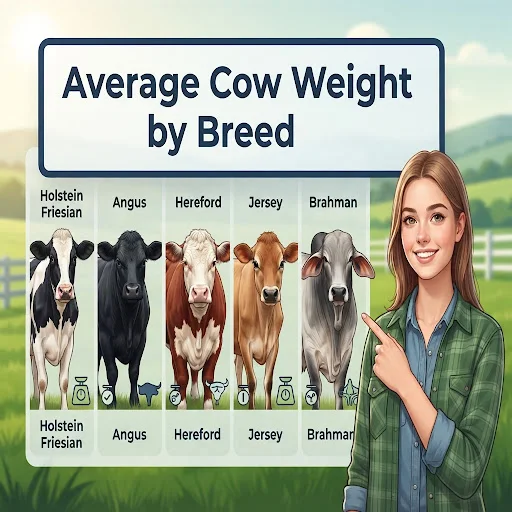
Breed is one of the strongest indicators of a cow’s expected mature size. Dairy breeds are selected for milk production, while beef breeds are generally selected for meat production, muscle development, and growth.
However, there is considerable overlap between the two groups. A large dairy cow can weigh more than a smaller beef cow.
The following table provides useful approximate mature female weights.
| Cattle breed | Typical mature female weight |
| Jersey | 900–1,200 lb (408–544 kg) |
| Guernsey | 1,000–1,400 lb (454–635 kg) |
| Holstein | 1,300–1,700 lb (590–771 kg) |
| Brown Swiss | 1,300–1,700 lb (590–771 kg) |
| Angus | 1,100–1,500 lb (499–680 kg) |
| Hereford | 1,100–1,500 lb (499–680 kg) |
| Charolais | 1,300–1,800 lb (590–816 kg) |
| Simmental | 1,300–1,800 lb (590–816 kg) |
| Limousin | 1,200–1,600 lb (544–726 kg) |
These ranges are practical estimates for general comparison. Individual animals and breed populations can differ. For example, Mississippi State University’s livestock judging reference lists an average Angus cow weight of approximately 1,100 pounds and a Charolais cow weight of approximately 1,550 pounds.
Center for 4-H Youth Development+2
Holstein Cow Weight
Mature cow, side view full udder, large brisket, a blue sky
The Holstein is a large dairy breed recognized by its black-and-white or red-and-white markings. It is widely used in commercial milk production.
A mature Holstein cow commonly weighs around 1,500 pounds (680 kilograms). Larger animals may weigh more, depending on their genetics and body condition.
Holsteins have relatively large frames and high milk-producing potential. Their nutritional requirements depend on body size, milk yield, stage of lactation, and overall health.
Jersey Cow Weight
Jersey cow side view, in a green pasture, looking and large udder
The Jersey is a smaller dairy breed known for its fawn-colored coat and milk with relatively high butterfat content.
A mature Jersey cow generally weighs around 900–1,200 pounds (408–544 kilograms).
Jerseys are lighter than Holsteins, but their smaller size does not mean they are less valuable dairy animals. Their milk composition, fertility, and ability to perform in different environments make them useful in dairy farming.
Angus Cow Weight
The Angus is a popular beef breed recognized for its black coat, muscular body, and naturally polled head.
Mature Angus cows commonly weigh around 1,100–1,500 pounds (499–680 kilograms). Their size varies according to genetics and breeding selection.
Angus cattle are widely raised for beef production. Farmers often select them for growth, carcass characteristics, and adaptability.
Hereford Cow Weight
A portrait of a brown and white hereford cow in natural settings
The Hereford is recognized by its reddish-brown body and distinctive white face.
A mature Hereford cow commonly weighs around 1,100–1,500 pounds (499–680 kilograms).
Hereford cattle are used in beef production and are valued for their practical characteristics in different farming environments. Their actual mature weight depends on frame size, genetics, and feeding conditions.
Charolais Cow Weight
The Charolais originated in France. It is known for its white or cream-colored coat and substantial muscular development.
A mature Charolais cow may weigh approximately 1,300–1,800 pounds (590–816 kilograms).
Charolais cattle are frequently used in beef production and crossbreeding programs. Their large frames make appropriate feeding and growth monitoring particularly important.
Simmental Cow Weight
The Simmental originated in Switzerland. Its coat commonly features red-and-white or golden-and-white markings.
Mature Simmental cows generally weigh around 1,300–1,800 pounds (590–816 kilograms), although individual weights vary.
The breed is used in both beef and dual-purpose production systems. Farmers value its growth potential and large body frame.
Brown Swiss Cow Weight
The Brown Swiss is a large dairy breed with a brown or gray-brown coat.
A mature Brown Swiss cow commonly weighs around 1,300–1,700 pounds (590–771 kilograms).
These cattle are raised for milk production and are recognized for their strong body structure and ability to perform in different dairy environments.
Guernsey Cow Weight
The Guernsey is a medium-sized dairy breed with a golden-fawn coat and white markings.
A mature Guernsey cow commonly weighs around 1,000–1,400 pounds (454–635 kilograms).
The University of Kentucky’s dairy breed reference lists approximately 1,200 pounds as the average mature cow size.
Animal & Food Sciences
Average Cow Weight by Age
The average cow weight by age changes as the animal develops. Calves grow rapidly during their early months, while heifers continue gaining weight as their bones and muscles develop.
However, age alone cannot determine whether a cow is growing properly. Breed, gender, nutrition, health, and farming conditions all influence growth.
The following table gives broad illustrative ranges for growing cattle.
| Age | Approximate weight |
| Newborn | 60–100 lb (27–45 kg) |
| 1 month | 80–120 lb (36–54 kg) |
| 3 months | 150–250 lb (68–113 kg) |
| 6 months | 300–450 lb (136–204 kg) |
| 9 months | 375–600 lb (170–272 kg) |
| 12 months | 450–750 lb (204–340 kg) |
| 15 months | 550–850 lb (249–386 kg) |
| 18 months | 650–1,000 lb (295–454 kg) |
| 24 months | 800–1,250 lb (363–567 kg) |
| 3 years | Depends on breed and maturity |
| 4–5 years | Usually approaching mature size |
These are illustrative ranges, not universal growth standards. A dairy heifer and a beef heifer of the same age may have different target weights.
Newborn Calf Weight
A newborn calf generally weighs between 60 and 100 pounds (27–45 kilograms). Some breeds produce smaller calves, while larger cattle breeds may have heavier birth weights.
Birth weight is influenced by:
- Breed and genetics
- Gender of the calf
- Size and age of the mother
- Pregnancy nutrition
- Individual development
The first hours after birth are especially important. Calves should receive adequate colostrum promptly because it supplies antibodies that help protect them against disease.
3-Month-Old Calf Weight
A three-month-old calf may weigh approximately 150–250 pounds (68–113 kilograms), although its actual weight depends on its starting birth weight and growth rate.
At this stage, calves consume milk or milk replacer alongside increasing quantities of solid feed. Clean water and suitable calf starter feed support rumen development.
6-Month-Old Calf Weight
A six-month-old calf may weigh approximately 300–450 pounds (136–204 kilograms).
Many calves are weaned around this age, although weaning decisions should depend on health, feed intake, development, and the farm’s management system.
Farmers should monitor weight before and after weaning to identify growth setbacks.
1-Year-Old Heifer Weight
A one-year-old heifer may weigh around 450–750 pounds (204–340 kilograms), depending on breed and production system.
Dairy heifers and beef heifers should not be evaluated using exactly the same growth targets.
For dairy cattle, the mature size of the herd provides a more useful benchmark than a general age-based weight chart.
2-Year-Old Cow Weight
A two-year-old female may weigh approximately 800–1,250 pounds (363–567 kilograms), although some breeds and individuals fall outside this range.
Many dairy heifers have their first calf at around two years of age. However, farmers should assess body weight, height, and reproductive development before breeding.
Penn State Extension explains that dairy heifers should generally reach around 55% of their herd’s mature body weight by breeding age. The exact target depends on the breed and herd.
Penn State Extension+1
When Does a Cow Reach Full Size?
Cattle do not all reach mature size at the same age.
Some animals approach their mature frame earlier, while larger breeds may continue developing for several years.
A cow can also continue gaining or losing weight after reaching mature height. Pregnancy, lactation, feeding, and body condition influence her weight throughout adulthood.
Average Cow Weight by Gender
Gender is another important factor when comparing cattle weight. Bulls generally weigh more than cows because they develop larger frames and greater muscle mass.
The following table provides general reference ranges.
| Cattle type | Approximate weight |
| Female newborn calf | 60–90 lb |
| Male newborn calf | 70–100 lb |
| Growing heifer | 450–1,000 lb |
| Mature cow | 1,000–1,500 lb |
| Market steer | 1,100–1,500 lb |
| Mature bull | 1,600–2,400 lb |
Female Cow Weight
A mature female cow commonly weighs between 1,000 and 1,500 pounds (454–680 kilograms).
Her weight depends on breed, age, genetics, pregnancy, and production requirements.
Dairy cows may experience weight loss during early lactation because milk production increases their energy requirements. Beef cows may also experience changes in weight while raising calves.
Average Bull Weight
A mature bull commonly weighs around 1,600–2,400 pounds (726–1,089 kilograms).
However, a smaller dairy bull and a large beef bull may have very different mature weights.
Bulls have larger shoulders and more developed muscles than female cattle. Their size is important when planning breeding programs, transportation, and livestock handling.
Safety note: Bulls can be dangerous regardless of their size or temperament. They should always be handled with appropriate livestock facilities and precautions.
Steer Weight
A steer is a male bovine that has been castrated.
Steers are commonly raised for beef production. Their market weight varies according to breed, age, feeding program, and desired carcass characteristics.
A finished beef steer may weigh approximately 1,100–1,500 pounds (499–680 kilograms) before slaughter.
Heifer Weight
A heifer is a young female that has not yet given birth.
Its weight depends on age, breed, and growth rate. Farmers often monitor heifers regularly to determine whether they are developing properly.
For dairy heifers, breeding readiness is better assessed using mature herd weight and body size than age alone.
Beef Cow Weight vs. Dairy Cow Weight
Beef cattle are primarily selected for meat production, growth, and carcass characteristics. Dairy cattle are selected for milk production, reproductive performance, and dairy efficiency.
1,000–1,500 lb
Typical mature female reference range
Walmart, Kroger bottle their own milk and shake up American dairy industry | Fox Business
Dairy cattle
900–1,500 lb
Typical mature female reference range
Average Beef Cow Weight
A mature beef cow commonly weighs around 1,000–1,500 pounds (454–680 kilograms).
Common beef cattle breeds include:
- Angus
- Hereford
- Charolais
- Simmental
- Limousin
- Brahman
Beef cattle are generally selected for growth potential, muscle development, and meat quality. However, farmers also consider reproductive performance, calving ease, and the ability to raise healthy calves.
Average Dairy Cow Weight
A mature dairy cow may weigh approximately 900–1,500 pounds (408–680 kilograms), although large breeds can exceed this range.
Common dairy cattle breeds include:
- Holstein
- Jersey
- Brown Swiss
- Guernsey
- Ayrshire
- Milking Shorthorn
Holsteins are generally among the larger dairy breeds, while Jerseys have smaller body frames.
Dairy farmers should monitor both body weight and body condition because milk production can affect energy balance and weight changes.
Average Cow Weight in Pakistan
Cattle farming plays an important role in Pakistan’s agricultural economy. Farmers raise cattle for milk, meat, breeding, and traditional agricultural purposes.
Pakistan has several indigenous cattle breeds adapted to different environments. These include Sahiwal, Red Sindhi, Cholistani, Dhanni, Bhagnari, Tharparkar, and others.
Unlike many general international cattle charts, Pakistan’s breed data provide useful local reference figures.
साहिवाल गाय से जुड़ी खास बातें शायद ही जानते होंगे आप – Know the special things related to sahiwal breed cow nyt
The following figures come from the Small and Medium Enterprises Development Authority’s Pakistan dairy and livestock sector study, which reports adult male and female body weights.
SMEDA
| Pakistani cattle breed | Adult female weight | Adult male weight |
| Sahiwal | 408 kg (899 lb) | 544 kg (1,199 lb) |
| Red Sindhi | 325 kg (717 lb) | 530 kg (1,168 lb) |
| Cholistani | 341 kg (752 lb) | 470 kg (1,036 lb) |
| Dhanni | 285 kg (628 lb) | 412 kg (908 lb) |
| Tharparkar | 285 kg (628 lb) | 470 kg (1,036 lb) |
| Bhagnari | 480 kg (1,058 lb) | 650 kg (1,433 lb) |
These are figures reported in the cited sector study, not guaranteed weights for every animal. Breed populations and individual cattle can vary.
Sahiwal Cow Weight
Sahiwal; cow with high milk fat content – Kisan Kheti Ganga
The Sahiwal is one of Pakistan’s best-known dairy cattle breeds.
According to the cited Pakistani sector study, the adult female Sahiwal weighs approximately 408 kilograms (899 pounds), while the adult male weighs around 544 kilograms (1,199 pounds).
Sahiwal cattle are recognized for their ability to perform in hot climates and their dairy production characteristics.
Red Sindhi Cow Weight
Red Sindhi Cow, the Perfect Livestock Animal – Meat Bucket
The Red Sindhi is recognized by its reddish coat and adaptability to tropical conditions.
The cited sector study reports an adult female weight of approximately 325 kilograms (717 pounds) and an adult male weight of 530 kilograms (1,168 pounds).
The breed is primarily associated with dairy production.
Cholistani Cow Weight
Elite specimen of Cholistani cow with the milk yield of 15-18 liters… | Download Scientific Diagram
The Cholistani is associated with the Cholistan desert region of Punjab.
The sector study reports an adult female weight of approximately 341 kilograms (752 pounds) and an adult male weight of 470 kilograms (1,036 pounds).
Research describes Cholistani cattle as hardy animals adapted to the demanding conditions of their native environment.
PubMed
Dhanni Cow Weight
The Dhanni is associated with the Potohar region, including areas around Attock, Rawalpindi, Chakwal, and Jhelum.
The cited study reports an adult female weight of approximately 285 kilograms (628 pounds) and an adult male weight of 412 kilograms (908 pounds).
Dhanni cattle have traditionally been associated with draught purposes.
Bhagnari Cow Weight
bhag nari bull – Sibi Balochistan Pakistan
The Bhagnari is a large indigenous breed associated with the Bhagnari region.
The cited sector study reports approximately 480 kilograms (1,058 pounds) for adult females and 650 kilograms (1,433 pounds) for adult males.
This makes Bhagnari cattle an interesting example of how Pakistani indigenous breeds differ in mature body size.
What Factors Affect the Average Weight of a Cow?
Two cows of the same breed and age can have different weights. Their development depends on several interacting factors.
1. Breed and Genetics
Genetics influence mature body size, frame structure, muscle development, and growth rate.
For example, a mature Holstein generally has a larger frame than a Jersey. Angus and Hereford cattle also have different genetic growth characteristics from Charolais and Simmental cattle.
Breeding selection can gradually change the average size of a herd over generations.
2. Nutrition and Feeding
A cow needs adequate energy, protein, minerals, vitamins, and water to maintain healthy body condition.
Common cattle feeds include:
- Fresh pasture grass
- Hay
- Alfalfa
- Silage
- Corn-based feed
- Commercial cattle rations
- Appropriate mineral supplements
Poor-quality forage or inadequate feeding can slow growth and contribute to weight loss.
However, overfeeding is not a solution. Excessive body fat can create health and reproductive management problems.
3. Age and Development
Young cattle generally gain weight as their bones and muscles develop.
Growth is usually faster during early life than after maturity. Once an animal reaches its mature frame, changes in weight are more closely related to body condition, pregnancy, lactation, and feeding.
4. Gender
Bulls generally have greater mature body weight than cows because of their larger frames and muscle development.
Steers, heifers, and bulls should therefore be compared using suitable growth references rather than one universal cattle weight chart.
5. Pregnancy and Lactation
Pregnancy increases total body weight as the calf and associated tissues develop.
Lactation can have the opposite effect on body reserves. A cow producing large quantities of milk may lose body condition if her energy intake does not meet her requirements.
Farmers should consider reproductive stage when evaluating changes in body weight.
6. Health and Parasites
Illness, parasites, dental problems, and digestive disorders can interfere with appetite and nutrient absorption.
Unexpected weight loss should not automatically be blamed on poor feed. A veterinarian may need to examine the animal to identify the underlying problem.
7. Climate and Environment
Extreme temperatures can affect feeding and energy requirements.
Hot weather may reduce feed intake, while cold weather can increase the energy cattle need to maintain body temperature.
Good-quality pasture, clean water, shade, and suitable shelter all support healthy cattle management.
How to Measure a Cow’s Weight
Knowing how to measure a cow’s weight is useful for farmers, livestock traders, veterinarians, and cattle owners.
There are three practical approaches: weighing scales, weight tapes, and body measurement formulas.
1. Use a Livestock Weighing Scale
A livestock weighing scale is the most reliable way to measure actual body weight.
The cow stands on a suitable weighing platform, and the equipment displays its weight.
Farmers can use the results to:
- Monitor growth.
- Check breeding readiness.
- Calculate feeding requirements.
- Prepare animals for sale.
- Record weight changes.
- Monitor health and body condition.
For reliable records, weigh animals under reasonably consistent conditions and use properly maintained equipment.
2. Use a Cattle Weight Tape
A cattle weight tape estimates body weight from the animal’s heart girth, which is the circumference around the chest immediately behind the front legs.
The tape is placed around the chest without pulling it excessively tight.
Some tapes have breed-specific markings, so choosing a suitable tape matters. An older or unsuitable tape may give inaccurate results for modern cattle.
The University of Wisconsin Extension also emphasizes that some weight tapes may not accurately represent the body sizes of today’s animals.
Dairy
3. Calculate Cow Weight Without a Scale
A traditional livestock estimation formula uses heart girth and body length.
The measurements must be in inches:
Estimatedweight(lb)=Heartgirth2Bodylength300
For example, suppose a cow has:
- Heart girth: 75 inches
- Body length: 65 inches
The calculation is:
757565300=1,218.75lb
Estimated result
Approximately 1,219 pounds, or 553 kilograms.
This is an estimate, not an exact measurement. Body shape, breed, and measurement technique can affect accuracy. Use a livestock scale when a precise weight is needed.
4. Visual Weight Estimation
Experienced farmers may estimate cattle weight by examining body length, chest width, muscle development, and body condition.
However, visual estimation is less reliable than an actual weighing scale.
It is useful for rough comparisons, but it should not be used as the only method when calculating medicine doses, feeding requirements, or livestock sale values.
Average Cow Weight and Meat Yield
One common question among cattle farmers and buyers is how much meat they can obtain from a cow.
The answer depends on live weight, dressing percentage, carcass characteristics, and processing losses.
It is important to understand three different measurements:
- Live weight: The animal’s weight before slaughter.
- Carcass weight: The weight after slaughter and dressing.
- Packaged meat weight: The amount of meat remaining after further processing, trimming, and deboning.
What Is Dressing Percentage?
Dressing percentage is the proportion of an animal’s live weight represented by its dressed carcass.
The calculation is:
Dressingpercentage=CarcassweightLiveweight100
For example, suppose a steer weighs 1,200 pounds before slaughter and produces a 744-pound carcass.
\[ \frac{744}{1200}\times100=62\% \]
The dressing percentage is 62%.
This is an illustrative example, not a guaranteed result. Breed, muscle development, fat cover, digestive tract contents, and slaughter procedures all influence the final percentage.
Cow Live Weight vs. Carcass Weight
| Measurement | Example weight |
| Live weight | 1,200 lb |
| Carcass weight at 62% | 744 lb |
| Packaged meat | Lower than carcass weight |
Packaged meat weight varies with the amount of bone, trimming, and cutting preferences.
A farmer should never assume that a 1,200-pound cow will produce 1,200 pounds of packaged beef.
How Much Does a Cow Eat Per Day?
A cow’s daily feed requirement depends on body weight, age, pregnancy, milk production, activity, and feed quality.
A common starting estimate for many adult cattle is approximately 2–3% of body weight in dry matter daily. However, this is not a universal feeding recommendation.
Dry matter means the portion of feed remaining after its water content is removed.
| Cow weight | Estimated daily dry matter at 2–3% |
| 500 lb | 10–15 lb |
| 800 lb | 16–24 lb |
| 1,000 lb | 20–30 lb |
| 1,200 lb | 24–36 lb |
| 1,400 lb | 28–42 lb |
| 1,600 lb | 32–48 lb |
For example, a 1,200-pound cow consuming 2.5% of her body weight in dry matter would need approximately 30 pounds of dry matter daily.
Fresh grass and silage contain water, so the actual weight of feed offered will be higher.
Dairy cows producing large amounts of milk may need additional nutrients and energy. Growing calves also require diets designed for their stage of development.
Farmers should use suitable livestock nutrition guidance rather than treating the table as a fixed ration.
Average Cow Weight in Kilograms and Pounds
Farmers in different countries use different measurement systems. Some prefer pounds, while others use kilograms.
The conversion is simple:
- 1 kilogram = 2.20462 pounds.
- 1 pound = 0.453592 kilograms.
Here is a practical cow weight conversion chart.
| Weight in pounds | Weight in kilograms |
| 100 lb | 45.4 kg |
| 200 lb | 90.7 kg |
| 300 lb | 136.1 kg |
| 400 lb | 181.4 kg |
| 500 lb | 226.8 kg |
| 600 lb | 272.2 kg |
| 700 lb | 317.5 kg |
| 800 lb | 362.9 kg |
| 900 lb | 408.2 kg |
| 1,000 lb | 453.6 kg |
| 1,200 lb | 544.3 kg |
| 1,400 lb | 635 kg |
| 1,600 lb | 725.7 kg |
| 1,800 lb | 816.5 kg |
| 2,000 lb | 907.2 kg |
| 2,400 lb | 1,088.6 kg |
This table is useful when comparing international cattle weight records, estimating livestock value, or planning feeding requirements.
How to Maintain a Healthy Cow Weight
Maintaining healthy body weight is important for cattle growth, reproduction, milk production, and general well-being.
Farmers should focus on overall body condition rather than trying to make every cow reach a particular number on the scale.
Provide Balanced Nutrition
Cattle need appropriate quantities of energy, protein, minerals, and vitamins.
The correct diet depends on their age, body size, pregnancy status, and production requirements.
Poor-quality feed can limit growth, while excessive energy intake can cause unwanted fat accumulation.
Monitor Body Condition
Body condition scoring helps farmers assess the amount of fat and muscle covering an animal.
A cow may have a high body weight but still have an unsuitable body condition. Similarly, a smaller cow may be healthy for its breed and frame size.
For beef cattle, a commonly used body condition scoring system ranges from 1 to 9, where lower scores indicate very thin animals and higher scores indicate excessive fatness.
Maintain Clean Water Access
Clean water is essential for digestion, temperature regulation, and normal body functions.
Water requirements change with weather, feed moisture, pregnancy, and milk production.
Farmers should provide continuous access to clean water whenever practical.
Follow a Regular Health Program
Regular veterinary checks help identify parasites, infections, and other conditions that may affect weight.
Vaccination, parasite management, and appropriate treatment support healthy livestock.
Record Weight Changes
Keeping records makes it easier to identify changes in cattle growth.
Farmers can record:
- Animal identification.
- Breed and gender.
- Birth date.
- Weight measurements.
- Feeding changes.
- Pregnancy status.
- Health treatments.
Weighing animals at regular intervals makes it easier to evaluate whether a feeding or management program is working.
Common Mistakes When Estimating Cow Weight
Incorrect weight estimates can affect feeding decisions, breeding management, and livestock transactions.
Here are mistakes worth avoiding.
Assuming all breeds weigh the same: A Jersey cow and a Charolais cow have different mature body sizes. Breed-specific references are more useful than one universal figure.
Confusing live weight with carcass weight: Live weight is measured before slaughter, while carcass weight is measured after dressing.
Ignoring pregnancy: A pregnant cow’s total weight includes the developing calf and associated pregnancy tissues.
Depending only on appearance: Visual estimates are not sufficiently reliable when precise weight information is needed.
Comparing animals of different ages: A six-month-old calf should not be evaluated using mature cow weight standards.
Ignoring body condition: Weight alone cannot determine whether an animal is healthy.
Using outdated weight tapes: Some measuring tapes may not accurately represent the body sizes of modern cattle.
Applying dairy breeding targets to every breed: A dairy heifer’s breeding target should not automatically be used for beef cattle.
Frequently Asked Questions
1. What is the average weight of a cow?
A mature female cow commonly weighs around 1,000–1,500 pounds (454–680 kilograms). Smaller breeds may weigh less, while larger cattle can exceed this range.
2. How much does an average cow weigh in pounds?
An average mature cow weighs approximately 1,000–1,500 pounds. Its exact weight depends on breed, age, genetics, nutrition, and body condition.
3. How much does a cow weigh in kilograms?
A mature cow commonly weighs around 454–680 kilograms. However, some breeds are naturally smaller or larger.
4. How much does a full-grown cow weigh?
A full-grown cow generally weighs between 1,000 and 1,500 pounds. Large breeds such as Charolais and Simmental may exceed 1,800 pounds.
5. How much does a Holstein cow weigh?
A mature Holstein cow typically weighs around 1,500 pounds (680 kilograms). Individual animals can weigh more or less.
6. How much does a Jersey cow weigh?
A mature Jersey cow generally weighs around 900–1,200 pounds (408–544 kilograms). Jersey cattle are smaller than Holstein cattle.
7. How much does a beef cow weigh?
A mature beef cow commonly weighs approximately 1,000–1,500 pounds (454–680 kilograms). Breed and genetics influence its mature body size.
8. How much does a dairy cow weigh?
A mature dairy cow usually weighs around 900–1,500 pounds (408–680 kilograms). Holsteins are generally larger than Jerseys.
9. How much does a newborn calf weigh?
A newborn calf generally weighs approximately 60–100 pounds (27–45 kilograms). Birth weight varies according to breed, genetics, and parental size.
10. How much does a 6-month-old calf weigh?
A six-month-old calf may weigh approximately 300–450 pounds (136–204 kilograms). Nutrition and breed influence its growth.
11. How much does a 1-year-old heifer weigh?
A one-year-old heifer may weigh around 450–750 pounds (204–340 kilograms). Actual growth targets depend on the breed and production system.
12. What is the average bull weight?
A mature bull generally weighs between 1,600 and 2,400 pounds (726–1,089 kilograms). Large beef bulls may exceed this range.
13. How much does an Angus cow weigh?
A mature Angus cow commonly weighs approximately 1,100–1,500 pounds (499–680 kilograms).
14. How much does a Sahiwal cow weigh?
The Pakistani livestock sector study reports an adult female Sahiwal weight of approximately 408 kilograms (899 pounds). Individual animals may differ.
15. How much does a Red Sindhi cow weigh?
The same Pakistani sector study reports an adult female Red Sindhi weight of approximately 325 kilograms (717 pounds).
16. How can I calculate cow weight without a scale?
You can estimate cow weight using a cattle weight tape or a formula based on heart girth and body length. These methods provide estimates rather than exact measurements.
17. Do beef cows weigh more than dairy cows?
Not necessarily. Some beef breeds are larger, but dairy breeds such as Holstein can weigh more than smaller beef cattle.
18. What is the heaviest cattle breed?
The Chianina is recognized as one of the largest cattle breeds in the world. Some individuals can reach exceptionally large body weights. However, the heaviest individual animal and the heaviest average breed are not the same measurement.
19. Does pregnancy increase cow weight?
Yes. Pregnancy increases total body weight because of the developing calf and associated tissues and fluids. The effect depends on the stage of pregnancy and the cow’s original body condition.
20. How much meat can you get from a 1,200-pound cow?
The amount depends on dressing percentage and processing. For example, at an illustrative dressing percentage of 62%, a 1,200-pound animal would produce a 744-pound carcass. Packaged meat weight would be lower.
Conclusion
The average cow weight generally falls between 1,000 and 1,500 pounds (454–680 kilograms) for many mature female cattle, but there is no single weight that applies to every breed.
Holstein cows commonly weigh around 1,500 pounds, while Jersey cows are generally smaller. Angus and Hereford cattle have different mature weight ranges from larger Charolais and Simmental animals. Pakistani breeds also show considerable differences, with the Sahiwal, Red Sindhi, Cholistani, Dhanni, and Bhagnari having distinct body-weight characteristics.

I am Daniel Scott, a passionate writer dedicated to creating meaningful and engaging content that informs, inspires, and connects with readers worldwide. I am passionate about exploring ideas, sharing knowledge, and presenting stories with clarity and creativity. My writing focuses on delivering valuable insights through well-researched articles and thoughtful perspectives. I am committed to maintaining accuracy, originality, and a reader-first approach in every piece I create.