
Newborn diaper weight is an important topic for parents who want to understand their baby’s diaper changes, monitor urine output, and choose the right diaper size. Whether you’re comparing a dry diaper with a wet one or trying to estimate how much urine your baby produces, understanding diaper weight can make newborn care easier.
However, newborn diaper weight can mean two different things. Some parents want to know how much an unused or wet diaper weighs, while others are looking for the baby’s body-weight range for newborn diaper sizes. These measurements are not the same, and understanding the difference helps prevent confusion.
A dry newborn diaper has a weight determined by its brand, size, materials, and construction. After your baby urinates, the diaper becomes heavier because it absorbs and retains moisture. Parents can compare these two measurements to estimate urine volume when a healthcare professional recommends monitoring it.
In this guide, you’ll learn how much a newborn diaper weighs, how to calculate wet diaper weight, how to use a newborn diaper weight conversion chart, and how many wet diapers your baby should have each day. You’ll also discover practical weighing methods, diaper-sizing advice, and signs that may indicate a feeding or hydration concern.
What Is Newborn Diaper Weight?

Newborn diaper weight refers to the measurement of a diaper before and after your baby uses it. There are two main measurements:
- Dry diaper weight: The weight of a clean, unused diaper before it absorbs urine or contains stool.
- Wet diaper weight: The combined weight of the diaper and the moisture it has absorbed.
These measurements serve different purposes. Dry diaper weight provides a baseline, while wet diaper weight can help estimate how much urine the diaper contains.
For example, imagine that an unused newborn diaper weighs 22 grams. After your baby urinates, you weigh it again and find that it weighs 47 grams.
The difference is 25 grams. If the diaper contains only urine, this weight increase represents approximately 25 milliliters of urine.
This method is sometimes used in healthcare settings to monitor urine output. Parents may also use it at home when a healthcare professional specifically recommends diaper weighing.
It’s important to understand that the total weight of a used diaper does not represent the amount of urine. You must subtract the original dry diaper weight to estimate the moisture it has absorbed.
How Much Does a Newborn Diaper Weigh?

There is no universal average newborn diaper weight because manufacturers use different materials and designs. A thin disposable diaper may weigh less than a thicker diaper with additional absorbent padding.
Even diapers from the same manufacturer can have different weights depending on their size and product range.
If you want to know how much a newborn diaper weighs, the most accurate approach is to measure an unused diaper from the exact brand and size you use.
Several factors affect dry newborn diaper weight.
1. Diaper Brand
Every manufacturer uses its own combination of materials, absorbent layers, elastic, and protective coverings. These differences affect the weight of a clean diaper.
For this reason, you should not assume that two newborn diapers from different brands have identical dry weights.
2. Diaper Size
Newborn diapers are generally smaller than size 1 and larger infant diapers. A larger diaper may contain more material, which can increase its starting weight.
However, size alone does not determine weight. A lightweight size 1 diaper may weigh less than a thicker newborn diaper from another product line.
3. Absorbent Materials
Disposable diapers usually contain absorbent materials that hold liquid inside the diaper. The type and quantity of these materials influence the overall weight.
Some products also have additional layers designed to improve moisture distribution and leak protection.
4. Diaper Construction
Elastic waistbands, leg cuffs, fastening tabs, leak guards, and extra padding can affect the weight of an unused diaper.
A diaper designed for overnight use may have a different construction from a standard daytime product.
5. Moisture Absorption
The biggest change usually happens after your baby urinates. The diaper absorbs liquid and becomes heavier.
A lightly wet diaper may gain only a small amount of weight, while a diaper worn for a longer period may contain considerably more moisture.
Important: There is no reliable gram-based average that applies to every newborn diaper. Always measure your own diaper rather than relying on an unsupported universal weight estimate.
How to Measure Dry Newborn Diaper Weight
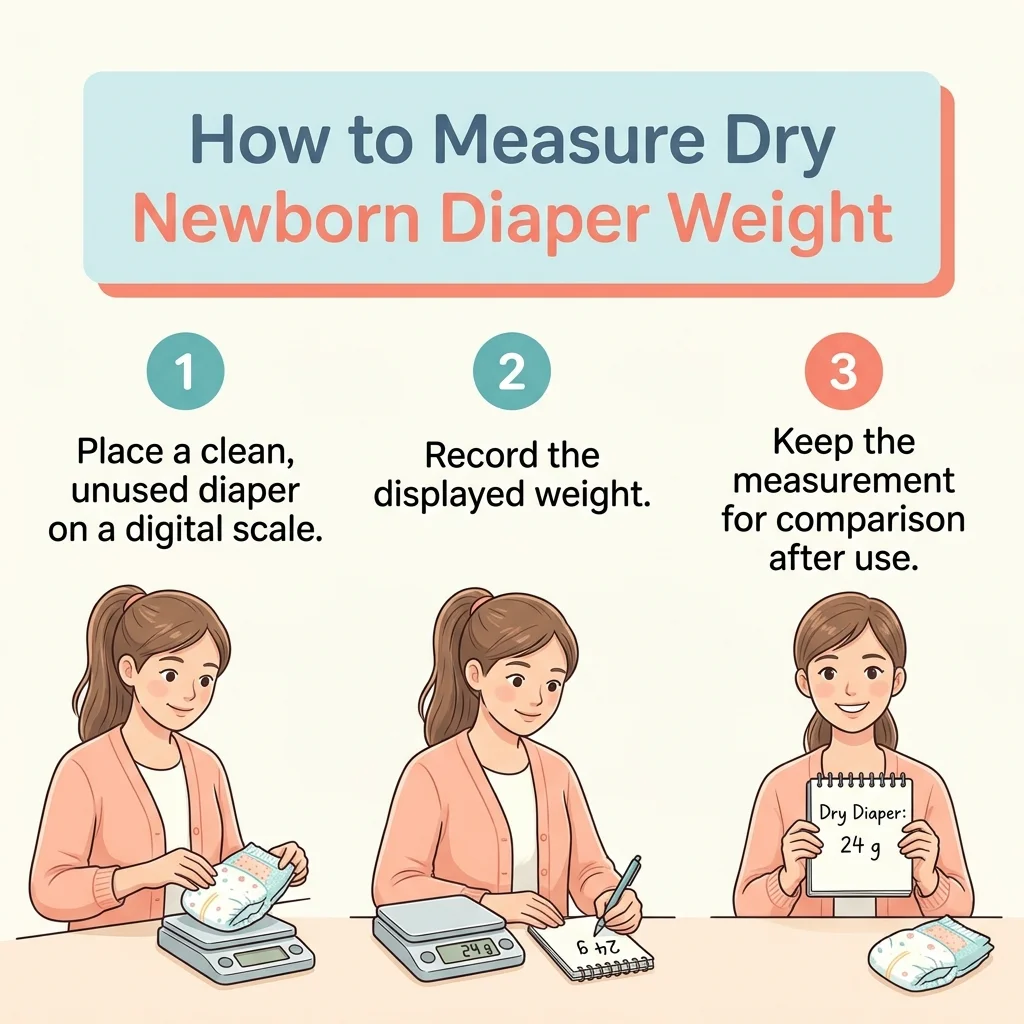
Measuring the weight of an unused diaper is simple. You only need a digital scale that displays measurements in grams.
Follow these steps:
- Place a digital kitchen scale on a flat, stable surface.
- Turn it on and select grams as the measurement unit.
- Take one clean diaper from its package.
- Place the diaper in the center of the scale.
- Record the displayed measurement.
- Repeat the process if you want to compare several diapers.
For example, suppose you weigh three unused newborn diapers from the same package and get these results:
| Diaper | Dry weight |
| Diaper 1 | 22 g |
| Diaper 2 | 23 g |
| Diaper 3 | 22 g |
These measurements show that the diapers have slightly different starting weights.
For the most accurate urine estimate, use the actual dry weight of the diaper being measured. If your healthcare provider gives you a particular weighing procedure, follow that procedure instead.
Dry vs. Wet Newborn Diaper Weight

Understanding the difference between dry and wet newborn diaper weight is essential when estimating urine volume.
A dry diaper contains only its original materials. A wet diaper contains those materials plus absorbed urine.
Consider this example:
| Measurement | Weight |
| Unused diaper | 22 grams |
| Used diaper | 47 grams |
| Weight increase | 25 grams |
| Estimated urine volume | 25 mL |
The weight increase is the important measurement. It tells you how much heavier the diaper became after use.
Why Does a Wet Diaper Weigh More?
A disposable diaper contains absorbent materials designed to take in and retain moisture.
When your newborn urinates, the liquid moves into the absorbent core. The diaper becomes heavier even if its outer surface does not feel particularly wet.
Some diapers distribute moisture across a large area. Others hold more liquid in the central absorbent section.
This is why a wetness indicator or a quick touch test cannot provide an exact measurement of urine volume.
Can a Wet Diaper Look Dry?
Yes. Some disposable diapers absorb urine so effectively that the surface feels relatively dry.
The absorbent core can retain moisture beneath the top layer. As a result, you may not notice how much urine the diaper contains just by touching it.
If you need to estimate urine volume, use a suitable digital scale rather than relying only on appearance or touch.
How to Calculate Newborn Urine Output Using Diaper Weight
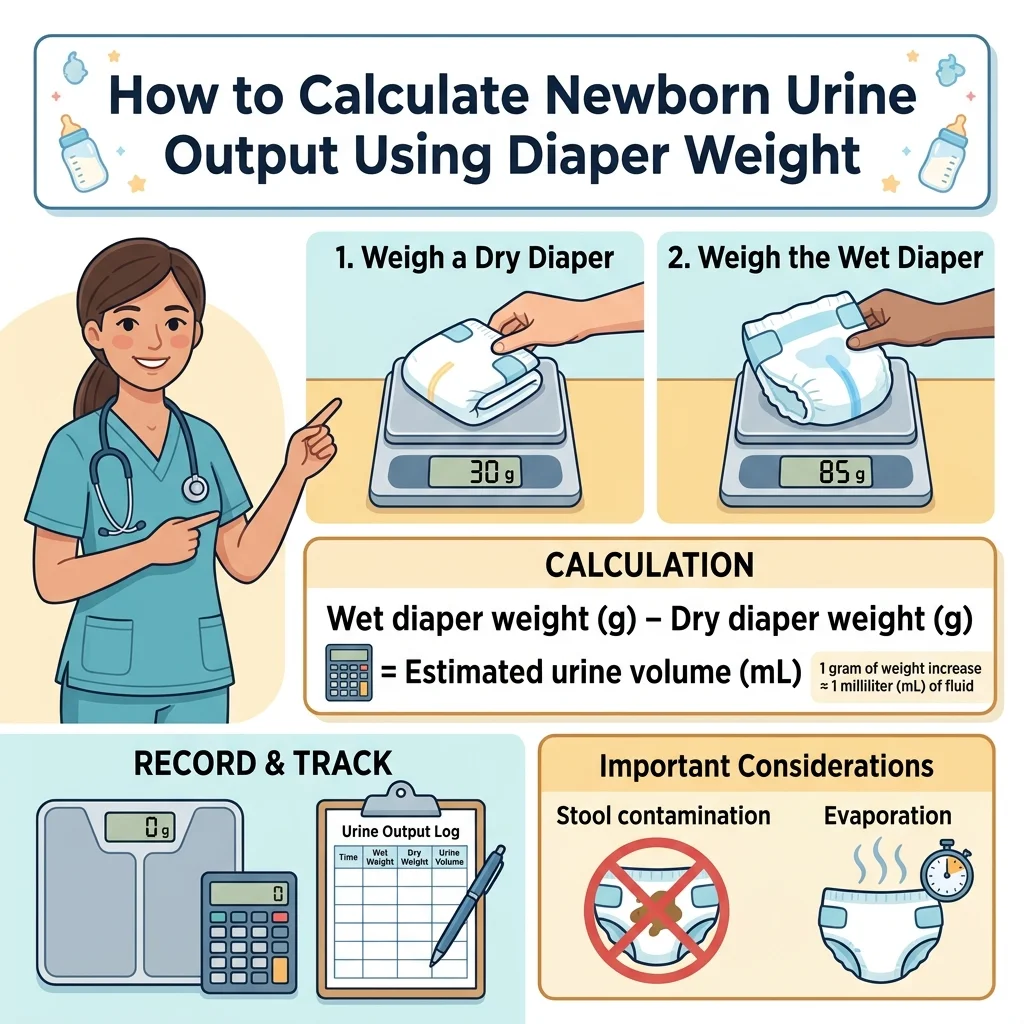
You can estimate newborn urine output by comparing the weight of an unused diaper with the weight of the same diaper after use.
The calculation is simple.
Formula:
Urineweight=Wetdiaperweight-Drydiaperweight
For practical estimates, one gram of urine is approximately equal to one milliliter of urine.
Step-by-Step Diaper Weighing Method
Step 1: Prepare a digital scale
Choose a digital kitchen scale that measures in grams. Place it on a flat surface and check that it displays measurements correctly.
Step 2: Weigh an unused diaper
Take a clean diaper of the same brand and size you plan to use. Place it on the scale and record its weight.
For example, the dry diaper weighs 21 grams.
Step 3: Record the starting measurement
Write down the dry weight. If you are weighing multiple diapers, establish the baseline for each one or follow your healthcare provider’s instructions.
Step 4: Use the diaper
Put the diaper on your newborn as usual. Change it promptly when it becomes wet or dirty.
Step 5: Weigh the used diaper
If you’re monitoring urine output, weigh the used diaper as soon as practical after removing it.
Suppose the scale displays 46 grams.
Step 6: Subtract the dry weight
46 – 21 = 25 grams.
Your estimated urine volume is approximately 25 milliliters.
Step 7: Record the result
Write down the time, diaper weight, and estimated urine volume. Share the record with your healthcare professional if requested.
Newborn Diaper Weight Calculation Examples
Here are some practical examples:
| Dry diaper | Used diaper | Weight increase | Estimated urine |
| 20 g | 30 g | 10 g | 10 mL |
| 21 g | 41 g | 20 g | 20 mL |
| 22 g | 47 g | 25 g | 25 mL |
| 23 g | 58 g | 35 g | 35 mL |
| 24 g | 64 g | 40 g | 40 mL |
These are illustrative measurements, not expected urine amounts or medical targets.
Important Limitations of Diaper Weighing
Diaper weighing provides an estimate rather than an exact clinical measurement.
Several things can affect the result:
- Stool adds weight and makes the urine estimate unreliable.
- Spilled milk or other liquids can increase the diaper weight.
- Evaporation can reduce the measured weight if you wait too long.
- Different diapers may have different starting weights.
- Some absorbent materials may retain liquid differently.
If your baby has a bowel movement in the diaper, do not treat the total weight increase as urine volume.
Newborn Diaper Weight Conversion Chart
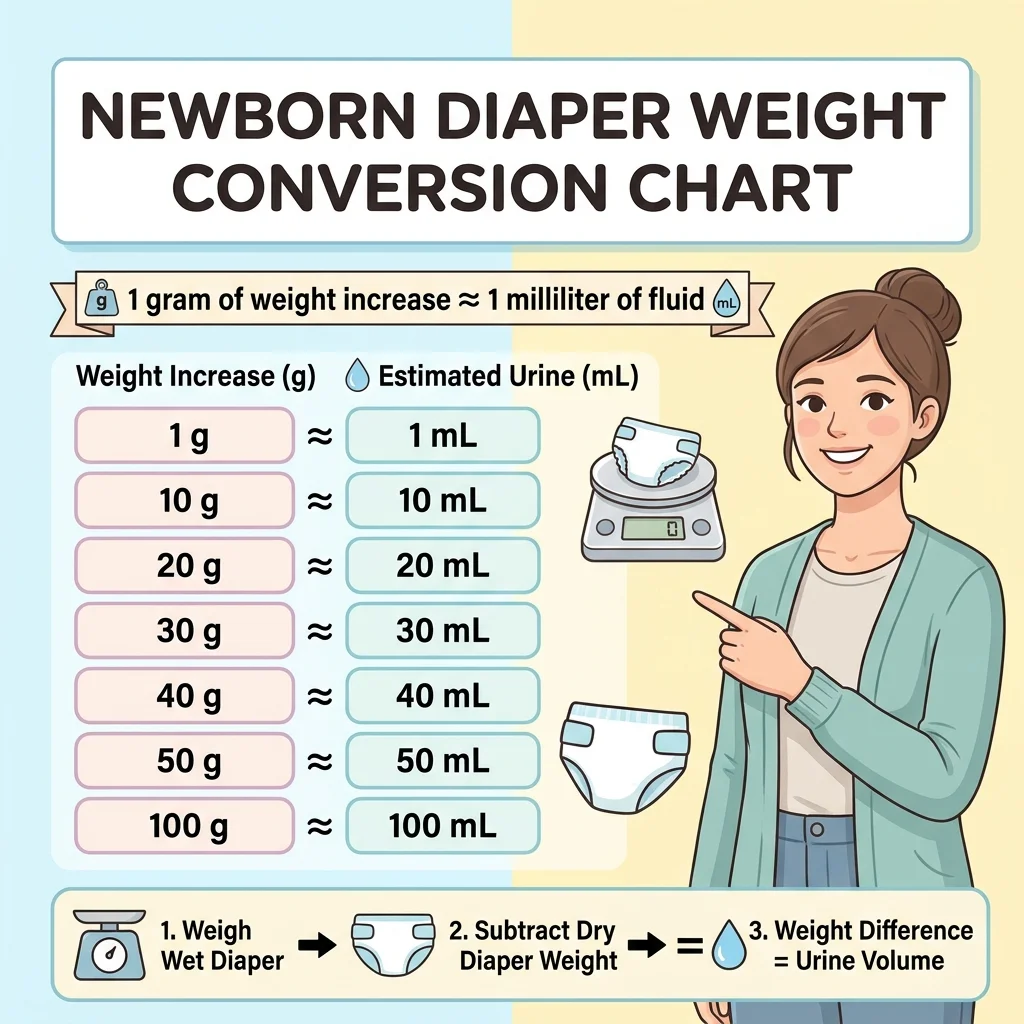
A newborn diaper weight conversion chart helps you understand how a change in diaper weight relates to estimated urine volume.
Because urine has a density close to water, one gram of urine is approximately one milliliter.
| Weight gained by diaper | Estimated urine volume |
| 5 grams | 5 mL |
| 10 grams | 10 mL |
| 15 grams | 15 mL |
| 20 grams | 20 mL |
| 25 grams | 25 mL |
| 30 grams | 30 mL |
| 35 grams | 35 mL |
| 40 grams | 40 mL |
| 45 grams | 45 mL |
| 50 grams | 50 mL |
| 60 grams | 60 mL |
| 70 grams | 70 mL |
| 80 grams | 80 mL |
| 90 grams | 90 mL |
| 100 grams | 100 mL |
This chart shows the estimated urine volume based on weight gained, not the total weight of a wet diaper.
For example, if a diaper weighs 70 grams after use and its original dry weight was 20 grams, the estimated urine volume is 50 milliliters.
Do not use these conversion figures to decide whether your newborn is producing enough urine. Medical assessment depends on age, body weight, feeding, health, and the measurement period.
How Many Wet Diapers Should a Newborn Have in 24 Hours?

The number of wet diapers generally increases during the first week after birth.
In the beginning, your newborn may produce only a small amount of urine. As feeding becomes established, wet diapers usually become more frequent.
The following chart provides general guidance for the first week.
| Baby’s age | General wet diaper expectation |
| Day 1 | At least 1 |
| Day 2 | At least 2 |
| Day 3 | Increasing output; guidance varies |
| Day 4 | Usually around 4–6 or more |
| Days 5–7 | At least 6 per 24 hours |
These figures are general monitoring guidelines. Published recommendations can differ slightly, especially for days three and four. The CDC’s newborn breastfeeding guidance lists a minimum of five wet diapers on day three and six on day four, while other clinical resources use different day-by-day expectations.
CDC+2
Wet Diapers During the First 24 Hours
During the first day after birth, your baby should generally produce at least one wet diaper.
The amount may be small because your newborn is adjusting to life outside the womb.
Record the number of wet diapers and feeding sessions. If your baby does not urinate during the first 24 hours, inform your healthcare professional.
Wet Diapers on Days 2 and 3
Urine production generally increases over the next two days.
You may notice more wet diapers as your baby begins receiving milk more regularly.
The number of wet diapers is more useful when considered alongside feeding, stool patterns, and weight changes.
Wet Diapers on Days 4 and 5
By the fourth and fifth days, wet diaper frequency should be increasing.
Many babies reach six wet diapers daily by around day five. If your baby has fewer wet diapers than expected, contact your pediatrician for advice about feeding and hydration.
HealthyChildren.org+1
Wet Diapers After the First Week
After the first week, many healthy newborns have at least six wet diapers every 24 hours.
The urine is generally pale yellow or nearly colorless.
However, diaper counts are only one part of assessing your baby’s health. Feeding effectiveness, weight gain, and general behavior also matter.
How Much Urine Does a Newborn Produce?

Newborn urine production varies according to age, body weight, feeding, and overall health.
During the first days after birth, babies usually produce smaller amounts of urine. Their output generally increases as milk intake becomes established.
Healthcare professionals may assess urine output using milliliters per kilogram per hour. This is a clinical measurement that considers the baby’s body weight and the amount of urine produced over a specific period.
For example, a medical team may collect urine measurements over several hours and compare the result with the baby’s weight.
This is different from simply counting wet diapers at home.
There is no single urine-volume target that should be applied to every newborn without considering age and medical circumstances. If your healthcare provider gives you a specific urine-output target, follow that instruction.
How to Know If Your Newborn’s Diaper Is Wet Enough

You do not always need a digital scale to recognize a wet diaper.
Disposable diapers often have absorbent cores and wetness indicators that help parents identify moisture.
Here are four practical ways to check.
1. Check the Wetness Indicator
Some disposable newborn diapers have a line that changes color when the diaper becomes wet.
The line may change from yellow to blue or another color, depending on the manufacturer.
A wetness indicator helps you recognize moisture but does not measure the amount of urine.
2. Feel the Absorbent Area
Gently check the outside of the diaper.
A wet diaper may feel heavier, fuller, or thicker around the middle.
However, highly absorbent diapers can make moisture difficult to detect through touch alone.
3. Compare It With an Unused Diaper
You can compare a used diaper with a clean diaper of the same brand and size.
A used diaper will usually feel heavier if it contains urine.
This method provides a general indication rather than an accurate measurement.
4. Use a Digital Kitchen Scale
A digital kitchen scale is useful when you need to estimate urine volume.
Weigh the clean diaper first. Then weigh the used diaper and subtract the original measurement.
If your healthcare professional has requested urine-output monitoring, ask whether this method is suitable for your baby’s needs.
What Is the Difference Between Diaper Absorbency and Urine Output?
Diaper absorbency and newborn urine output are related, but they are not the same thing.
Absorbency describes how much liquid a diaper can hold while maintaining its design and performance.
Urine output describes how much urine your baby produces over a specific period.
A highly absorbent diaper may hold a substantial amount of urine without feeling particularly wet on the surface.
A less absorbent diaper may feel wet sooner, even when it contains a smaller amount of urine.
This is why the appearance and feel of a diaper cannot provide a precise urine measurement.
Parents should focus on wet diaper frequency and their healthcare provider’s instructions rather than comparing the apparent fullness of different diaper brands.
What Is the Correct Newborn Diaper Size by Baby Weight?
Newborn diaper size is generally selected according to the baby’s body weight, not the weight of the diaper itself.
Manufacturers provide recommended weight ranges on their packaging. These ranges can differ between brands.
Here is an illustrative sizing guide:
| Diaper size | Example baby weight range |
| Preemie | Up to approximately 6 lb |
| Newborn (N) | Up to approximately 10 lb |
| Size 1 | Approximately 8–14 lb |
| Size 2 | Approximately 10–22 lb |
| Size 3 | Approximately 13–26 lb |
| Size 4 | Approximately 15–34 lb |
These are broad examples, not universal sizing standards. Always check the specific manufacturer’s packaging.
Newborn Diapers (Size N)
Newborn diapers are designed for smaller babies.
Some products include a cutout around the belly button to help prevent friction against the healing umbilical stump.
However, not every baby needs newborn-size diapers. Some larger newborns may fit size 1 from the beginning.
Size 1 Diapers
Size 1 diapers are generally designed for babies who have outgrown the newborn size.
Check the fit around the waist and legs. A diaper should be secure without leaving deep marks on your baby’s skin.
Size 2 Diapers
Size 2 diapers are designed for growing babies who need more room and absorbency.
Your baby may move into this size at a different age depending on growth and body shape.
Signs Your Baby Needs a Different Diaper Size
Consider checking the fit if:
- The fastening tabs no longer reach comfortably.
- The diaper leaves deep red marks.
- Urine regularly leaks around the legs.
- The diaper does not cover your baby’s bottom properly.
- The waist or leg openings feel too tight.
A good fit helps reduce leaks and keeps your baby comfortable.
How Many Diapers Does a Newborn Use Per Day?
Newborns need frequent diaper changes because they urinate and pass stool several times throughout the day.
Many newborns use approximately 8–12 diapers every 24 hours, although individual needs vary.
The total includes both wet and dirty diapers.
Frequent changes are important because newborn skin is delicate. Leaving urine or stool against the skin for extended periods can contribute to irritation and diaper rash.
The NHS recommends changing a baby’s diaper as soon as practical after urination or a bowel movement.
NHS
Why Do Newborns Need Frequent Diaper Changes?
There are several reasons newborns use more diapers than older babies.
Small bladder capacity: Newborns have small bladders and may urinate frequently.
Frequent feeding: Babies feed regularly during the first weeks, and urine output generally increases as milk intake becomes established.
Bowel movements: Newborns may pass stool several times a day, especially during the early weeks.
Sensitive skin: Frequent diaper changes help limit prolonged exposure to moisture and stool.
Should You Change a Newborn’s Diaper After Every Feeding?
Check your baby’s diaper around feeding times and whenever you suspect it is wet or dirty.
Change a diaper containing stool promptly. Also change wet diapers regularly, especially when they are heavily soaked.
You do not necessarily need to change a clean, dry diaper after every feeding.
At night, balance your baby’s sleep with the need to keep the skin clean and comfortable. Follow your healthcare professional’s advice if your newborn needs a specific changing schedule.
Does a Heavier Diaper Mean Your Newborn Is Getting Enough Milk?
A heavier wet diaper can indicate that your newborn has produced more urine. Regular urination is one useful sign when assessing feeding and hydration.
However, diaper weight alone cannot establish whether your baby is getting enough milk.
Healthcare professionals consider several indicators together:
- Number of wet diapers.
- Feeding frequency.
- Effective sucking and swallowing.
- Stool patterns.
- Weight changes and growth.
- Alertness and general behavior.
- Signs of hydration.
The American Academy of Pediatrics recommends considering diaper output, feeding, and weight changes when evaluating whether a newborn is receiving enough milk.
HealthyChildren.org+1
Signs Your Newborn May Be Getting Enough Milk
Some reassuring signs include:
Regular wet diapers: By around five to seven days of age, many newborns have at least six wet diapers every 24 hours.
Effective feeding: Your baby appears to latch and swallow effectively during breastfeeding or takes feeds appropriately when bottle-fed.
Healthy weight progress: Your healthcare provider checks your baby’s weight and monitors growth.
Normal alertness: Your newborn has periods of alertness and responds normally when awake.
No single sign provides a complete assessment. Look at the overall pattern and attend recommended newborn checkups.
Signs Your Newborn May Be Dehydrated
Newborn dehydration needs attention because babies can become unwell quickly.
Watch for changes in your baby’s usual feeding and diaper patterns.
Possible warning signs include:
- Fewer wet diapers than expected for your baby’s age.
- Dark or unusually concentrated urine.
- Persistent orange or pinkish urate stains.
- Dry mouth.
- Poor feeding.
- Unusual sleepiness.
- Difficulty waking for feeds.
- A sunken soft spot on the head.
- Poor weight gain.
A marked reduction in urine output should not be ignored.
Contact your baby’s healthcare professional promptly if you notice fewer wet diapers than expected or have concerns about feeding.
Seek urgent medical assessment if your newborn is difficult to wake, cannot feed effectively, appears seriously unwell, or has other signs of significant dehydration.
Do not wait for a diaper-weight calculation before seeking help.
Why Does Your Newborn’s Diaper Have Orange or Pink Spots?
Sometimes parents notice orange, pink, or brick-red marks in a newborn’s diaper.
During the first week after birth, these marks may be caused by urate crystals. Urates are substances found in urine that can leave reddish-orange stains when urine is concentrated.
These marks are not always blood.
However, persistent stains may be a reason to assess feeding and hydration. Contact your healthcare professional if they continue, particularly if your baby has fewer wet diapers or is feeding poorly.
Actual blood in the urine or unexplained bleeding should always be discussed with a healthcare professional.
HealthyChildren.org+1
How to Weigh Newborn Diapers Accurately
If your healthcare provider recommends measuring urine output, consistency is important.
Follow these practical guidelines.
Use a Suitable Digital Scale
Choose a digital kitchen scale that displays measurements in grams.
A scale with small measurement increments makes it easier to identify minor differences in diaper weight.
Use the Same Diaper Brand and Size
Different brands and sizes have different starting weights.
Using the same type of diaper makes comparisons easier.
Record Measurements Promptly
Weigh a used diaper as soon as practical after removing it.
Waiting too long can allow some moisture to evaporate and change the measurement.
Keep Other Liquids Out of the Calculation
Do not include diapers containing spilled milk, bathwater, or other liquids.
These substances increase the weight without representing urine.
Separate Wet and Dirty Diapers
Stool adds weight, so a diaper containing both stool and urine cannot provide a reliable urine-only estimate.
Follow your healthcare provider’s instructions for handling soiled diapers during monitoring.
Keep a Diaper Weight Log
A written record can help you identify patterns and share measurements with your baby’s healthcare professional.
Here is an example:
| Time | Dry weight | Used weight | Estimated urine |
| 6:00 AM | 21 g | 36 g | 15 mL |
| 9:00 AM | 21 g | 42 g | 21 mL |
| 12:00 PM | 21 g | 51 g | 30 mL |
| 3:00 PM | 21 g | 40 g | 19 mL |
These are example measurements, not recommended urine-output targets.
Your healthcare provider can interpret the results based on your newborn’s age, weight, and medical condition.
Disposable vs. Cloth Newborn Diapers: Does Weight Differ?
Yes. Disposable and reusable cloth diapers have different materials and absorbent properties. As a result, their dry and wet weights can vary considerably.
Disposable Newborn Diapers
Disposable diapers contain absorbent materials designed to hold moisture inside the diaper.
Their dry weight depends on the brand, size, padding, and construction.
Many disposable products also include wetness indicators, making it easier for parents to recognize when their baby has urinated.
Reusable Cloth Diapers
Cloth diapers are made from materials such as cotton, bamboo, or microfiber.
Their weight depends on the fabric, number of layers, inserts, and overall design.
Some reusable diapers become considerably heavier when wet because the fabric absorbs and retains moisture.
Which Diaper Type Is Better for Measuring Urine Output?
Both types can potentially be weighed, but the measurement method must account for their different materials.
Disposable diapers may retain liquid within their absorbent cores, while cloth diapers distribute moisture throughout their fabric layers.
If your healthcare professional needs accurate urine-output measurements, ask which diaper type and weighing procedure they recommend.
Does Newborn Diaper Weight Change During the Night?
Yes. A diaper worn for several hours may weigh more than one worn for a shorter period because it has more time to collect urine.
However, the amount of urine your baby produces depends on feeding, age, sleep patterns, and individual health.
An overnight diaper may also contain additional absorbent material, which means its starting weight can differ from an ordinary daytime diaper.
When comparing overnight and daytime diaper weight, consider:
- How long your baby wore each diaper.
- Whether your baby fed during that period.
- Whether the diaper contains stool.
- Whether you used the same brand and size.
- Whether the diaper was weighed promptly after removal.
For medical urine-output monitoring, follow the measurement intervals recommended by your healthcare professional.
Common Mistakes Parents Make When Weighing Newborn Diapers
Diaper weighing is relatively simple, but small mistakes can affect the results.
Here are six common mistakes to avoid.
1. Forgetting to Subtract the Dry Weight
The total weight of a used diaper is not the same as its urine content.
Always subtract the original dry diaper weight to estimate the amount of absorbed liquid.
2. Including Stool in the Calculation
Stool contributes additional weight and makes urine-only measurements unreliable.
Do not interpret the total weight increase of a wet and dirty diaper as urine volume.
3. Using Different Diaper Brands
Different brands use different materials and absorbent layers.
Use consistent diaper types whenever possible and establish a new baseline if you change products.
4. Waiting Too Long Before Weighing
Moisture can evaporate over time.
Weigh the used diaper promptly after removal to reduce measurement differences.
5. Using an Inaccurate Scale
A scale that measures only in large increments may not detect smaller weight changes.
Use a suitable digital scale that displays grams.
6. Treating Diaper Weight as a Medical Diagnosis
A heavy diaper does not automatically mean your baby is healthy, and a lightweight diaper does not automatically mean dehydration.
Consider feeding, wet diaper frequency, weight gain, and general behavior.
Frequently Asked Questions About Newborn Diaper Weight
1. What Is the Normal Weight of a Dry Newborn Diaper?
There is no universal normal weight for a dry newborn diaper. Its weight depends on the brand, size, materials, and design. Weigh an unused diaper on a digital scale to establish its exact starting weight.
2. How Much Does a Wet Newborn Diaper Weigh?
A wet newborn diaper weighs more than an unused diaper because it contains absorbed moisture. Its total weight depends on the original diaper weight and the amount of urine. Subtract the dry weight to estimate urine volume.
3. How Many Grams of Urine Does a Newborn Diaper Hold?
There is no fixed amount of urine that every newborn diaper holds. The quantity depends on how long your baby wears it, how frequently your baby urinates, and the diaper’s absorbent capacity.
4. Is 20 Grams of Urine Normal for a Newborn?
A diaper weight increase of 20 grams represents approximately 20 milliliters of urine. Whether this amount is appropriate depends on your baby’s age, body weight, and the time between diaper changes.
5. How Do I Calculate Urine Output From a Wet Diaper?
Weigh the used diaper and subtract the weight of an identical unused diaper. The difference in grams is approximately equal to the urine volume in milliliters, provided the diaper contains no stool or other moisture.
6. Can I Use a Kitchen Scale to Weigh Newborn Diapers?
Yes. A digital kitchen scale that measures in grams can help estimate urine output. Place it on a flat surface, establish the dry diaper weight, and weigh the used diaper promptly.
7. How Many Wet Diapers Should a Newborn Have in 24 Hours?
Wet diaper counts generally increase during the first week. By approximately five to seven days of age, many newborns have at least six wet diapers daily. Contact your healthcare professional if your baby’s output is lower than expected.
8. Does a Heavier Diaper Mean My Baby Is Drinking More Milk?
Not necessarily. A heavier diaper means it contains more moisture, but it does not directly measure milk intake. Healthcare professionals consider feeding effectiveness, urine output, weight gain, and other signs together.
9. Should I Weigh Every Newborn Diaper?
No. Most healthy newborns do not need every diaper weighed. Counting wet diapers is generally sufficient for routine home monitoring. Weigh diapers when your healthcare professional specifically recommends it.
10. Can a Wet Diaper Be Too Heavy?
A heavily soaked diaper is not automatically a problem. However, unusual changes in urination or other symptoms may require medical evaluation. Discuss concerns with your pediatrician.
11. How Long Can a Newborn Wear a Wet Diaper?
Change wet diapers regularly and change dirty diapers promptly. Avoid leaving your baby in a heavily soaked diaper for extended periods because prolonged moisture exposure can contribute to skin irritation and diaper rash.
12. Why Does My Newborn’s Diaper Have Orange Spots?
Orange or reddish stains during the first few days may be caused by urate crystals. These can occur when newborn urine is concentrated. If the stains persist, contact your healthcare professional to assess feeding and hydration.
13. Is a Lightweight Newborn Diaper a Sign of Dehydration?
Not necessarily. A single lightweight diaper does not establish dehydration. However, consistently fewer wet diapers, dark urine, poor feeding, and unusual sleepiness can indicate a problem that needs medical assessment.
14. Does Newborn Diaper Weight Depend on the Brand?
Yes. Different manufacturers use different absorbent materials, padding, and diaper construction. Therefore, two unused newborn diapers from different brands may have different starting weights.
15. Can I Estimate Urine Output Without Weighing Diapers?
Yes. For most healthy newborns, counting wet diapers throughout the day is a practical way to monitor urine output. Your pediatrician may recommend additional measurements if your baby needs closer monitoring.
16. What Is the Difference Between Dry and Wet Diaper Weight?
Dry diaper weight is the measurement of an unused diaper. Wet diaper weight includes the original diaper and absorbed moisture. Subtracting the dry weight from the used weight provides an estimate of urine volume.
17. Does a Newborn’s Diaper Weight Increase Every Day?
Not necessarily. A diaper becomes heavier as it absorbs urine, but the weight of individual diapers depends on the time between changes and your baby’s urine production. There is no requirement for each diaper to weigh more than the previous one.
Final Thoughts
Understanding newborn diaper weight can make everyday baby care easier. Whether you want to compare dry and wet diapers, estimate urine output, or choose the right diaper size, knowing how these measurements work can help you make more informed decisions. Remember that there is no single standard weight for every newborn diaper. The brand, size, absorbent materials, and amount of urine all affect the final measurement.
If you need to calculate urine output, weigh an unused diaper first and subtract its weight from the used diaper’s weight. One gram of urine is approximately equal to one milliliter. However, diaper weight is only one way to monitor your baby’s needs. Wet diaper frequency, feeding effectiveness, weight gain, and general behavior are also important.

I am William Harris, a passionate writer dedicated to creating informative, engaging, and valuable content for readers around the world. I enjoy researching different topics and sharing well-crafted articles that provide useful insights, practical tips, and meaningful information. I am committed to delivering high-quality content with accuracy, clarity, and a reader-focused approach. Through my writing, I aim to educate, inspire, and help people discover new ideas.