If you are a 6-foot-tall male, you may wonder what your ideal body weight should be. Whether you want to lose weight, build muscle, or maintain your current physique, understanding the healthy weight range for your height can help you make better health decisions.
The ideal weight for a 6 foot male generally falls between 136 and 184 pounds (61.9 and 83.5 kg) according to the standard adult Body Mass Index (BMI) classification. This range applies to adults aged 20 and older and provides a useful starting point for evaluating weight.
However, your healthiest weight is not determined by height alone. Muscle mass, body fat distribution, bone structure, age, genetics, and lifestyle can all influence your body weight.
For example, a muscular man who weighs 195 pounds may have a different body composition from someone who weighs the same amount but carries more abdominal fat.
This guide explains the healthy weight range for a 6-foot male, provides detailed weight and BMI charts, discusses different body types, and shares practical nutrition and exercise recommendations.
What Is the Ideal Weight for a 6 Foot Male?
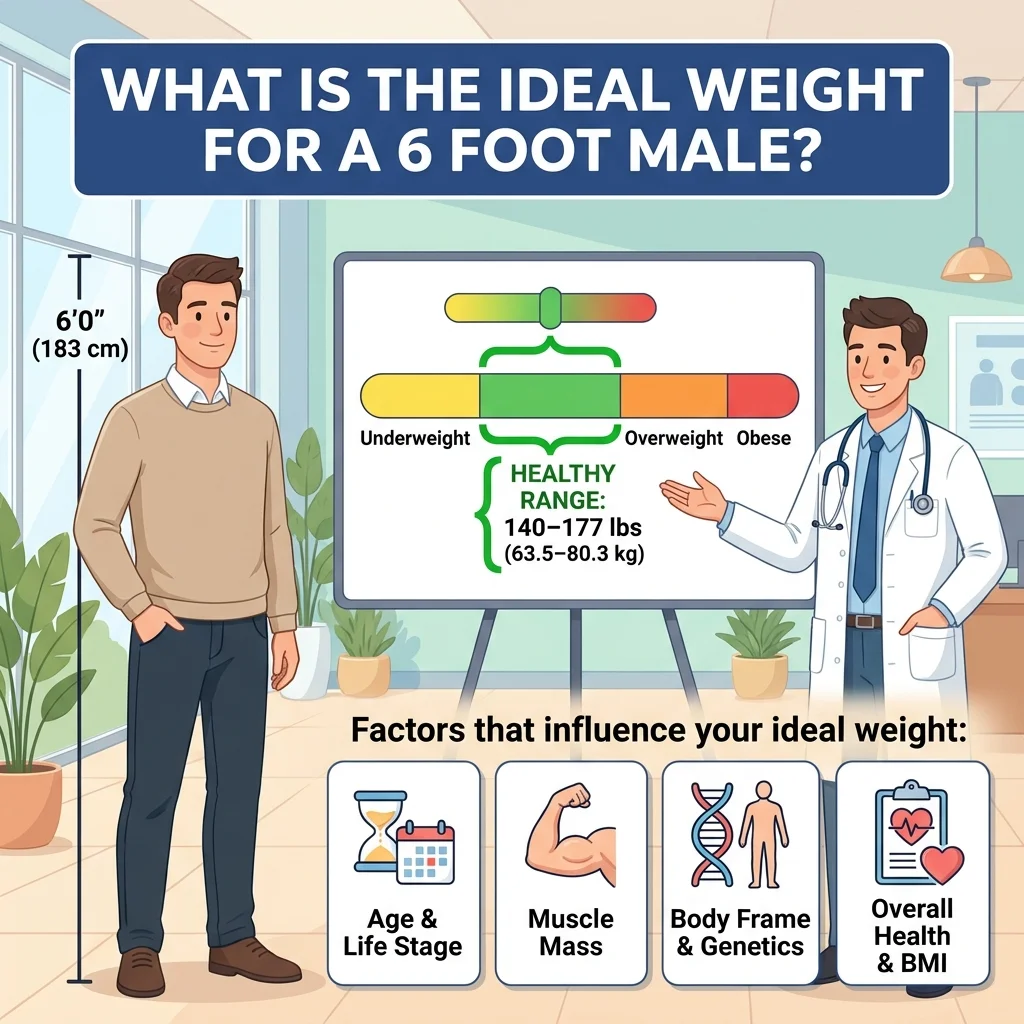
The ideal weight for a 6-foot man depends on his physical characteristics and overall health. According to standard adult BMI guidelines, the healthy BMI range is 18.5 to less than 25.
For someone who is exactly 6 feet tall, this corresponds to approximately 136–184 pounds (61.9–83.5 kg).
Here is a quick overview:
| Measurement | Value |
| Height | 6 feet |
| Height in inches | 72 inches |
| Height in centimeters | 182.88 cm |
| Lower healthy weight | Approximately 136 lbs |
| Upper healthy weight | Approximately 184 lbs |
| Lower healthy weight in kg | 61.9 kg |
| Upper healthy weight in kg | 83.5 kg |
| Healthy BMI range | 18.5–24.9 |
These numbers are based on standard BMI classifications for adults. They do not represent a single perfect weight for every man.
For instance, a naturally slim man may feel comfortable at 150 pounds, while another man with more muscle may maintain a healthy lifestyle at a higher weight.
The best approach is to use the BMI range as a starting point and consider additional measurements when evaluating your health.
Healthy Weight Chart for a 6-Foot Male
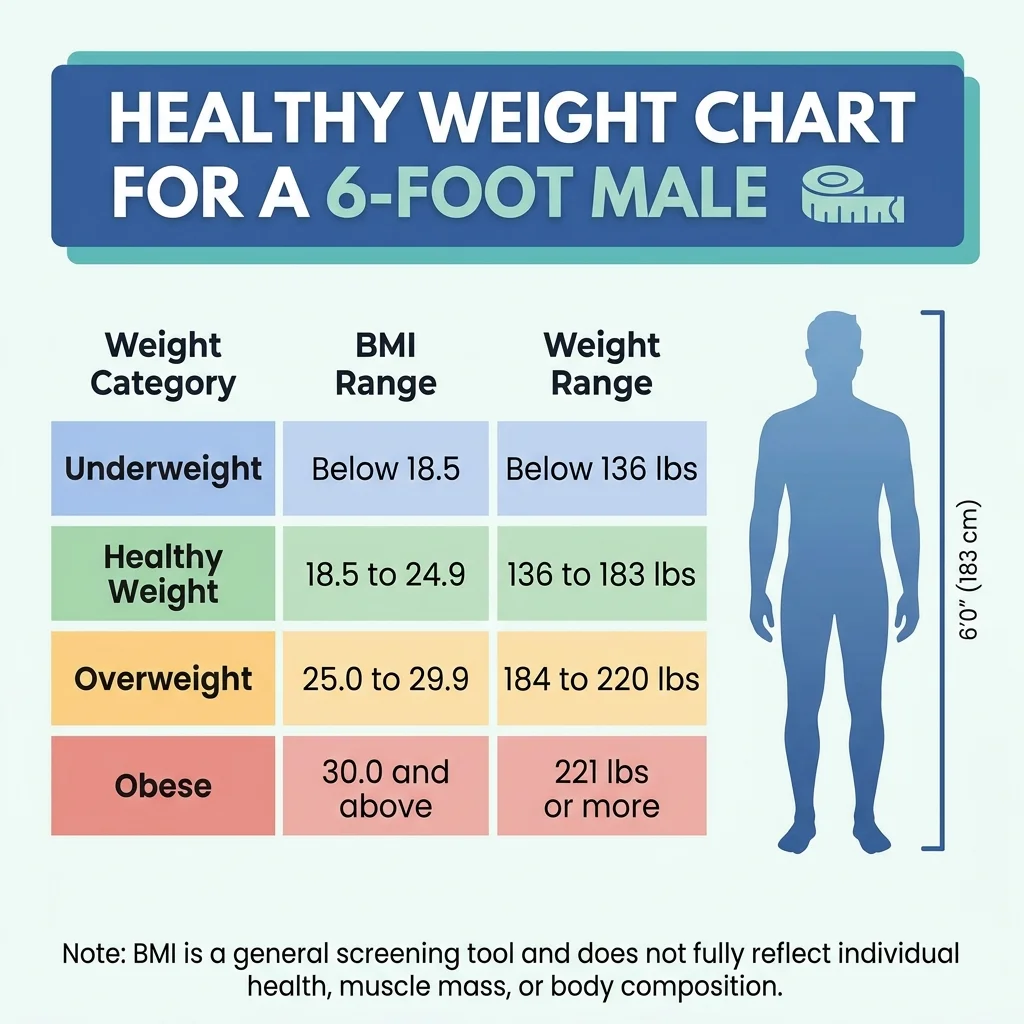
A weight chart makes it easier to understand how different body weights relate to BMI.
The following table shows approximate BMI values for men who are exactly 6 feet tall.
| Weight (lbs) | Weight (kg) | BMI | Weight category |
| 130 | 59.0 | 17.6 | Underweight |
| 140 | 63.5 | 19.0 | Healthy |
| 150 | 68.0 | 20.3 | Healthy |
| 160 | 72.6 | 21.7 | Healthy |
| 170 | 77.1 | 23.1 | Healthy |
| 180 | 81.6 | 24.4 | Healthy |
| 185 | 83.9 | 25.1 | Overweight |
| 190 | 86.2 | 25.8 | Overweight |
| 195 | 88.5 | 26.4 | Overweight |
| 200 | 90.7 | 27.1 | Overweight |
| 210 | 95.3 | 28.5 | Overweight |
| 220 | 99.8 | 29.8 | Overweight |
| 230 | 104.3 | 31.2 | Obesity |
| 240 | 108.9 | 32.6 | Obesity |
The categories in this chart follow standard adult BMI guidelines:
- Underweight: BMI below 18.5.
- Healthy weight: BMI 18.5 to less than 25.
- Overweight: BMI 25 to less than 30.
- Obesity: BMI 30 or higher.
The boundaries are approximate when expressed as whole pounds. A BMI of 25 begins at approximately 184.3 pounds for a man who is exactly 6 feet tall.
These categories are useful for general screening, but they should not be treated as a complete assessment of body fat or individual health.
Ideal Weight for a 6-Foot Male in Pounds and Kilograms
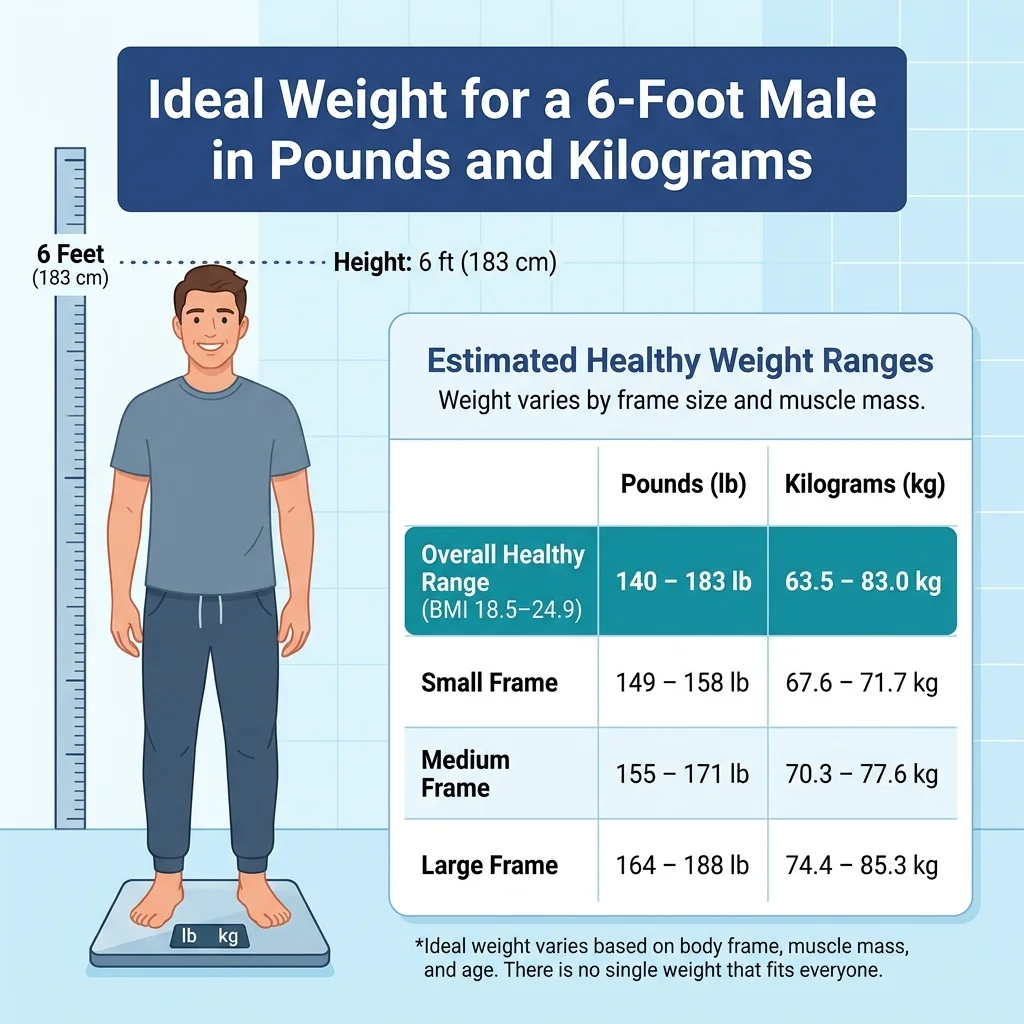
People often use different measurements when discussing body weight. In the United States, pounds are common, while kilograms are widely used in many other countries.
A man who is 6 feet tall measures approximately 182.88 centimeters. His standard healthy BMI weight range is approximately 61.9–83.5 kilograms.
Here is a simple conversion guide:
| Pounds | Kilograms |
| 130 lbs | 59.0 kg |
| 135 lbs | 61.2 kg |
| 140 lbs | 63.5 kg |
| 145 lbs | 65.8 kg |
| 150 lbs | 68.0 kg |
| 155 lbs | 70.3 kg |
| 160 lbs | 72.6 kg |
| 165 lbs | 74.8 kg |
| 170 lbs | 77.1 kg |
| 175 lbs | 79.4 kg |
| 180 lbs | 81.6 kg |
| 185 lbs | 83.9 kg |
| 190 lbs | 86.2 kg |
| 195 lbs | 88.5 kg |
| 200 lbs | 90.7 kg |
| 210 lbs | 95.3 kg |
| 220 lbs | 99.8 kg |
If your current weight is between approximately 136 and 184 pounds, you fall within the standard healthy BMI category for your height.
If your weight falls outside this range, consider your body composition and other health measurements before deciding whether you need to gain or lose weight.
How to Calculate BMI for a 6-Foot Male
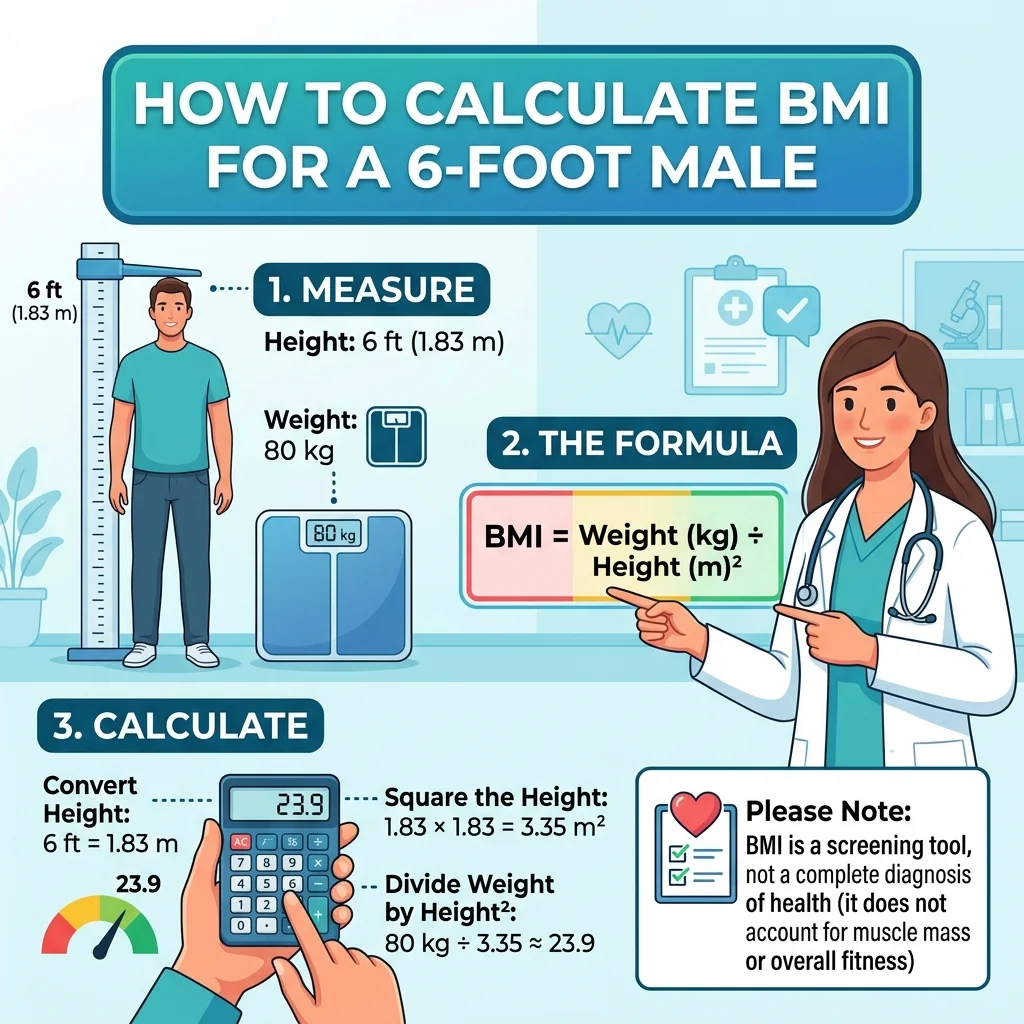
Body Mass Index (BMI) is a measurement that compares your weight with your height. Healthcare professionals commonly use it as an initial screening tool to identify possible weight-related health concerns.
The formula is:
BMI = Weight in kilograms ÷ Height in meters²
For a 6-foot male, the height is approximately 1.8288 meters.
Suppose you weigh 80 kilograms.
First, multiply your height by itself:
1.8288 × 1.8288 = 3.3445
Next, divide your weight by this number:
80 ÷ 3.3445 = 23.9
Your BMI is approximately 23.9, which falls within the standard healthy adult BMI category.
BMI Categories Explained
The following table explains how BMI categories are generally classified for adults aged 20 and older.
| BMI | Category |
| Below 18.5 | Underweight |
| 18.5–24.9 | Healthy weight |
| 25.0–29.9 | Overweight |
| 30.0–34.9 | Obesity class 1 |
| 35.0–39.9 | Obesity class 2 |
| 40.0 or higher | Obesity class 3 |
BMI categories are generally the same for adult individuals. They are also not separated into different standard categories for every adult age group.
However, BMI has limitations. It does not directly measure body fat, distinguish muscle from fat, or show where fat is stored.
For example, a bodybuilder may have a BMI above 25 because of substantial muscle mass. Another person with the same BMI may have more body fat and less muscle.
This is why BMI should be considered alongside other health measurements.
Source: CDC Adult BMI Categories.
Does Age Affect the Ideal Weight for a 6-Foot Male?
Age can influence muscle mass, fat distribution, physical activity, and overall body composition.
Although standard adult BMI categories generally remain the same for people aged 20 and older, your individual health needs may change as you get older.
Ideal Weight in Your 20s
Men in their 20s may have relatively high muscle mass and participate in activities such as running, swimming, weightlifting, and sports.
If you are 6 feet tall and in your 20s, the standard healthy BMI range provides a useful starting point.
For example, a man weighing 170 pounds has a BMI of approximately 23.1. This falls within the standard healthy category.
However, physical fitness is not determined by body weight alone. Your strength, endurance, nutrition, and body composition also matter.
Ideal Weight in Your 30s
During your 30s, work responsibilities and changes in daily routines may reduce your physical activity.
Some men gradually gain weight because they spend more time sitting, eat larger portions, or exercise less frequently.
Maintaining regular physical activity and balanced eating habits can help you manage these changes.
You do not need to maintain exactly the same weight you had in your 20s. Instead, focus on preserving muscle, maintaining a healthy waist measurement, and monitoring your overall health.
Ideal Weight in Your 40s
Men in their 40s may notice changes in muscle mass, fat distribution, and recovery after exercise.
Strength training becomes particularly useful because it helps maintain muscle strength and physical function.
If your weight increases, consider whether the change comes from increased body fat, muscle development, or other factors.
Pay attention to your waist measurement and general health rather than relying entirely on the weighing scale.
Ideal Weight in Your 50s
During your 50s, maintaining muscle strength, bone health, and mobility becomes increasingly important.
A combination of resistance exercises, walking, balanced nutrition, and adequate sleep can support healthy aging.
Avoid extreme diets or rapid weight-loss methods because losing weight too quickly can also result in muscle loss.
If you experience unexplained weight changes, consult a healthcare professional.
Ideal Weight After 60
Men over 60 may experience age-related changes in muscle mass, appetite, metabolism, and physical activity.
For this reason, maintaining strength and nutritional health is especially important.
BMI can still provide general information, but it should not be treated as a complete assessment of health in older adults.
A healthcare professional can help determine an appropriate weight goal based on your medical history, muscle strength, nutritional status, and other health indicators.
What Factors Influence the Ideal Weight of a 6-Foot Male?
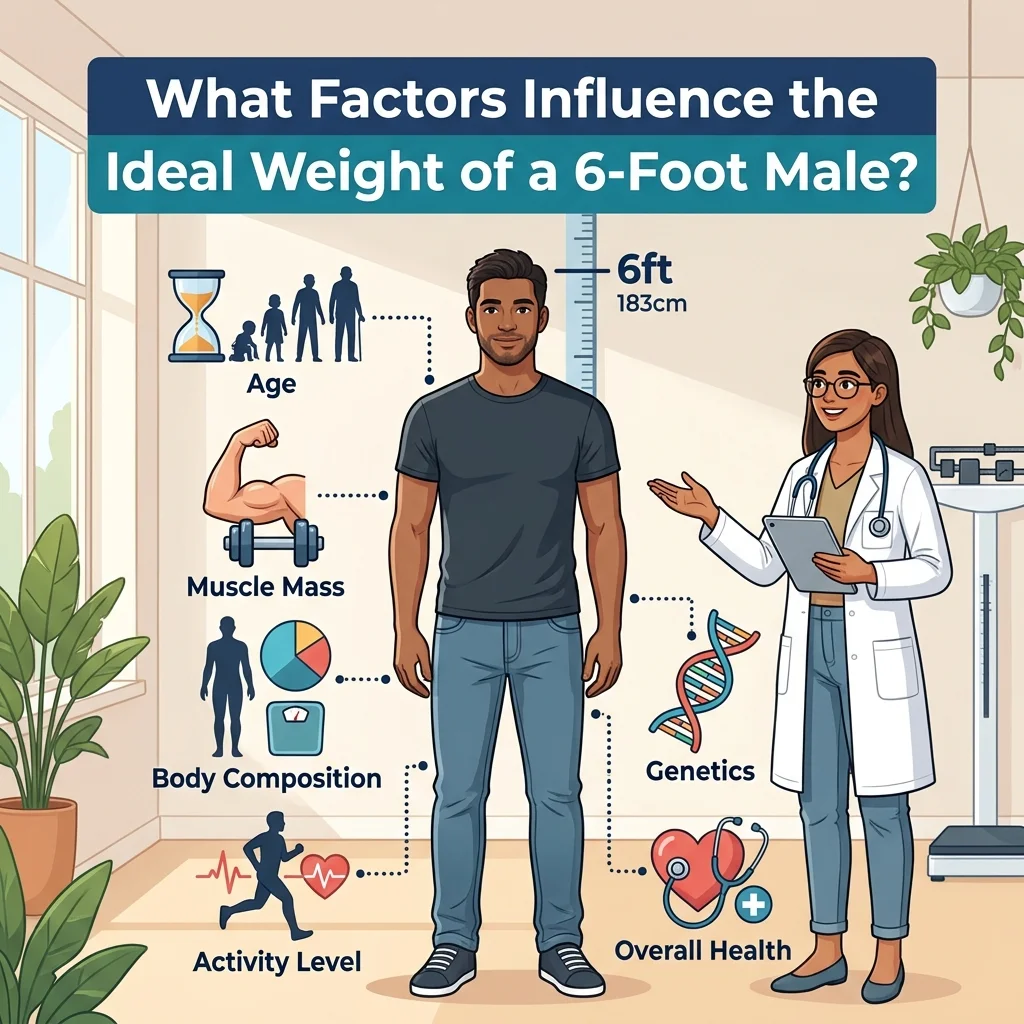
Two men with the same height can have different healthy body weights. Several physical and lifestyle factors influence how much you should weigh.
Muscle Mass
Muscle contributes to your total body weight. Men who regularly participate in strength training may weigh more than men with less muscle mass.
For example, a 6-foot man who weighs 195 pounds may have developed substantial muscle through years of resistance training.
Another man of the same height and weight may have less muscle and more body fat.
This explains why BMI alone cannot accurately describe everyone’s body composition.
Body Fat Percentage
Body fat percentage describes how much of your total body weight comes from fat.
For example, if you weigh 180 pounds and have 20% body fat, approximately 36 pounds of your weight comes from fat.
The remaining weight includes muscle, bones, organs, water, and other tissues.
Body fat distribution is also important. Excess fat around the abdomen can be associated with increased health risks.
Bone Structure and Body Frame
People naturally have different skeletal structures.
Some men have broader shoulders, larger frames, and heavier bones. Others have narrower frames and smaller skeletal structures.
These differences can influence body weight without necessarily indicating a health problem.
Your natural body frame may help explain why your comfortable weight differs from someone else’s weight at the same height.
Genetics
Genetics can influence natural body shape, muscle development, fat distribution, and your tendency to gain or lose weight.
You may naturally have a slim, athletic, or broad body type.
Although genetics play a role, nutrition, exercise, sleep, and other lifestyle factors also influence your health.
Physical Activity
Your activity level can significantly affect your weight and body composition.
A man who exercises regularly may develop more muscle and maintain better cardiovascular fitness than someone with a sedentary lifestyle.
Walking, cycling, swimming, resistance training, and sports can all contribute to maintaining a healthy body.
Diet and Eating Habits
Your daily food intake affects your energy balance and weight over time.
Consuming more calories than your body uses can contribute to weight gain. Consistently consuming fewer calories than your body needs can lead to weight loss.
However, food quality matters too.
A balanced diet containing protein, vegetables, fruits, whole grains, and healthy fats can support your overall health.
What Is a Healthy Waist Size for a 6-Foot Male?
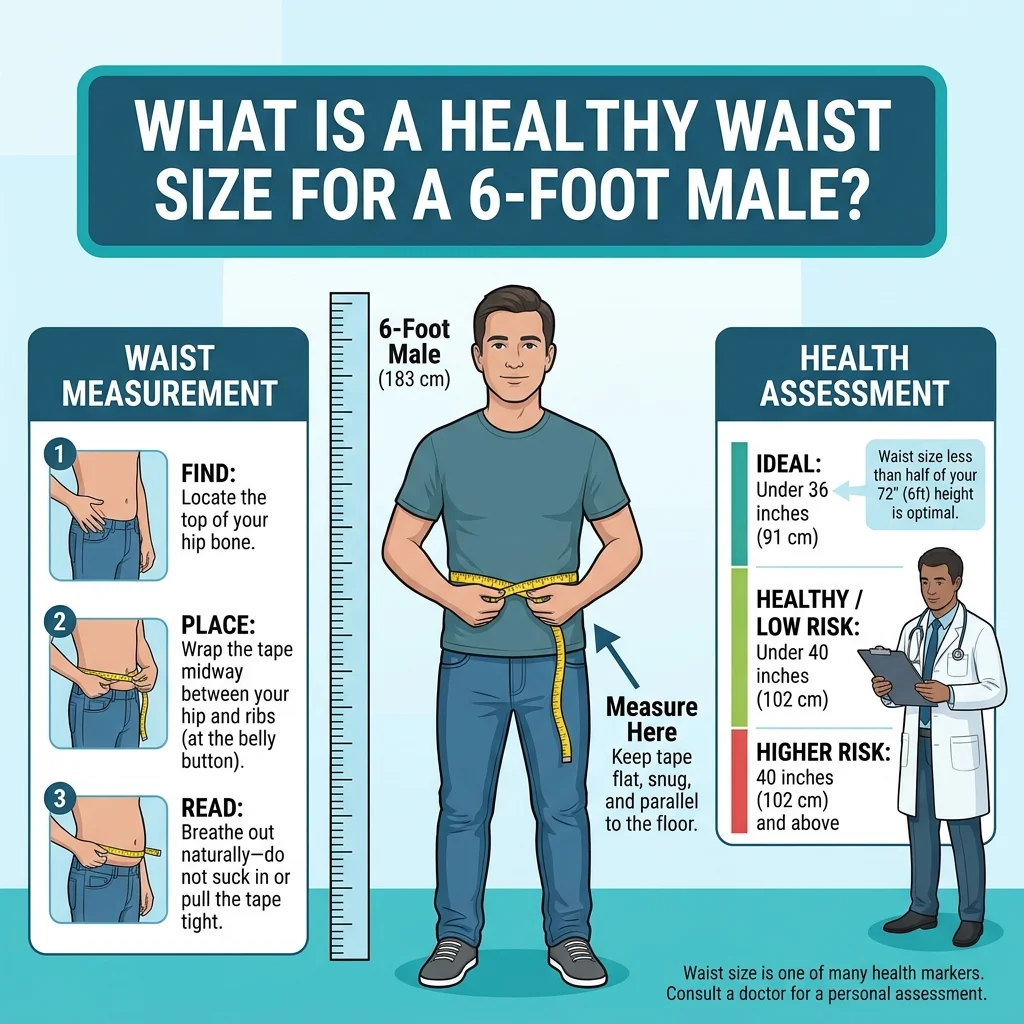
Your waist measurement provides additional information about body fat distribution.
Two men can have the same BMI but different waist measurements. The man carrying more fat around his abdomen may have different health risks.
One useful measurement is the waist-to-height ratio.
The calculation is simple:
Waist-to-height ratio = Waist circumference ÷ Height
For a 6-foot man, your height is 72 inches.
A waist measurement below half your height means keeping your waist below 36 inches.
For example:
| Waist measurement | Waist-to-height ratio | General interpretation |
| 32 inches | 0.44 | Below 0.5 |
| 34 inches | 0.47 | Below 0.5 |
| 36 inches | 0.50 | Threshold |
| 38 inches | 0.53 | Increased central adiposity |
| 40 inches | 0.56 | Increased central adiposity |
| 44 inches | 0.61 | Higher central adiposity |
According to NICE guidance, a waist-to-height ratio below 0.5 is a useful general target for adults. A ratio of 0.5–0.59 indicates increased central adiposity, while 0.6 or higher indicates a greater level.
How to Measure Your Waist Correctly
Follow these steps:
- Stand naturally without pulling your stomach inward.
- Find the bottom of your ribs and the top of your hip bones.
- Place a measuring tape around your waist midway between these points.
- Keep the tape level and comfortably close to your skin.
- Breathe out naturally and record the measurement.
- Divide your waist measurement by your height using the same units.
Waist-to-height ratio is particularly useful because it considers abdominal fat rather than relying only on total body weight.
It is still a screening measurement, not a diagnosis.
Source: NICE – Identifying and Assessing Overweight and Central Adiposity.
What Is the Best Weight for a 6-Foot Male With Different Body Types?
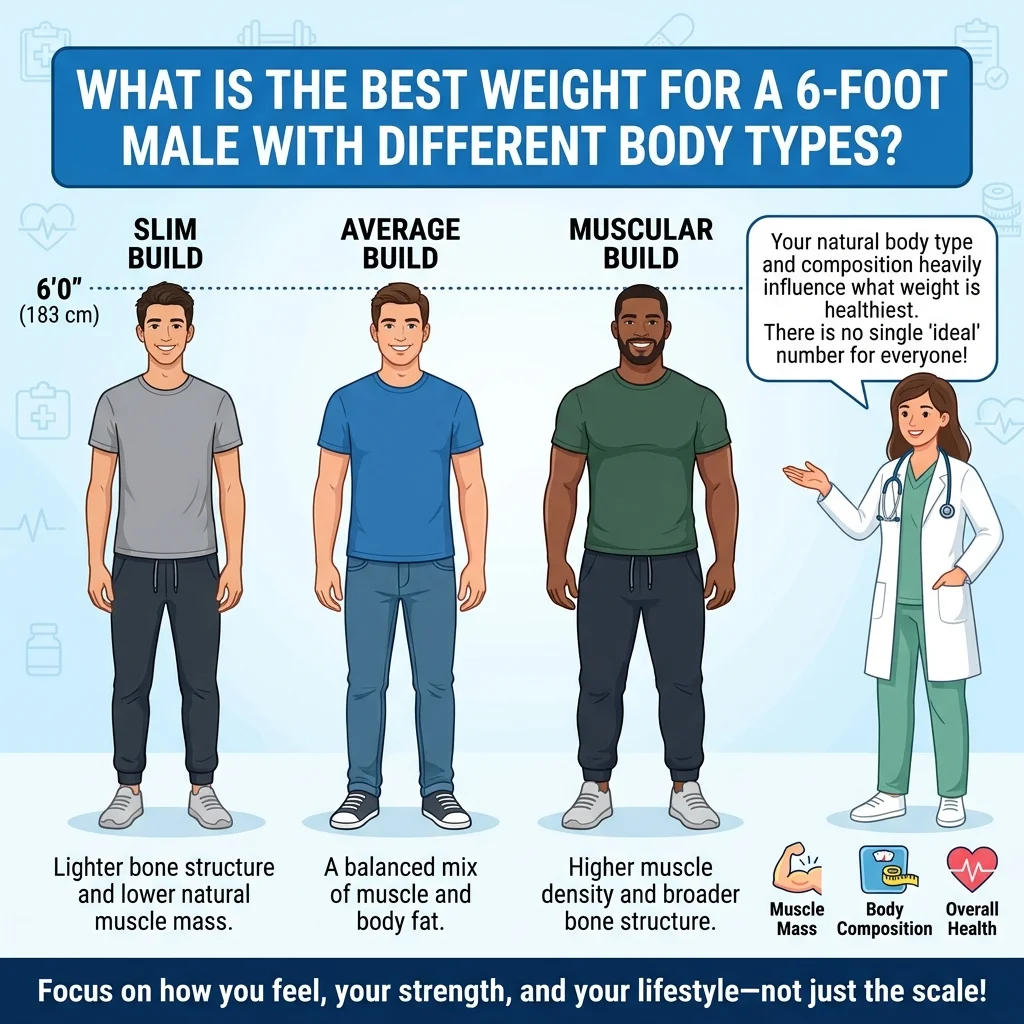
There is no universally perfect weight for every body type. Your natural build and muscle development can influence where you feel strongest and most comfortable.
The following examples are illustrative rather than medically established weight targets.
Slim Body Type
A slim man usually has a narrower frame and less muscle mass.
If you are 6 feet tall with a naturally slim build, your weight may fall toward the lower or middle part of the healthy BMI range.
For example, 150–165 pounds may be a comfortable weight for some men with this body type.
However, being naturally slim does not automatically mean you are underweight. Your nutrition, strength, and health indicators matter.
Average Body Type
An average body type generally has a moderate amount of muscle and body fat.
Some 6-foot men with this build may weigh between 165 and 180 pounds.
This is an illustrative range, not a medical requirement. Your personal healthy weight may be higher or lower.
Athletic Body Type
An athletic man may have developed muscles through sports, resistance training, or regular physical activity.
Some athletic men who are 6 feet tall weigh 180–195 pounds or more.
Their BMI may exceed the standard healthy range because BMI cannot distinguish muscle from body fat.
In these situations, waist circumference, body composition, physical examination, and other health measurements can provide useful additional information.
Muscular Body Type
A muscular man generally has a higher amount of lean body mass.
If you regularly participate in bodybuilding, powerlifting, or strength training, you may weigh more than the standard BMI range.
For example, a muscular 6-foot man weighing 200 pounds may have a different health profile from another man of the same height and weight with more abdominal fat.
A healthcare professional can help assess whether your weight is appropriate for your individual circumstances.
Is 170 Pounds a Good Weight for a 6-Foot Male?
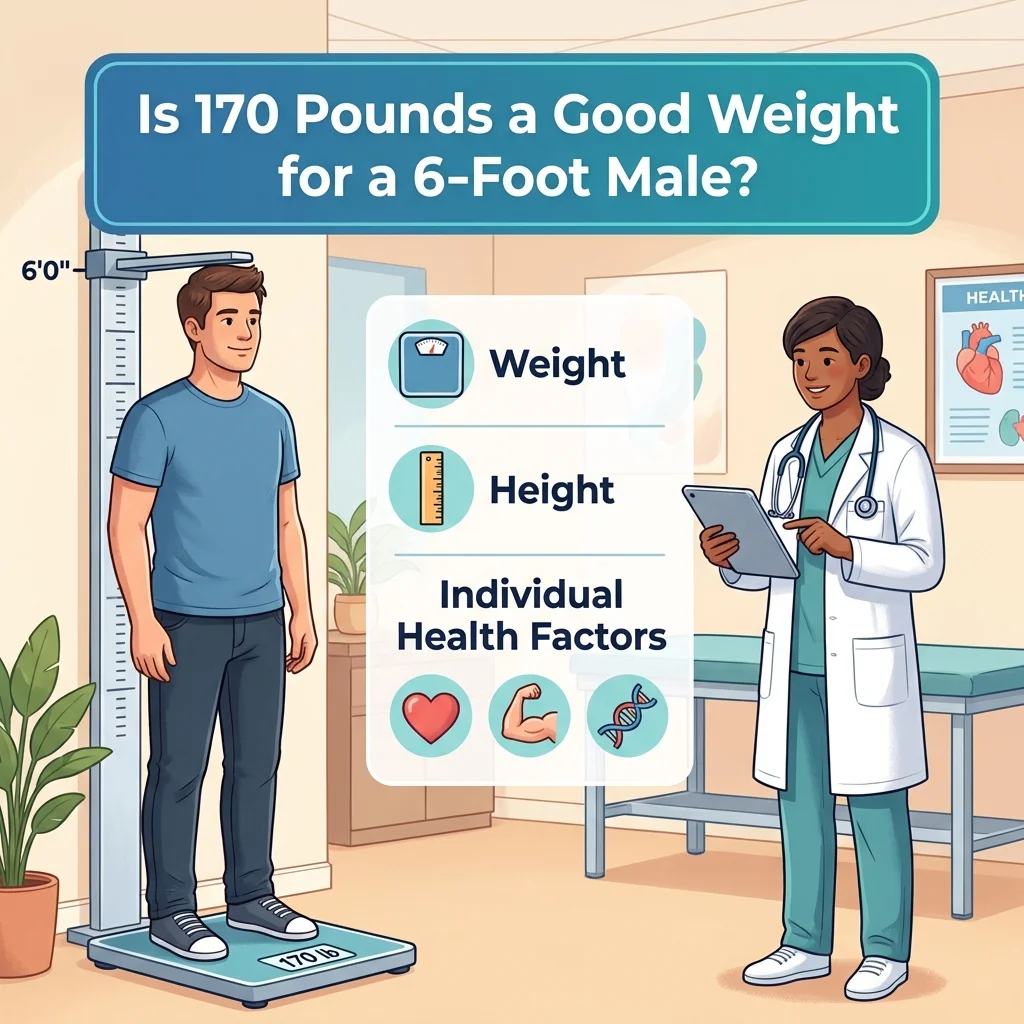
Yes. A 6-foot man weighing 170 pounds has a BMI of approximately 23.1, which falls within the standard healthy adult BMI range.
This weight may be suitable for many men, especially those with a moderate amount of muscle and body fat.
However, your fitness level and waist measurement also matter.
If you weigh 170 pounds, eat a balanced diet, exercise regularly, and maintain good overall health, there may be no reason to pursue a lower weight.
Is 180 Pounds a Healthy Weight for a 6-Foot Male?
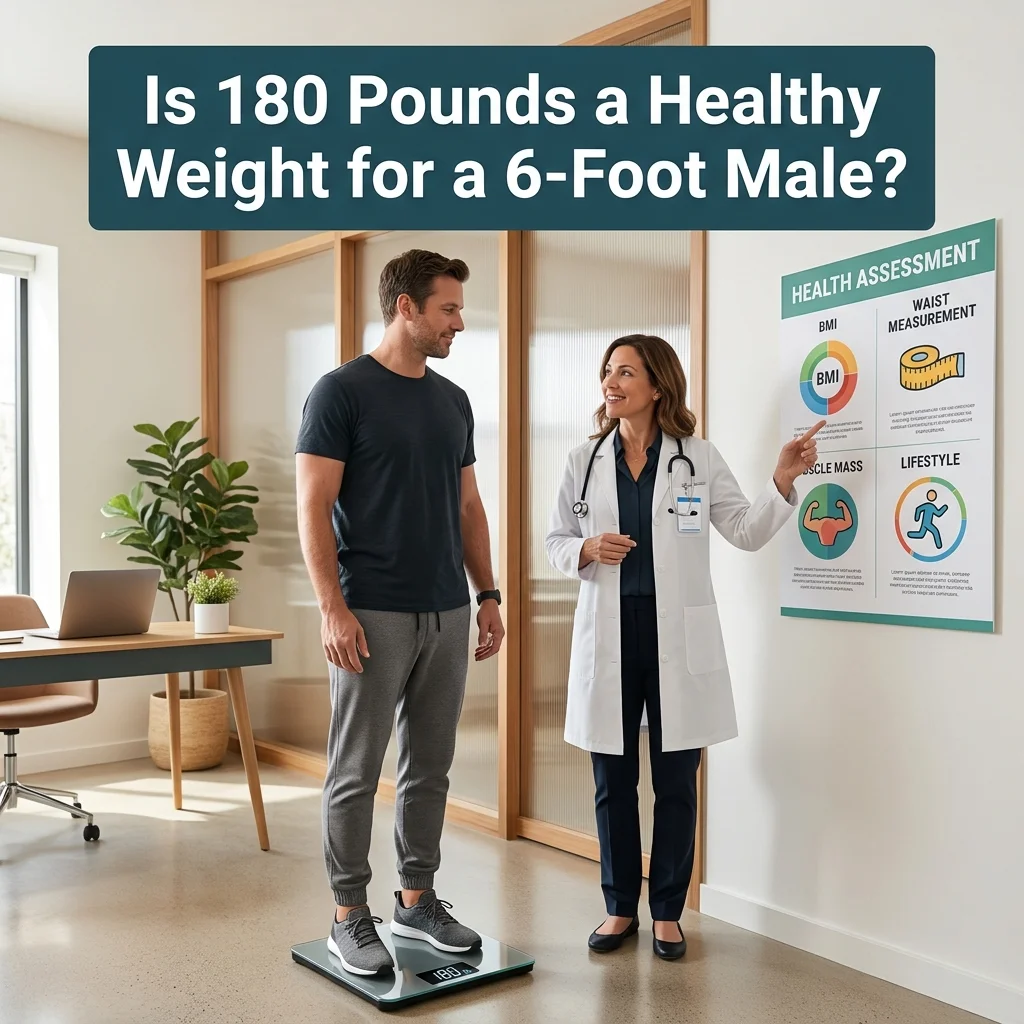
Yes. A 6-foot man weighing 180 pounds has a BMI of approximately 24.4.
This falls within the standard healthy adult BMI category, although it is relatively close to the overweight threshold.
If you weigh 180 pounds, consider your waist circumference, physical activity, body composition, and other health indicators.
There is no need to lose weight simply because you want to reach a lower number.
Is 185 Pounds Overweight for a 6-Foot Male?
At 185 pounds, a 6-foot man has a BMI of approximately 25.1.
This falls just inside the standard overweight category.
However, the difference between 184 and 185 pounds is very small. It should not be treated as a sudden change in health status.
BMI categories are screening boundaries. They do not account for every individual’s muscle mass, body fat distribution, or medical history.
Is 190 Pounds Overweight for a 6-Foot Male?
A 6-foot man weighing 190 pounds has a BMI of approximately 25.8.
According to standard BMI classifications, this falls within the overweight category.
However, a muscular individual may have a higher BMI because muscle contributes to total body weight.
For someone with less muscle and more abdominal fat, the same weight may indicate a greater need to evaluate weight-related health risks.
Consider your waist measurement and other health indicators before deciding whether weight loss is appropriate.
Is 200 Pounds Healthy for a 6-Foot Male?
A 6-foot man weighing 200 pounds has a BMI of approximately 27.1, which falls within the standard overweight category.
Whether this weight is appropriate depends on body composition and overall health.
For example, someone who has spent years building muscle may have a different health profile from someone whose weight has increased mainly because of excess body fat.
If you weigh 200 pounds and want to improve your health, consider discussing your weight and potential health risks with a healthcare professional.
How to Maintain a Healthy Weight at 6 Feet Tall
Maintaining a healthy weight does not require extreme dieting or spending every day in the gym.
Small, consistent lifestyle changes can help you manage your weight and improve your physical fitness.
Eat a Balanced Diet
Your daily diet should provide the nutrients your body needs to function properly.
Include a variety of foods:
- Protein: Eggs, chicken, fish, beans, lentils, and yogurt.
- Vegetables: Spinach, broccoli, carrots, tomatoes, and leafy greens.
- Fruits: Apples, bananas, oranges, berries, and other seasonal fruits.
- Whole grains: Oats, brown rice, whole-wheat bread, and whole-grain cereals.
- Healthy fats: Nuts, seeds, olive oil, and avocados.
Try to limit frequent consumption of highly processed foods, sugary drinks, and meals containing excessive amounts of added sugar or saturated fat.
You do not need to eliminate your favorite foods completely. Instead, focus on portion sizes and your overall eating pattern.
Exercise Regularly
Physical activity helps maintain muscle strength, improve cardiovascular fitness, and manage body weight.
For most adults, the CDC recommends at least 150 minutes of moderate-intensity aerobic activity each week, along with muscle-strengthening activities on at least two days.
Examples include:
Aerobic activities:
- Brisk walking
- Jogging
- Cycling
- Swimming
- Dancing
Strength-training activities:
- Push-ups
- Squats
- Lunges
- Weightlifting
- Resistance-band exercises
Start at a comfortable level if you are new to exercise. Gradually increase your activity as your fitness improves.
Get Enough Sleep
Sleep plays an important role in appetite regulation, energy levels, recovery, and general health.
Most adults should aim for at least seven hours of sleep each night.
Try to maintain a regular bedtime, reduce screen exposure before sleeping, and keep your bedroom comfortable and quiet.
Drink Enough Water
Water supports digestion, temperature regulation, circulation, and many other bodily functions.
Your hydration needs depend on your activity level, climate, health, and daily routine.
Drink water regularly throughout the day, particularly during exercise or hot weather.
Monitor Your Weight and Waist Measurement
Checking your weight occasionally can help you understand long-term changes.
However, your weight may fluctuate because of hydration, food intake, salt consumption, and other normal factors.
Instead of reacting to every small change, look at longer-term patterns.
You can also monitor your waist measurement, physical performance, and how your clothes fit.
Sample Daily Meal Plan for a 6-Foot Male
A balanced meal plan can help you maintain a healthy weight while providing the nutrients your body needs.
The following example is a general meal structure, not a personalized calorie prescription.
| Meal | Example foods |
| Breakfast | Two eggs, whole-grain toast, fruit, and milk |
| Morning snack | Yogurt and a handful of nuts |
| Lunch | Grilled chicken, rice, and mixed vegetables |
| Afternoon snack | Banana or apple with peanut butter |
| Dinner | Fish or lentils, whole grains, and vegetables |
| Optional snack | Plain yogurt or milk if hungry |
You can adjust portions according to your appetite, activity level, health needs, and weight goals.
If you want to lose weight, portion sizes and total calorie intake may need adjustment. If you want to gain muscle, you may need additional energy and protein.
People with diabetes, kidney disease, food allergies, or other medical conditions may need a more individualized eating plan.
Sample Weekly Workout Plan for a 6-Foot Male
You do not need a complicated workout routine to improve your fitness.
The following example combines aerobic exercise with strength training.
| Day | Activity |
| Monday | Full-body strength training |
| Tuesday | 30-minute brisk walk |
| Wednesday | Full-body strength training |
| Thursday | Cycling or swimming |
| Friday | Full-body strength training |
| Saturday | Walking or another enjoyable sport |
| Sunday | Rest or gentle stretching |
Adjust the intensity according to your current fitness level.
If you are new to exercise, begin with shorter sessions and lighter resistance. Allow your body time to recover.
The goal is to establish a routine that you can maintain consistently.
How to Lose Weight if You Are a 6-Foot Male
If your weight is above your personal healthy range, gradual weight loss may help improve certain health indicators.
However, your weight-loss target should depend on your current health, body composition, and medical needs.
Create a Moderate Calorie Deficit
A calorie deficit occurs when you consume fewer calories than your body uses.
You can create a moderate deficit by making small adjustments to your eating habits and increasing physical activity.
For example:
- Replace sugary drinks with water.
- Reduce oversized food portions.
- Eat more vegetables and fiber-rich foods.
- Choose lean protein sources.
- Reduce frequent high-calorie snacks.
- Increase daily walking.
Avoid extremely restrictive diets. They can make it difficult to get enough nutrients and maintain your progress.
Prioritize Protein and Strength Training
Protein supports muscle maintenance and recovery, particularly when combined with resistance training.
Good sources include chicken, fish, eggs, yogurt, beans, lentils, and tofu.
Strength training can help preserve muscle while you work toward a healthier body composition.
Set Realistic Goals
Avoid trying to lose a large amount of weight in a short period.
A realistic goal should consider your current weight, health, lifestyle, and ability to maintain new habits.
If you have a significant amount of weight to lose, a doctor or registered dietitian can help you create an appropriate plan.
How to Gain Weight if You Are a 6-Foot Male
Some 6-foot men want to gain weight because they feel too slim, have low muscle mass, or struggle to maintain their current weight.
If you are underweight, unexplained weight loss or difficulty gaining weight may require medical evaluation.
If you are otherwise healthy and want to increase your weight, consider these strategies.
Eat More Nutrient-Dense Foods
Gradually increase your food intake by adding nutritious foods to your meals.
Examples include:
- Peanut butter
- Nuts and seeds
- Whole milk
- Eggs
- Avocados
- Rice
- Oats
- Potatoes
- Salmon
- Yogurt
These foods provide energy and important nutrients.
Eat Regular Meals
If you struggle to eat large meals, try having smaller meals and snacks throughout the day.
For example, you could include breakfast, lunch, dinner, and two nutritious snacks.
Avoid relying entirely on sugary foods or fast food to increase your calorie intake.
Follow a Strength-Training Routine
Resistance training can help you develop muscle when combined with adequate nutrition and recovery.
Exercises such as squats, rows, push-ups, and weightlifting can target different muscle groups.
Begin with manageable resistance and focus on proper technique.
Allow your muscles enough time to recover between demanding workouts.
Include Protein in Your Meals
Protein provides amino acids that your body uses to build and repair muscle tissue.
Include a protein source in your regular meals.
You can also speak with a qualified nutrition professional about how much protein is appropriate for your individual needs.
When Should a 6-Foot Male Be Concerned About His Weight?
Your weight deserves attention when it changes significantly without an obvious explanation or when it is accompanied by other symptoms.
Consider speaking with a healthcare professional if you experience:
- Unexplained weight loss.
- Rapid or unexpected weight gain.
- Persistent fatigue or weakness.
- Difficulty maintaining your appetite.
- Changes in your waist size.
- Shortness of breath during ordinary activities.
- Other unusual or persistent physical symptoms.
A healthcare professional may review your medical history, medications, diet, physical activity, and relevant laboratory results.
Do not assume that every weight change is caused by eating habits. Some medical conditions and medications can influence body weight.
Special Considerations for South Asian Men
BMI thresholds may need additional interpretation for people of different ethnic backgrounds.
Some people of South Asian ancestry may develop higher body fat levels and metabolic health risks at lower BMI values than some other populations.
Certain clinical guidelines therefore use lower BMI action points for South Asian populations. NICE guidance, for example, identifies BMI values of 23 and 27.5 as relevant thresholds for overweight and obesity assessment in these populations.
This does not mean every South Asian man has the same health risks. It means that relying only on the standard BMI range may not provide the complete picture.
If you have South Asian ancestry, consider discussing your BMI, waist measurement, blood pressure, blood sugar, and cholesterol with a healthcare professional.
Frequently Asked Questions About Ideal Weight for 6 Foot Male
What Is the Ideal Weight for a 6-Foot Male?
The standard healthy BMI range for an adult man who is 6 feet tall corresponds to approximately 136–184 pounds (61.9–83.5 kg). Your individual healthy weight may vary depending on muscle mass, body fat, and overall health.
How Much Should a 6-Foot Male Weigh?
A 6-foot adult male generally falls within the standard healthy BMI category at approximately 136–184 pounds. However, body composition and individual health factors should also be considered.
What Is the Average Weight for a 6-Foot Male?
There is no single universal average weight for all 6-foot men. Average body weight varies by age, country, population, physical activity, and other characteristics. The standard healthy BMI range provides a more useful screening reference than assuming one average weight suits everyone.
Is 150 Pounds a Good Weight for a 6-Foot Male?
A 6-foot man weighing 150 pounds has a BMI of approximately 20.3, which falls within the standard healthy BMI category. Whether it is an appropriate weight depends on muscle mass, nutrition, and overall health.
Is 170 Pounds a Good Weight for a 6-Foot Male?
Yes. A 6-foot male weighing 170 pounds has a BMI of approximately 23.1. This falls within the standard healthy adult BMI range.
Is 175 Pounds Healthy for a 6-Foot Male?
Yes. At 175 pounds, a 6-foot male has a BMI of approximately 23.7, which falls within the standard healthy BMI category.
Is 180 Pounds Too Heavy for a 6-Foot Male?
No. A 6-foot male weighing 180 pounds has a BMI of approximately 24.4. This falls within the standard healthy BMI range.
Is 185 Pounds Overweight for a 6-Foot Male?
At 185 pounds, a 6-foot man has a BMI of approximately 25.1. This falls just inside the standard overweight category. However, BMI does not distinguish muscle mass from body fat.
Is 190 Pounds Overweight for a 6-Foot Male?
Yes, according to standard adult BMI classifications, 190 pounds corresponds to a BMI of approximately 25.8. However, a muscular man may have a higher BMI without having excessive body fat.
Is 200 Pounds Healthy for a 6-Foot Male?
A 6-foot man weighing 200 pounds has a BMI of approximately 27.1, which falls into the standard overweight category. His body composition, waist measurement, and other health indicators should also be considered.
Can a 6-Foot Male Weigh 220 Pounds and Be Healthy?
Some muscular men may weigh 220 pounds because of substantial muscle mass. However, this weight corresponds to a BMI of approximately 29.8, which is close to the standard obesity threshold. A more complete health assessment is important.
What Is the Ideal Weight for a 6-Foot Male in KG?
The standard healthy BMI range corresponds to approximately 61.9–83.5 kilograms for a man who is exactly 6 feet tall.
What Should a 6-Foot Male Weigh at 25?
There is no separate standard BMI weight range specifically for 25-year-old men. For an adult aged 25, the general healthy BMI range corresponds to approximately 136–184 pounds at 6 feet tall.
Does Muscle Mass Change the Ideal Weight?
Yes. Muscle contributes to your total body weight. A man with more muscle may weigh more than someone with less muscle at the same height. BMI does not distinguish muscle from fat, so additional measurements can help provide a clearer picture.
What Waist Size Should a 6-Foot Male Aim For?
A waist-to-height ratio below 0.5 is a commonly recommended general target. For someone who is 72 inches tall, this means keeping the waist measurement below 36 inches. This is a screening guide rather than a guarantee of good health.
How Can a 6-Foot Male Maintain His Ideal Weight?
Maintain a balanced diet, exercise regularly, get sufficient sleep, stay hydrated, and monitor long-term weight changes. Focus on sustainable habits rather than extreme diets or unrealistic fitness goals.
Final Thoughts
Finding the ideal weight for a 6 foot male involves more than looking at a weight chart. The standard adult BMI range suggests that a man who is exactly 6 feet tall should weigh approximately 136–184 pounds (61.9–83.5 kg) to fall within the healthy BMI category. However, your muscle mass, body fat percentage, waist measurement, age, and lifestyle can influence your personal health goals.
If you weigh 170 or 180 pounds, you may already fall within the standard healthy BMI range. If you weigh 190 or 200 pounds, consider your body composition and other health measurements before deciding whether you need to lose weight. Whether you want to lose fat, gain muscle, or maintain your current body weight, focus on balanced nutrition, regular exercise, sufficient sleep, and sustainable daily habits.

I am Daniel Scott, a passionate writer dedicated to creating meaningful and engaging content that informs, inspires, and connects with readers worldwide. I am passionate about exploring ideas, sharing knowledge, and presenting stories with clarity and creativity. My writing focuses on delivering valuable insights through well-researched articles and thoughtful perspectives. I am committed to maintaining accuracy, originality, and a reader-first approach in every piece I create.