Have you ever stopped while writing because you couldn’t decide between bear weight or bare weight? You’re not alone. These two expressions sound exactly alike, but their meanings are quite different. Using the wrong spelling can make an otherwise correct sentence confusing.
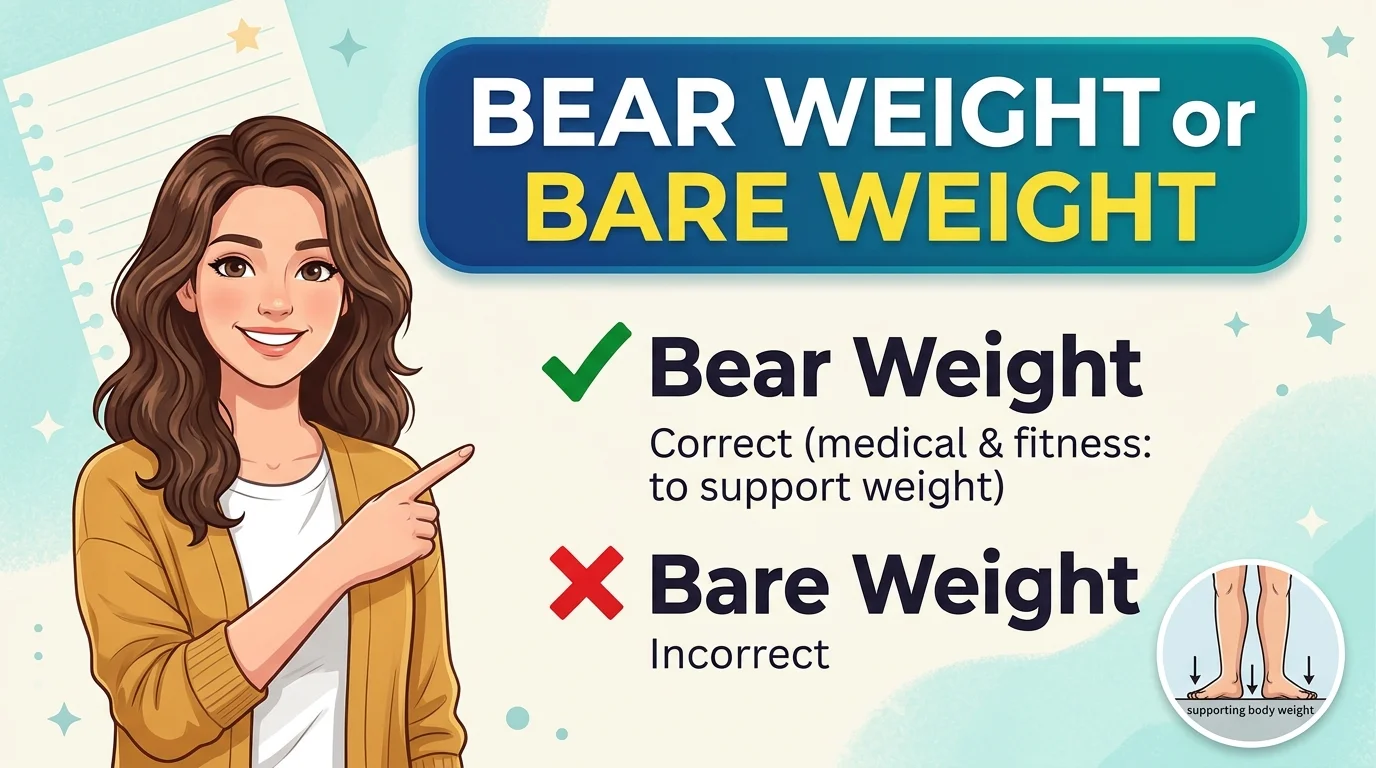
The correct expression is usually bear weight when you’re talking about supporting, carrying, or holding something heavy. For example, a doctor might ask whether you can bear weight on your injured foot, or an engineer might explain how much weight a bridge can support.
The word bare has a different meaning. It describes something uncovered, exposed, or without additional features. Although the expression bare weight can make sense in certain technical contexts, it isn’t a substitute for bear weight.
Understanding the difference between these homophones will help you avoid common spelling mistakes in conversations, emails, school assignments, and professional writing.
In this guide, you’ll discover the bear weight meaning, the difference between bear and bare, correct sentence examples, pronunciation, grammar rules, and common expressions. You’ll also learn a simple trick to remember which spelling to choose.
Bear Weight or Bare Weight: Which Is Correct?
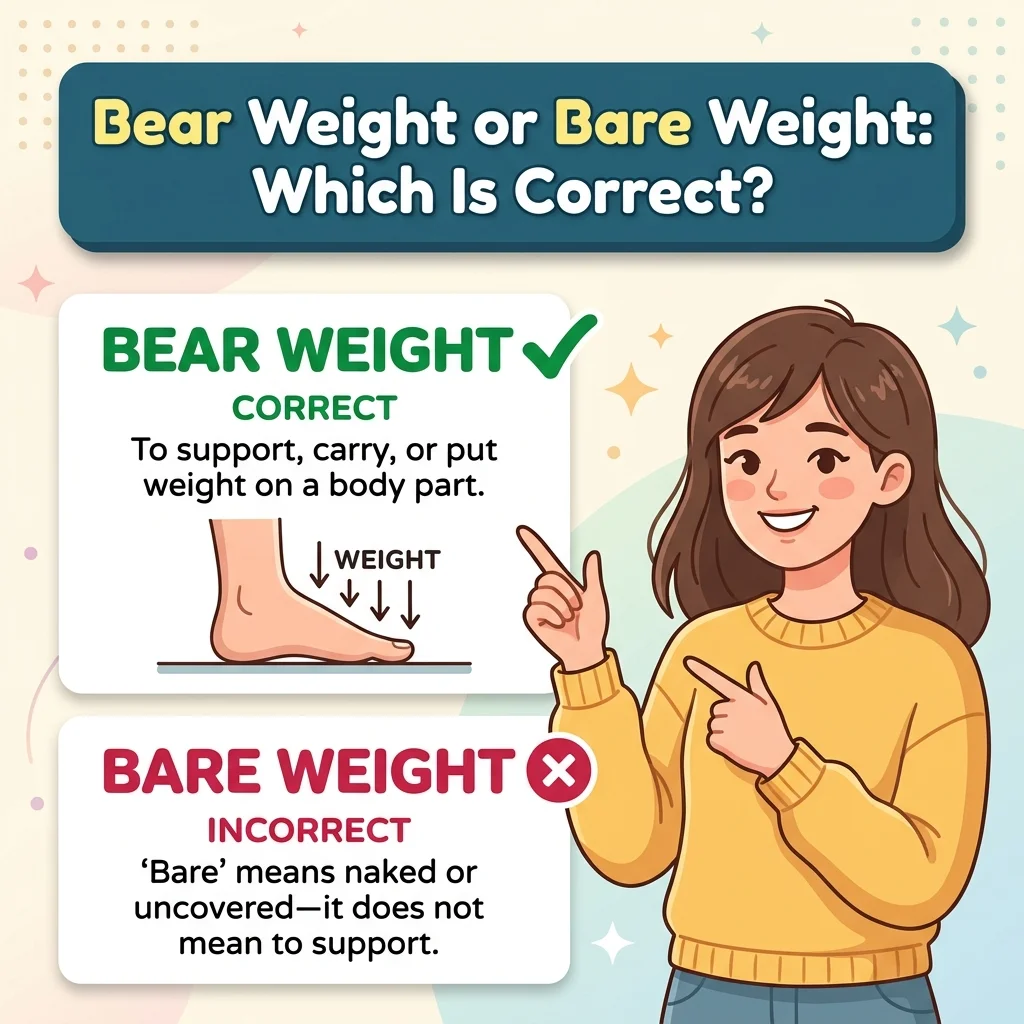
Bear weight is correct when you mean supporting, carrying, or withstanding physical weight. The verb bear describes the ability to hold a load, tolerate pressure, or handle a responsibility.
Bare weight is not the standard expression for supporting something heavy. However, it may be understandable when bare describes an object’s basic or uncovered weight without additional components.
Consider these examples:
| Expression | Meaning | Example |
| Bear weight | Support a physical load | The bridge can bear heavy vehicles. |
| Bear the weight | Support a particular load or burden | The floor can bear the weight of the machine. |
| Bare weight | Basic weight without additional features | The bare weight of the equipment is 12 kg. |
| Bare feet | Feet without shoes or socks | She walked across the grass with bare feet. |
Here are two sentences that demonstrate the difference:
- Correct: The injured player cannot bear weight on his right leg.
- Incorrect: The injured player cannot bare weight on his right leg.
The first sentence is correct because the player is unable to support body weight through the injured leg.
A useful way to remember the spelling is to replace bear with support. If the sentence still makes sense, you probably need the word bear.
What Does Bear Weight Mean?
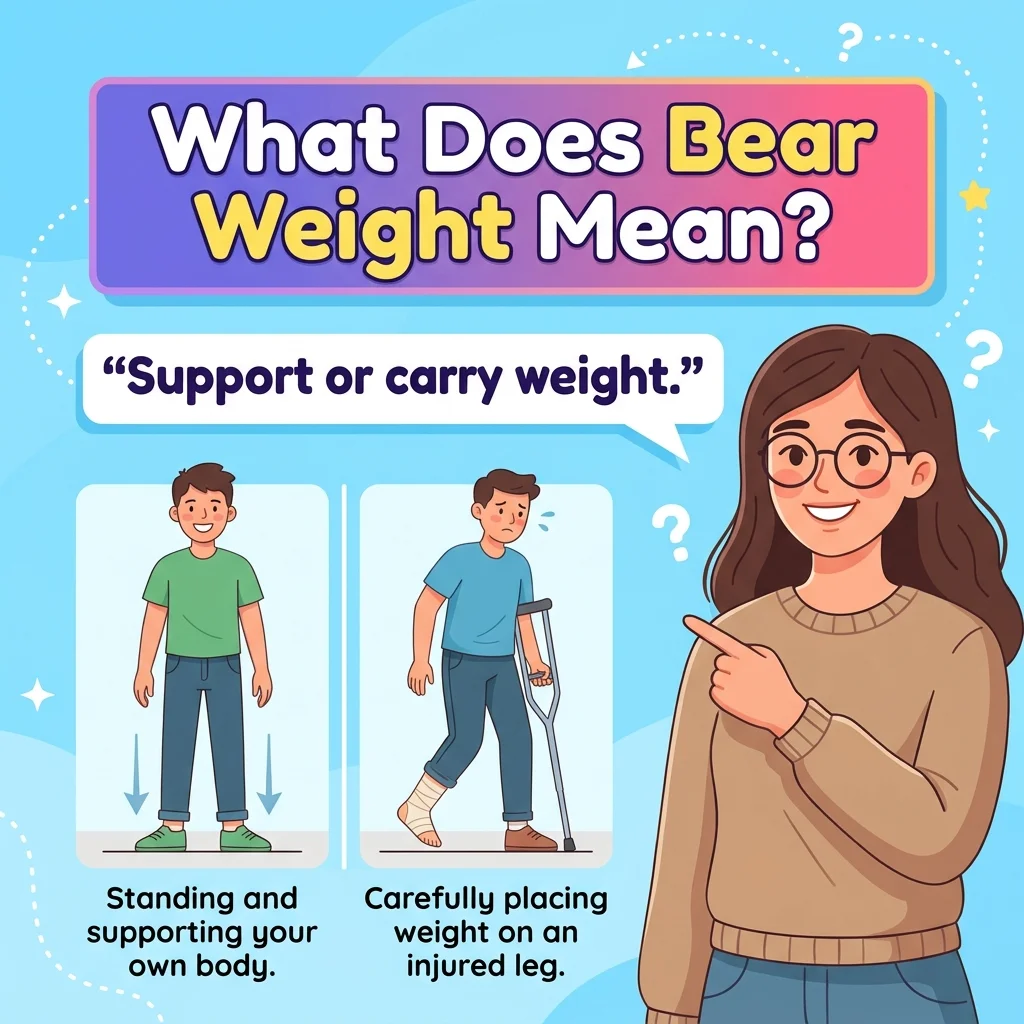
The phrase bear weight means to support or carry a physical load. It describes the amount of weight a person, object, or structure can safely hold or withstand.
The verb bear has several meanings in English. It can mean carry, support, endure, tolerate, or accept responsibility.
For example, consider a wooden shelf holding several heavy books. If the shelf is strong enough to support them without bending or breaking, you can say:
“The shelf can bear the weight of the books.”
The same expression is commonly used when discussing injuries.
Imagine that you twist your ankle while playing football. Standing on the injured foot may cause pain, making it difficult to support your body.
You could explain the situation by saying:
“I cannot bear weight on my injured ankle.”
This means that you cannot comfortably place your body weight through that ankle.
Different Ways to Use Bear Weight
The expression has several applications depending on the situation.
1. Supporting physical objects
Use it when describing the strength of something that holds another object.
Example: The metal frame can bear the weight of heavy equipment.
2. Supporting body weight
This meaning commonly appears in medical and fitness discussions.
Example: The patient can now bear weight on both legs after rehabilitation.
3. Handling responsibilities
Weight can also describe emotional or professional pressure.
Example: The manager had to bear the weight of several important decisions.
4. Withstanding environmental pressure
Buildings, roofs, bridges, and other structures must sometimes bear heavy loads caused by weather or external forces.
Example: The roof was designed to bear the weight of accumulated snow.
When Should You Use Bear Weight?
Use this expression when discussing:
- A person’s ability to stand or walk.
- An injured leg, knee, ankle, or foot.
- The strength of floors, bridges, and buildings.
- Furniture supporting heavy objects.
- Vehicles carrying passengers or cargo.
- Industrial equipment supporting loads.
- Emotional pressure and responsibilities.
In each situation, bear communicates the idea of carrying, supporting, or enduring something.
What Does Bare Weight Mean?
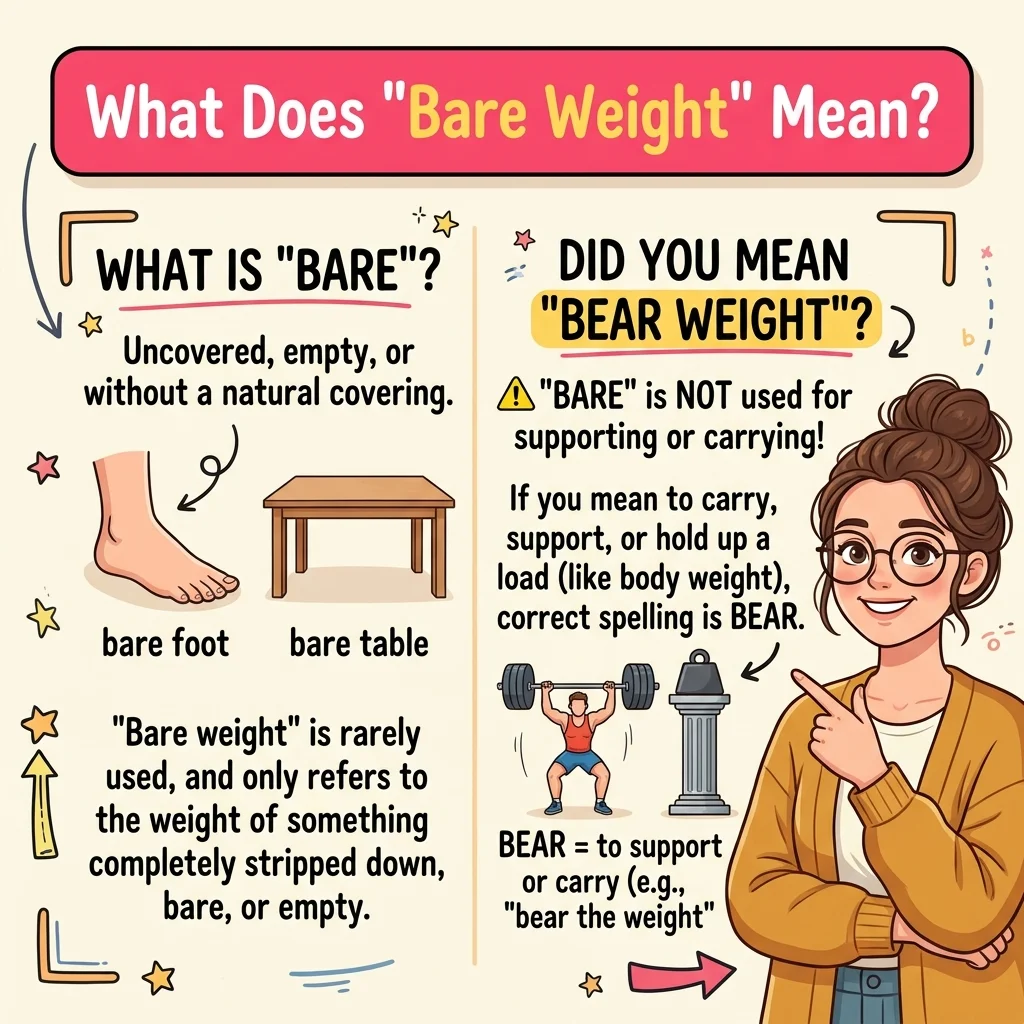
The expression bare weight is less common than bear weight. It is not a standard phrase for describing the ability to support a load.
However, the words can appear together when bare describes something in its simplest or most basic form.
The word bare is generally an adjective meaning uncovered, exposed, empty, or without additional features.
For example:
“The bare weight of the equipment is 12 kilograms.”
A writer might use this sentence to describe the equipment’s basic weight without accessories or additional materials. However, more precise technical expressions include net weight, empty weight, and unladen weight, depending on the situation.
Common Expressions Using Bare
Understanding familiar expressions makes the meaning of bare easier to remember.
Bare minimum: The smallest amount needed to complete something.
Example: He did the bare minimum required to finish the assignment.
Bare essentials: Only the most necessary items.
Example: We packed the bare essentials for our weekend trip.
Bare feet: Feet without shoes or socks.
Example: The children played outside with bare feet.
Bare walls: Walls without decorations, pictures, or coverings.
Example: The apartment had bare walls and simple furniture.
Bare hands: Hands without gloves or protective coverings.
Example: She picked up the small object with her bare hands.
The common idea behind these expressions is that something is uncovered, exposed, or without extras.
Bear vs. Bare: What Is the Difference?
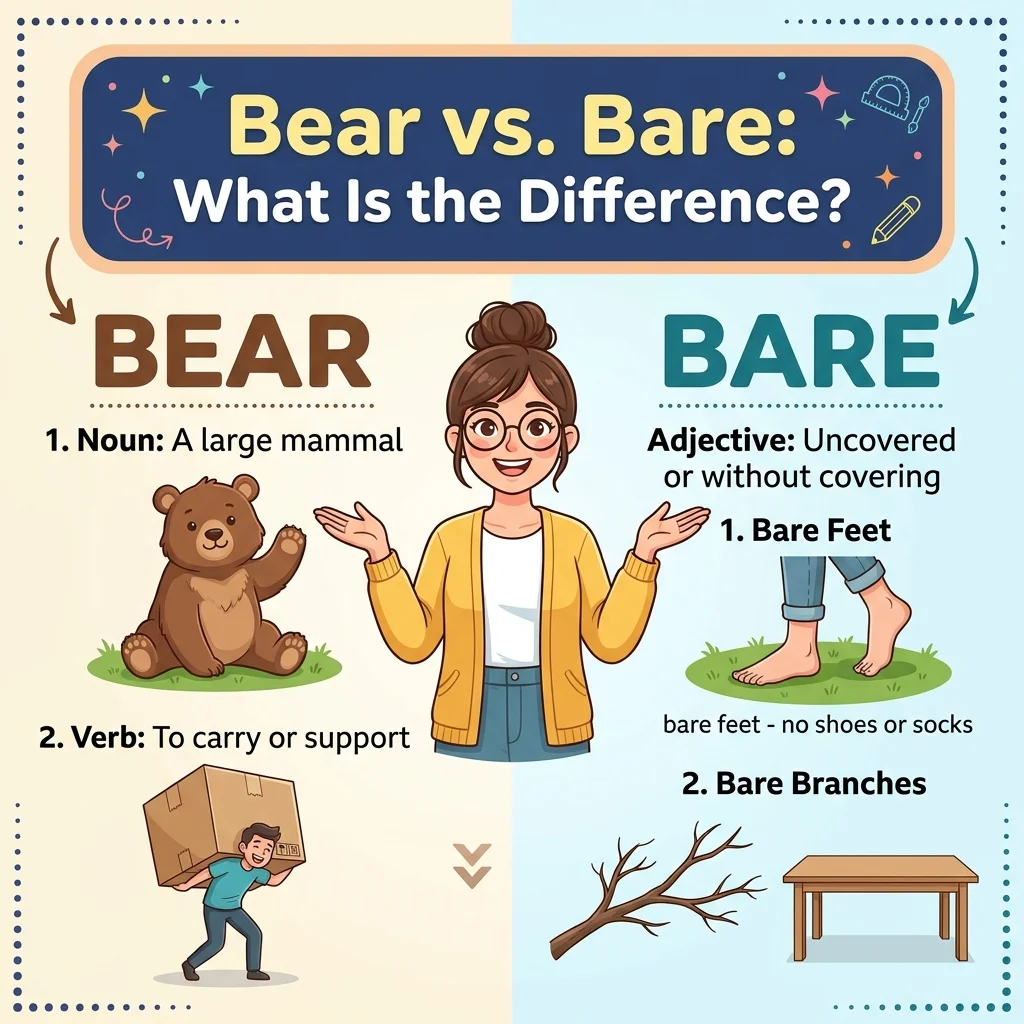
The main difference between bear and bare is their meaning and grammatical function.
Although they sound identical, they are not interchangeable. One can function as a noun and a verb, while the other commonly appears as an adjective and a verb.
| Feature | Bear | Bare |
| Part of speech | Noun and verb | Adjective and verb |
| Main meaning | Carry, support, or endure | Uncovered or exposed |
| Pronunciation | /ber/ | /ber/ |
| Verb example | Bear a heavy load | Bare your arms |
| Adjective example | Not applicable in this sense | Bare feet |
| Common expression | Bear responsibility | Bare minimum |
1. Bear as a Verb
As a verb, bear means to carry, support, tolerate, or endure something.
Examples:
- I cannot bear the pain anymore.
- The bridge can bear heavy traffic.
- She had to bear the responsibility for the decision.
- The injured horse could not bear weight on its front leg.
- He had to bear the consequences of his actions.
2. Bear as a Noun
Bear is also the name of a large mammal.
Examples:
- We saw a brown bear in the forest.
- The polar bear lives in Arctic regions.
- A black bear was spotted near the campsite.
This meaning is unrelated to supporting weight, but it helps you recognize the spelling.
3. Bare as an Adjective
As an adjective, bare describes something uncovered, exposed, or without decoration.
Examples:
- She walked across the beach with bare feet.
- The room had bare walls.
- He placed the book on the bare table.
- The tree had bare branches during winter.
4. Bare as a Verb
As a verb, bare means to uncover or expose something.
Examples:
- He decided to bare his feelings.
- She bared her arms in the warm weather.
- The investigation helped reveal the truth.
The difference becomes easier when you remember that bear involves carrying or enduring, while bare involves exposing or uncovering.
How Are Bear and Bare Pronounced?
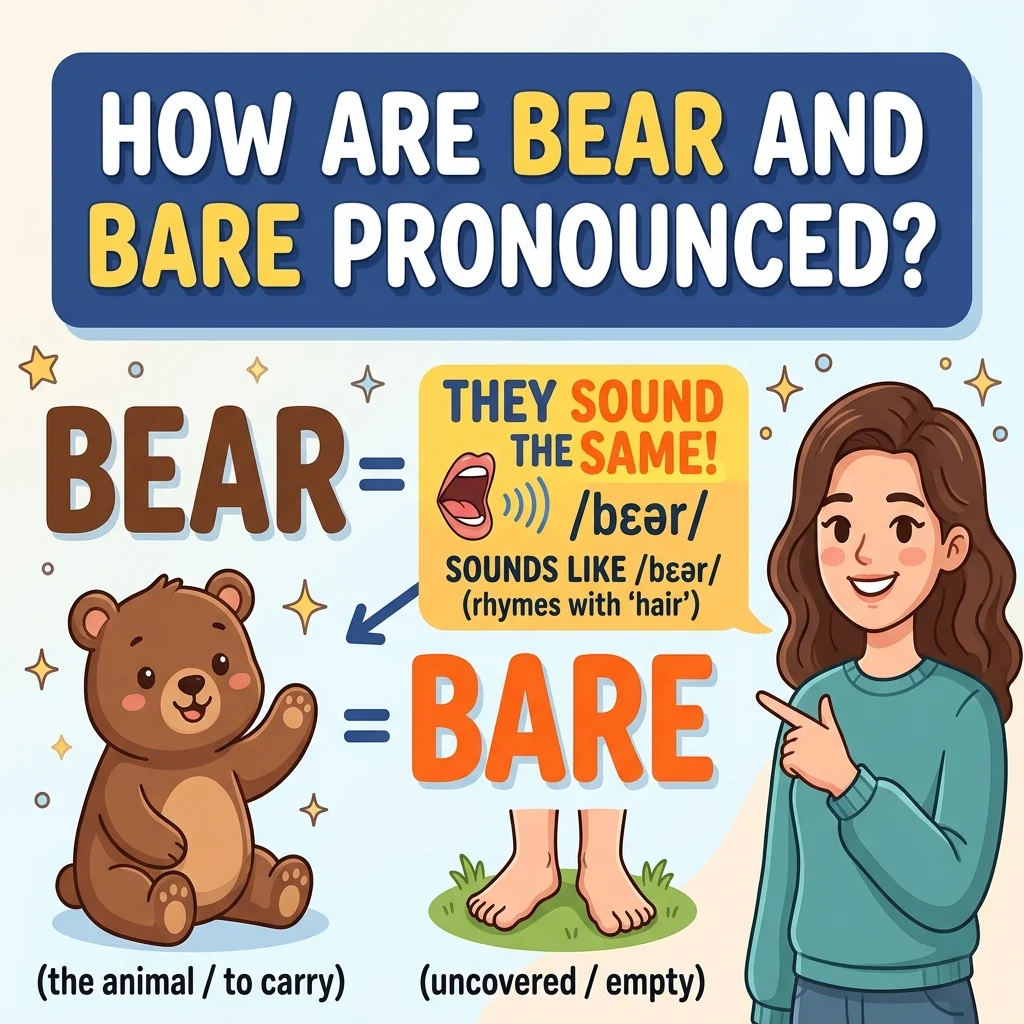
One reason people confuse these words is that they are homophones.
Homophones are words that sound the same but have different spellings and meanings.
Both bear and bare have the same standard pronunciation:
- Bear: /ber/
- Bare: /ber/
The vowel sound is the same in both words. You cannot reliably identify the correct spelling by listening alone.
Instead, you need to understand the meaning of the sentence.
For example:
- The building can bear heavy loads.
- The building has bare walls.
Both sentences sound similar, but the first discusses structural strength, while the second describes an uncovered interior.
Other familiar English homophones include:
| Word pair | Meaning |
| Their / There | Belonging to them / A place |
| To / Too | Direction or infinitive marker / Also or excessively |
| Right / Write | Correct or opposite of left / Put words on paper |
| Here / Hear | This place / Perceive sound |
| Sea / See | Large body of water / Look at something |
| Bear / Bare | Carry or support / Uncovered or exposed |
Recognizing homophones can improve your spelling and help you understand English sentence structure.
Bear Weight in Medical and Fitness Language

The phrase bear weight is particularly common in medicine, physical therapy, sports, and rehabilitation.
Healthcare professionals use it to describe whether someone can support body weight through an injured or recovering leg.
For example, after a fracture or ankle injury, a doctor may ask whether you can stand on the affected foot.
What Does It Mean to Bear Weight on Your Foot?
To bear weight on your foot means to place some or all of your body weight through that foot while standing, walking, or performing another movement.
If you can stand and walk using your foot within your medical restrictions, you may be described as able to bear weight.
However, if pain, weakness, or an injury prevents you from putting weight through the foot, you may be described as unable to bear weight.
Types of Weight-Bearing Restrictions
Medical professionals use different terms to explain how much weight a patient may place through an injured leg.
| Medical term | Explanation |
| Full weight-bearing | You are permitted to place your full body weight through the affected leg. |
| Partial weight-bearing | You can place only a specified or limited amount of weight through the leg. |
| Non-weight-bearing | You must not place weight through the affected leg. |
| Weight-bearing as tolerated | You may place as much weight as you can comfortably manage within your medical instructions. |
| Touch-down weight-bearing | You may lightly touch the foot to the ground for balance without using it to support meaningful body weight. |
These terms are commonly used after fractures, orthopedic surgery, ligament injuries, and other conditions affecting mobility.
Always follow your healthcare professional’s instructions. Do not increase your weight-bearing activity without medical approval.
Examples of Bear Weight in Medical Sentences
- The patient cannot bear weight on her injured ankle.
- The doctor advised him not to bear weight on his left leg.
- The athlete gradually regained the ability to bear weight.
- Physical therapy helped her bear weight more comfortably.
- The patient was instructed to avoid weight-bearing activities after surgery.
Medical note: An inability to bear weight after an injury can indicate a serious problem, including a fracture. Seek prompt medical assessment, especially if you experience severe pain, swelling, deformity, or difficulty moving the affected limb.
Everyday Examples of Bear Weight
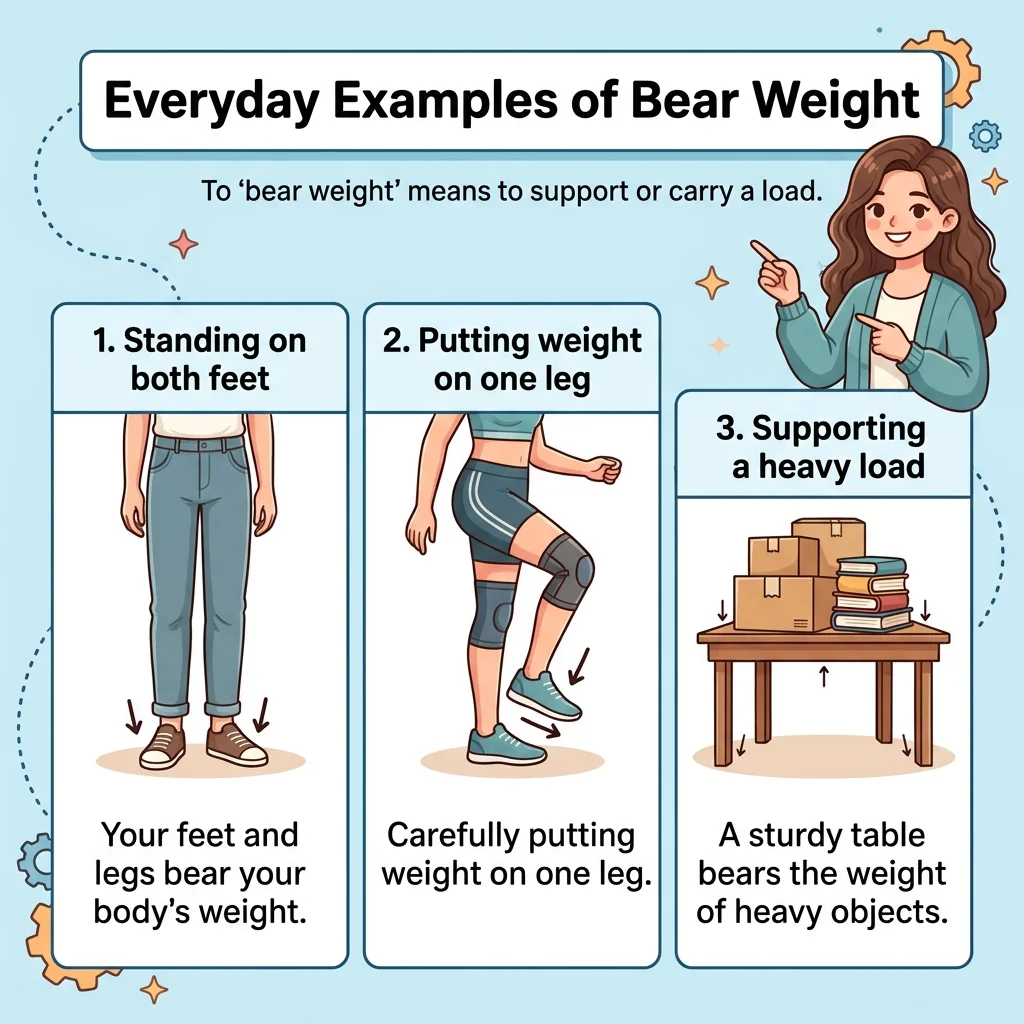
You can use bear weight in many situations outside medical discussions.
Here are examples from different areas of everyday life.
Construction and Buildings
“The bridge was designed to bear the weight of heavy vehicles.”
This means the structure can support the load created by passing traffic.
Furniture and Household Items
“The wooden table cannot bear the weight of the industrial machine.”
This explains that the table is not strong enough to support the machine.
Sports and Exercise
“The player could not bear weight on his injured foot after the match.”
This describes the athlete’s difficulty supporting body weight through the injured foot.
Transportation
“The trailer can bear the weight of the construction materials.”
This means the trailer is designed to support the load.
Workplace Responsibilities
“She had to bear the weight of managing the entire project.”
Here, weight represents responsibility and pressure rather than physical mass.
Weather Conditions
“The roof must bear the weight of heavy snowfall.”
This describes the roof’s ability to withstand the snow.
20 Correct Example Sentences Using Bear and Bare
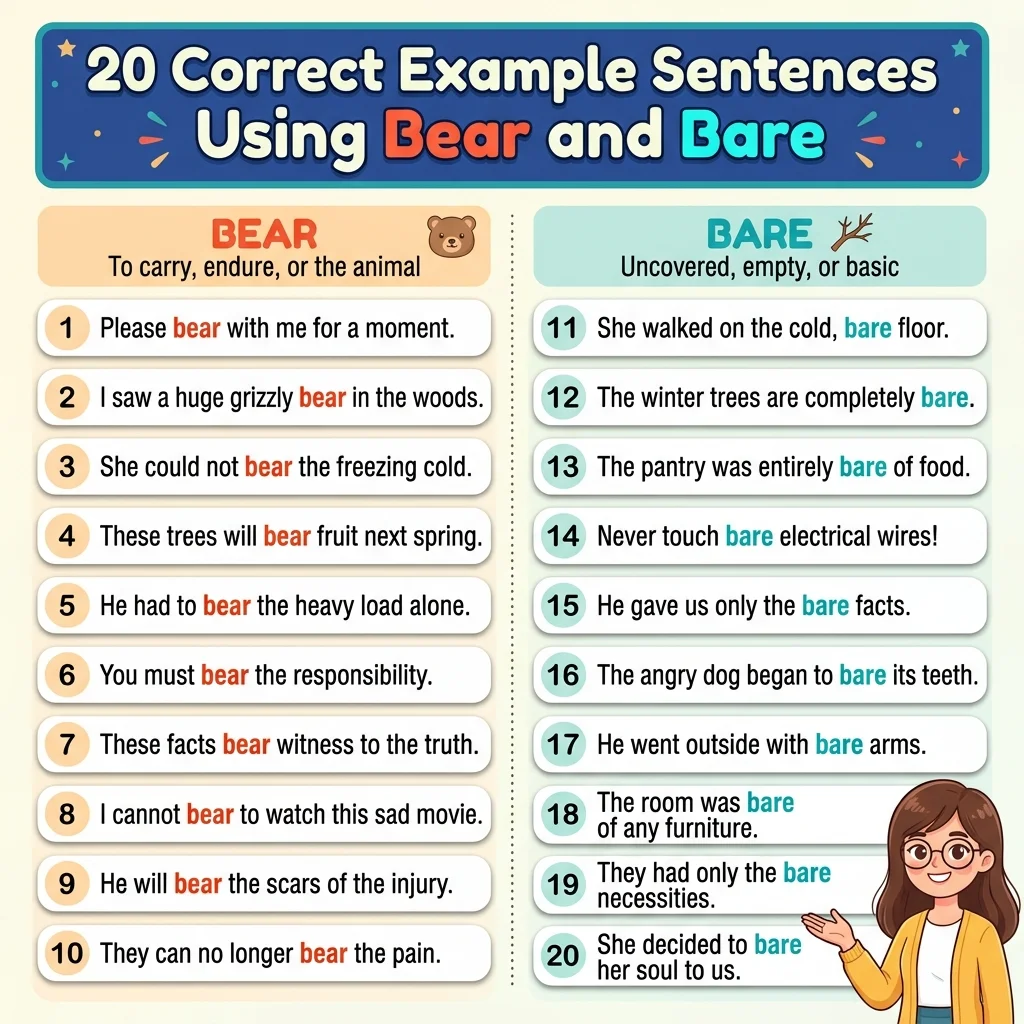
The following examples demonstrate how to use both words correctly in everyday English.
Bear Examples
- The wooden bridge can bear the weight of several people at once.
- My injured ankle cannot bear weight without causing pain.
- The table is strong enough to bear the weight of a large computer.
- The building was designed to bear heavy machinery.
- The doctor asked whether I could bear weight on my right foot.
- The old chair cannot bear the weight of an adult.
- The athlete struggled to bear weight after the accident.
- The roof must bear the weight of accumulated snow.
- This shelf can easily bear several heavy books.
- The patient gradually regained the ability to bear weight.
- The wooden platform can bear the weight of the equipment.
- The injured horse could not bear weight on its front leg.
- Engineers tested the structure to determine how much weight it could bear.
- The backpack straps must bear the weight of all the supplies.
- The floor cannot safely bear the weight of the heavy machine.
Bare Examples
- She walked across the grass with bare feet.
- The apartment had bare walls and very little furniture.
- He packed only the bare essentials for his trip.
- The tree had bare branches during the winter.
- She decided to bare her feelings during the conversation.
Notice how the meanings change depending on the spelling. Bear describes carrying or enduring something, while bare describes something uncovered or exposed.
Common Mistakes When Using Bear and Bare
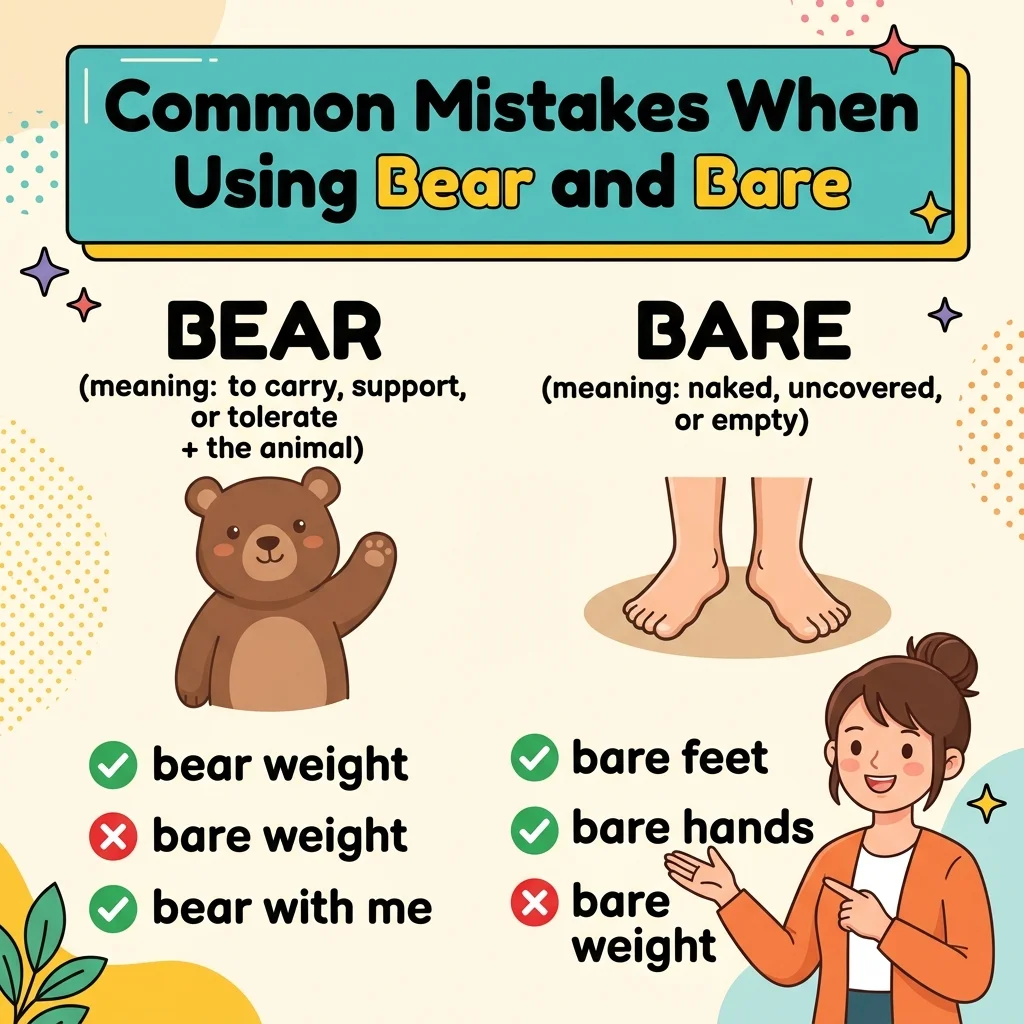
Even experienced English speakers sometimes confuse these words. The best way to avoid mistakes is to understand the intended meaning before choosing the spelling.
Here are some common errors and their corrections.
| Incorrect | Correct |
| The bridge can bare the weight. | The bridge can bear the weight. |
| I cannot bare weight on my foot. | I cannot bear weight on my foot. |
| He walked with bear feet. | He walked with bare feet. |
| She had to bare the responsibility. | She had to bear the responsibility. |
| The floor cannot bare the load. | The floor cannot bear the load. |
| The room had bear walls. | The room had bare walls. |
Mistake 1: Using Bare Instead of Bear
Incorrect: The injured person cannot bare weight on his leg.
Correct: The injured person cannot bear weight on his leg.
The sentence describes the person’s ability to support body weight. Therefore, bear is the correct verb.
Mistake 2: Using Bear Instead of Bare
Incorrect: He walked across the beach with bear feet.
Correct: He walked across the beach with bare feet.
The sentence describes feet without shoes or socks. Therefore, bare is the correct adjective.
Mistake 3: Confusing Bear With Bare in Responsibility Expressions
Incorrect: She had to bare the burden of leadership.
Correct: She had to bear the burden of leadership.
The sentence describes enduring responsibility rather than uncovering something.
Mistake 4: Confusing Bare Weight With Body Weight
Incorrect: The injured athlete cannot bare his body weight.
Correct: The injured athlete cannot bear his body weight.
The correct verb is bear because the athlete is trying to support physical weight.
Easy Ways to Remember Bear Weight or Bare Weight
You don’t need to memorize complicated grammar rules to remember these words. A few simple associations can make the difference easier.
1. Connect Bear With Carrying
Think about the verb carry.
If you can replace the word with carry or support and the sentence still makes sense, use bear.
Example:
“The bridge can bear heavy loads.”
You can also say:
“The bridge can support heavy loads.”
Both sentences communicate a similar meaning.
2. Connect Bare With Bare Feet
Imagine walking outside without shoes or socks.
Your feet are uncovered, so you have bare feet.
This association helps you remember that bare relates to being exposed or uncovered.
3. Remember the Bear Animal
Think of a large bear carrying or supporting something.
This mental image can help you connect the spelling bear with strength and physical support.
4. Ask Yourself What the Sentence Means
Before writing, check the intended meaning:
- Carrying a physical load? Use bear.
- Supporting body weight? Use bear.
- Enduring responsibility? Use bear.
- Uncovered or exposed? Use bare.
- Without shoes or decorations? Use bare.
This quick check is especially useful when writing quickly or answering grammar questions.
Bear Weight vs. Carry Weight: Are They the Same?
The expressions bear weight and carry weight have similar meanings, but they are not always interchangeable.
Both can describe handling a physical load. However, they often emphasize different actions.
Bear weight generally emphasizes supporting or withstanding a load.
Carry weight usually emphasizes transporting or holding something.
Consider these examples:
| Bear weight | Carry weight |
| The floor can bear the weight of the machine. | The worker can carry the machine. |
| My injured foot cannot bear weight. | The backpack can carry 10 kilograms. |
| The bridge must bear heavy loads. | The truck can carry heavy equipment. |
In medical conversations, bear weight is the standard expression for describing whether a person can support body weight through an injured limb.
Bear Weight vs. Body Weight: What Is the Difference?
These expressions are related, but they describe different things.
Body weight refers to how much a person’s body weighs. It is generally measured in kilograms or pounds.
Bear weight describes the ability to support or carry a load through a particular body part or structure.
For example:
“My body weight is 70 kilograms.”
This sentence describes the person’s weight.
“I cannot bear weight on my left foot.”
This sentence describes the person’s inability to support body weight through the injured foot.
Understanding this distinction is useful when reading medical instructions, fitness articles, and rehabilitation advice.
Test Your Knowledge: Bear or Bare?
Try these five sentences to see whether you understand the difference.
Choose the correct word for each sentence:
- The injured player cannot (bear/bare) weight on his ankle.
- She walked across the garden with (bear/bare) feet.
- The wooden shelf can (bear/bare) the weight of several books.
- He decided to (bear/bare) his feelings.
- The building must (bear/bare) the weight of heavy equipment.
Answers:
- Bear
- Bare
- Bear
- Bare
- Bear
If you answered all five correctly, you understand the basic difference between these commonly confused words.
Frequently Asked Questions
1. Is It Bear Weight or Bare Weight?
Bear weight is correct when you mean supporting or carrying physical weight. Bare means uncovered or exposed, so it cannot replace bear when describing the ability to support a load.
2. What Is the Difference Between Bear and Bare?
Bear is a verb meaning to carry, support, or endure. Bare is generally an adjective meaning uncovered or exposed, although it can also be a verb meaning to uncover something.
3. What Does It Mean When Someone Cannot Bear Weight?
It means someone cannot comfortably or safely support body weight through a particular leg or foot. This can happen because of an injury, fracture, pain, or another medical condition.
4. Is Bare Weight Ever Grammatically Correct?
Yes. The words can appear together when bare describes an object’s basic weight without additional components. However, it is not the standard expression for supporting or carrying a load.
5. How Do You Use Bear Weight in a Sentence?
You can write: “The injured athlete cannot bear weight on his right foot.”
This sentence means the athlete cannot support body weight through the injured foot.
6. What Does Bear the Weight Mean?
It means supporting a physical load or handling a responsibility. For example, “The bridge must bear the weight of heavy vehicles.”
7. Is Bear Weight Common in Medical Terminology?
Yes. Healthcare professionals commonly use this expression when discussing fractures, injuries, surgery, walking ability, and physical rehabilitation.
8. What Is Another Word for Bear Weight?
Depending on the context, alternatives include support, carry, sustain, withstand, and hold. For medical situations, support body weight is also a clear alternative.
9. Are Bear and Bare Homophones?
Yes. They are homophones because they have the same pronunciation but different spellings and meanings.
10. What Does Full Weight-Bearing Mean?
Full weight-bearing means a person is permitted to place their full body weight through an affected leg. It is commonly used in medical instructions following injuries or surgery.
11. Is It Bear Weight on Your Foot or Bare Weight on Your Foot?
The correct expression is bear weight on your foot. It means placing body weight through your foot while standing or walking.
12. Does Bear Mean Carry?
Yes. One meaning of the verb bear is to carry or support something. It can also mean tolerating or enduring a difficult experience.
Conclusion
The difference between bear weight or bare weight is easier to understand when you focus on the meaning of each word. Use bear weight when describing the ability to support, carry, or withstand a physical load. It is the standard expression in medical conversations, construction, fitness, and everyday writing.
Use bare when describing something uncovered, exposed, or without additional features. Common examples include bare feet, bare walls, and bare essentials. Remember this simple trick: bear means carry or support, while bare means uncovered or exposed.

I am James Carter, a passionate writer dedicated to creating informative, engaging, and valuable content for readers. I enjoy exploring different topics, researching new ideas, and sharing knowledge through clear and meaningful writing. I am committed to providing accurate information, helpful insights, and well-crafted articles that inspire and educate audiences. With a strong focus on quality and creativity, I aim to connect with readers and deliver content that adds real value.