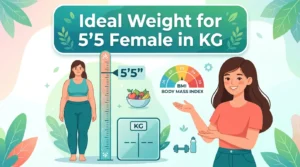
If you are 5 feet 5 inches tall, you may wonder how much you should weigh to maintain a healthy body. Knowing the ideal weight for 5’5 female in kg can help you understand your weight range, evaluate your fitness goals, and make informed decisions about your health.
For an adult woman who is 5 feet 5 inches (165.1 cm) tall, the standard healthy Body Mass Index (BMI) range of 18.5–24.9 corresponds to approximately 50.4 kg to 67.9 kg. This range is a general health reference, not a strict requirement for every woman.
Your 5’5 female weight in kg may differ from someone else’s because of muscle mass, body composition, genetics, age, physical activity, and medical conditions. For example, two women with the same height may weigh 55 kg and 65 kg while both fall within the standard healthy BMI category.
However, a healthy weight assessment involves more than checking the number on a weighing scale. Your waist measurement, eating habits, physical fitness, and medical history also matter.
In this guide, you will find a detailed 5’5 female weight chart, BMI calculations, age-related considerations, and practical tips for maintaining a healthy weight.
What Is the Ideal Weight for a 5’5 Female in KG?

The standard BMI-based healthy weight range for a 5’5 adult woman is approximately 50.4–67.9 kg. This calculation uses the internationally recognized adult BMI healthy-weight category of 18.5–24.9.
A height of 5 feet 5 inches equals approximately 165.1 centimeters or 1.651 meters.
Here is a quick overview:
| Measurement | Value |
| Height in feet | 5 feet 5 inches |
| Height in inches | 65 inches |
| Height in centimeters | 165.1 cm |
| Height in meters | 1.651 m |
| Lower BMI-based weight boundary | 50.4 kg |
| Upper BMI-based weight boundary | 67.9 kg |
| Standard healthy BMI range | 18.5–24.9 |
This means a woman weighing 55 kg, 60 kg, or 65 kg falls within the standard healthy BMI category.
However, these numbers do not represent three different levels of health. A woman weighing 55 kg may have a smaller body frame, while another weighing 65 kg may have more muscle mass.
The most appropriate weight depends on individual circumstances. Your goal should be to maintain good health rather than reach one specific number.
It is also important to distinguish between an average weight and an ideal weight. An average describes the weight of a population, while a healthy weight assessment considers individual health indicators.
5’5 Female Weight Chart in KG

A 5’5 female weight chart helps you understand how different body weights correspond to BMI categories.
The following table uses the standard adult BMI classification.
| Weight (KG) | Approximate BMI | Standard BMI Category |
| 45 kg | 16.5 | Underweight |
| 48 kg | 17.6 | Underweight |
| 50 kg | 18.3 | Underweight |
| 52 kg | 19.1 | Healthy weight |
| 55 kg | 20.2 | Healthy weight |
| 58 kg | 21.3 | Healthy weight |
| 60 kg | 22.0 | Healthy weight |
| 63 kg | 23.1 | Healthy weight |
| 65 kg | 23.9 | Healthy weight |
| 67 kg | 24.6 | Healthy weight |
| 68 kg | 25.0 | higher-weight person threshold |
| 70 kg | 25.7 | higher-weight person |
| 75 kg | 27.5 | higher-weight person |
| 80 kg | 29.4 | higher-weight person |
| 85 kg | 31.2 | Obesity category |
These calculations are approximate and use standard adult BMI categories for adults aged 20 and older.
According to this chart, the standard healthy weight range for a 5’5 woman is approximately 50.4–67.9 kg.
However, BMI does not distinguish between muscle and fat. A woman with greater muscle mass may have a higher BMI without having the same body-fat distribution as someone with less muscle.
The chart is therefore a useful starting point, not a complete medical assessment.
How to Calculate the BMI for a 5’5 Woman

Body Mass Index is a screening measurement that compares your weight with your height.
You can calculate your BMI using a simple mathematical formula:
BMI = Weight in kilograms ÷ Height in meters²
For a 5’5 woman, the height measurement is approximately 1.651 meters.
Let’s calculate the BMI of a woman weighing 60 kg.
Step 1: Convert height into meters.
5 feet 5 inches = 1.651 meters.
Step 2: Multiply your height by itself.
1.651 × 1.651 = 2.7258.
Step 3: Divide your weight by the result.
60 ÷ 2.7258 = 22.0.
Her estimated BMI is 22.0, which falls within the standard healthy adult BMI category.
Standard Adult BMI Categories
| BMI Value | Weight Classification |
| Below 18.5 | Underweight |
| 18.5–24.9 | Healthy weight |
| 25.0–29.9 | higher-weight person |
| 30.0 or higher | Obesity |
These categories are generally used for adults aged 20 and older.
According to the Centers for Disease Control and Prevention (CDC), BMI is a screening tool rather than a diagnostic measurement. Healthcare professionals may also consider medical history, physical examination findings, and laboratory results when assessing someone’s health.
For a more detailed assessment, use the CDC Adult BMI Calculator.
Ideal Weight for a 5’5 Female by Age

Age can influence body composition, muscle strength, physical activity, and nutritional requirements. However, the standard adult BMI categories do not provide separate ideal-weight targets for every age group.
For adults aged 20 and older, the same general BMI categories are used. Individual health circumstances can still change what weight is appropriate.
Ideal Weight for a 5’5 Female in Her 20s
Women in their 20s may experience changes in their eating habits, exercise routines, and daily activities.
The standard healthy BMI-based weight range for a 5’5 adult woman is approximately 50.4–67.9 kg.
However, this does not mean every woman in her 20s should aim for the same weight.
For example, a woman who participates in strength training may have more muscle mass than someone who follows a mostly sedentary lifestyle. Their weights may differ even when both maintain healthy habits.
Women in this age group can support their health through balanced nutrition, regular physical activity, and adequate sleep.
Ideal Weight for a 5’5 Female in Her 30s
Women in their 30s may experience lifestyle changes related to work, family responsibilities, pregnancy, and daily routines.
These changes can influence eating patterns and activity levels.
The standard adult BMI-based weight range remains approximately 50.4–67.9 kg.
Rather than focusing on a specific number, women in their 30s should consider their overall fitness, muscle strength, and nutritional needs.
Regular physical activity and balanced meals can help maintain long-term health.
Ideal Weight for a 5’5 Female in Her 40s
During their 40s, some women experience hormonal changes associated with perimenopause.
These changes may influence appetite, fat distribution, and body composition. Reduced muscle mass and changes in physical activity can also affect weight.
The standard adult BMI categories remain the same. However, healthcare professionals may consider additional measurements, such as waist circumference, blood pressure, and blood glucose.
Strength training and adequate protein intake can support muscle health during this stage of adulthood.
Ideal Weight for a 5’5 Female Over 50
Women over 50 may experience menopause-related changes, reduced muscle mass, and changes in bone health.
Maintaining adequate nutrition and physical strength becomes especially important.
The standard adult BMI reference range remains approximately 50.4–67.9 kg. However, BMI should be interpreted carefully in older adults, particularly those aged 65 and above.
Medical history, physical function, existing health conditions, and nutritional status can influence individual weight recommendations.
What About Girls Under 20?
The adult BMI chart should not be used to determine the healthy weight of girls under 20.
Teenagers are still growing and developing. Their BMI must be interpreted using age- and sex-specific growth charts.
The CDC recommends BMI-for-age percentiles for children and teenagers aged 2–19.
If a teenage girl is 5’5, her healthy weight assessment should consider her exact age and development rather than relying on the adult weight chart.
Is 55 kg Healthy for a 5’5 Female?

Yes. A weight of 55 kg falls within the standard healthy BMI range for an adult woman who is 5’5.
Her estimated BMI is:
55 ÷ 2.7258 = 20.2.
This result falls within the standard healthy category of 18.5–24.9.
A woman who naturally maintains 55 kg while eating adequately and feeling physically well may have no reason to change her weight.
However, reaching 55 kg through extreme dieting or excessive exercise is not a healthy approach.
The right weight should support your nutritional needs, physical strength, and overall well-being.
Is 60 kg a Healthy Weight for a 5’5 Female?

Yes. A 5’5 woman weighing 60 kg has an estimated BMI of approximately 22.0.
This falls within the standard healthy adult BMI range.
A weight of 60 kg can be appropriate for many women of this height. However, the number alone cannot determine someone’s health.
Other factors include muscle mass, waist circumference, physical fitness, blood pressure, and medical history.
If you feel healthy, eat balanced meals, and maintain regular physical activity, there may be no reason to pursue additional weight loss.
Is 65 kg a Good Weight for a 5’5 Female?

Yes. According to standard adult BMI categories, 65 kg is within the healthy weight range for a woman who is 5’5.
Her estimated BMI is approximately 23.8.
However, women from South Asian backgrounds should also understand that some clinical guidelines use lower BMI thresholds when assessing weight-related health risks.
For example, NICE guidance uses BMI 23–27.4 as the higher-weight personcategory for South Asian adults and BMI 27.5 or above as the obesity threshold.
This does not mean every woman weighing 65 kg has a health problem. It means that BMI should be interpreted alongside waist measurements and other health indicators.
Is 70 kg Too Much for a 5’5 Female?

A woman who is 5’5 and weighs 70 kg has an estimated BMI of approximately 25.7.
Under standard adult BMI categories, this falls within the higher-weight person range.
For women of South Asian backgrounds, the interpretation may be different because some guidelines use lower BMI thresholds.
However, BMI alone cannot determine whether someone needs to lose weight.
A healthcare professional can evaluate body composition, waist circumference, blood pressure, blood glucose, and other relevant factors before recommending weight management.
What Is the Healthy Weight Range for a 5’5 South Asian Female?

Women from South Asian backgrounds, including Pakistan, India, and Bangladesh, may develop certain weight-related metabolic risks at lower BMI levels than people from some other ethnic backgrounds.
For this reason, NICE recommends lower practical BMI thresholds for South Asian adults.
The guidance classifies:
- BMI 23–27.4 as higher-weight person.
- BMI 27.5 or higher as obesity.
For a woman who is 5’5, these thresholds correspond approximately to:
| BMI | Weight in KG | NICE South Asian Classification |
| 18.5 | 50.4 kg | Lower standard healthy BMI boundary |
| 22.0 | 60.0 kg | Below the 23 threshold |
| 23.0 | 62.7 kg | higher-weight person threshold |
| 25.0 | 68.1 kg | higher-weight person range |
| 27.4 | 74.7 kg | Upper higher-weight personrange |
| 27.5 | 75.0 kg | Obesity threshold |
These thresholds are intended for clinical risk assessment. They do not establish a separate universal ideal-weight range for every South Asian woman.
For example, a Pakistani woman who weighs 65 kg at 5’5 has a standard BMI of approximately 23.8. Although this falls within the standard adult healthy BMI category, it is above the lower BMI threshold used in NICE guidance for South Asian adults.
This is why considering ethnicity, waist measurements, and other health indicators can provide a more complete assessment.
What Factors Affect the Ideal Weight for a 5’5 Woman?
Two women with the same height can have different body weights for several reasons. Understanding these differences helps explain why one ideal-weight number cannot apply to everyone.
Muscle Mass
Muscle contributes to your total body weight. Women who regularly perform strength training may weigh more because they have greater muscle mass.
For example, two women may both be 5’5 and weigh 60 kg and 65 kg. Their different weights do not automatically indicate that one is healthier than the other.
BMI does not distinguish muscle from fat, so it may be less informative for people with high muscle mass.
Body Fat Percentage
Body fat percentage describes the proportion of your total body weight that comes from fat.
Women naturally have different body-fat distributions. Some store more fat around their hips and thighs, while others carry more around their abdomen.
The weighing scale cannot show these differences.
Genetics and Body Structure
Genetics influence body shape, bone structure, and natural differences in fat distribution.
Some women naturally have broader frames, while others have smaller frames.
These differences help explain why women of the same height may maintain different body weights.
Hormonal Changes
Hormones influence appetite, energy levels, metabolism, and fat storage.
Changes associated with menstruation, pregnancy, perimenopause, and menopause can affect body weight.
Certain medical conditions, including thyroid disorders and polycystic ovary syndrome (PCOS), may also influence weight.
If you experience unexplained weight gain or weight loss, discuss it with a healthcare professional.
Physical Activity
Your activity level influences energy requirements and body composition.
Women who walk regularly, participate in sports, cycle, swim, or perform strength training may have different nutritional needs from women with mostly sedentary routines.
Eating Habits
Your daily food choices influence your nutritional intake and energy balance.
Regularly eating vegetables, fruits, whole grains, protein-rich foods, and healthy fats can support general health.
A balanced eating pattern is usually more sustainable than following restrictive diets.
How to Maintain a Healthy Weight at 5’5
Maintaining a healthy weight does not require complicated exercise routines or extreme dietary restrictions.
Small, consistent habits can support your health over time.
Eat Balanced Meals
A balanced diet provides the nutrients your body needs for energy, muscle maintenance, and normal body functions.
Try to include different food groups in your daily meals:
- Fruits: Apples, bananas, oranges, berries, and seasonal fruits.
- Vegetables: Spinach, carrots, broccoli, tomatoes, and other vegetables.
- Protein: Eggs, chicken, fish, beans, lentils, and yogurt.
- Whole grains: Oats, brown rice, and whole-wheat bread.
- Healthy fats: Nuts, seeds, olive oil, and avocados.
You do not need to eliminate your favorite foods. Focus on variety, appropriate portions, and regular eating habits.
Include Protein in Your Diet
Protein supports muscle development, tissue repair, and several important body functions.
Some affordable protein sources include eggs, chicken, fish, milk, yogurt, beans, and lentils.
Try to include protein in different meals throughout the day.
Your individual protein requirements depend on age, activity level, and health conditions.
Exercise Regularly
Physical activity supports cardiovascular health, muscle strength, mobility, and overall fitness.
You can choose activities that match your fitness level, such as:
- Walking outdoors.
- Cycling.
- Swimming.
- Dancing.
- Yoga.
- Strength training.
- Recreational sports.
The CDC recommends that adults aim for at least 150 minutes of moderate-intensity aerobic activity each week, along with muscle-strengthening activities on two or more days.
You can divide your weekly exercise into shorter sessions that fit your routine.
Drink Enough Water
Water supports digestion, circulation, temperature regulation, and other essential functions.
Your hydration requirements depend on climate, physical activity, and individual health.
Women who exercise in hot weather may need additional fluids because they lose water through sweating.
Get Enough Sleep
Most adults need approximately seven to nine hours of sleep each night.
Insufficient sleep can affect appetite, mood, energy levels, and daily activity.
A consistent bedtime and a comfortable sleeping environment can help improve sleep quality.
Manage Stress
Long-term stress can influence eating habits, sleep, and physical activity.
Some women eat more when stressed, while others experience a reduced appetite.
Walking, reading, meditation, and spending time with family and friends may help you develop healthier ways to manage daily stress.
What Should a 5’5 Female Eat to Maintain Her Weight?
There is no single meal plan that works for every woman. Your nutritional requirements depend on age, activity level, health conditions, and personal preferences.
However, the following example shows how you can organize balanced meals.
| Meal | Example Foods |
| Breakfast | Two eggs, whole-wheat toast, and fruit |
| Morning snack | Plain yogurt or a handful of nuts |
| Lunch | Chicken or lentils, vegetables, and rice |
| Afternoon snack | Fruit or roasted chickpeas |
| Dinner | Fish, beans, or chicken with vegetables |
| Optional snack | Milk or yogurt if hungry |
This is an example of meal composition, not a personalized calorie-controlled diet.
You can adjust portions according to your appetite, activity level, and nutritional requirements.
Healthy Foods to Include Regularly
Some nutritious foods can help you prepare balanced meals without complicated recipes.
Protein-rich foods: Eggs, chicken, fish, milk, yogurt, lentils, and beans.
Fiber-rich foods: Oats, apples, pears, vegetables, whole grains, and legumes.
Healthy fat sources: Almonds, walnuts, seeds, olive oil, and avocados.
Calcium-rich foods: Milk, yogurt, cheese, and calcium-fortified alternatives.
Eating a variety of foods helps provide essential vitamins, minerals, protein, fiber, and healthy fats.
How Can a 5’5 Female Lose Weight Safely?
If your healthcare professional recommends weight loss, gradual lifestyle changes are generally more sustainable than crash diets.
The goal should be to improve your health while maintaining adequate nutrition and muscle strength.
Focus on Sustainable Eating Habits
Start by reviewing your regular eating habits.
You may notice that you frequently skip breakfast, consume sugary drinks, or eat very little during the day before becoming extremely hungry at night.
Instead of making several restrictive changes at once, work on one or two habits.
For example, you could add vegetables to your lunch and dinner or replace some sugary drinks with water.
Choose an Exercise Routine You Enjoy
You do not need to run every day to improve your fitness.
Walking, swimming, cycling, dancing, and strength training are all possible ways to stay active.
Choose activities you enjoy so that you can maintain them consistently.
Avoid Extreme Diets
Very restrictive diets can make it difficult to meet your nutritional requirements.
They may also contribute to fatigue, nutrient deficiencies, and muscle loss.
Avoid plans that promise dramatic weight loss within a few days.
If weight management is medically necessary, a registered dietitian or healthcare professional can help you develop an appropriate plan.
Monitor More Than Your Weight
The weighing scale is only one way to monitor changes.
You can also consider:
- Physical strength.
- Energy levels.
- Exercise performance.
- Sleep quality.
- General fitness.
- Waist measurements, when appropriate.
These indicators can provide additional information about your health.
How Can a 5’5 Female Gain Weight Safely?
Some women who are 5’5 may weigh below the standard healthy BMI range and want to gain weight.
If you are underweight, the first step is to understand why.
Low body weight can sometimes be associated with inadequate food intake, digestive problems, thyroid conditions, medication effects, or other medical issues.
A healthcare professional can help identify possible causes.
If weight gain is appropriate, consider the following habits.
Eat Regular, Balanced Meals
Try to establish a regular eating schedule that includes breakfast, lunch, and dinner.
You can add nutritious snacks between meals if you struggle to consume enough food.
Choose Nutrient-Dense Foods
Foods that provide energy and important nutrients include:
- Nuts and nut butters.
- Whole milk and yogurt.
- Eggs.
- Rice and potatoes.
- Avocados.
- Olive oil.
- Cheese.
- Beans and lentils.
Adding these foods to balanced meals can help increase energy intake without relying entirely on highly processed foods.
Include Strength Training
Strength training can support muscle development and improve physical strength.
Exercises such as squats, resistance-band movements, and weight training can be useful when performed with appropriate technique.
Beginners should start gradually and consider professional instruction.
Avoid Unnecessary Weight-Gain Supplements
Not every weight-gain supplement is necessary or appropriate.
Some products make exaggerated claims about rapid results.
A balanced diet and an individualized nutrition plan are generally better starting points. Consult a healthcare professional before using supplements, particularly if you have an underlying medical condition.
Why Is Waist Measurement Important for a 5’5 Female?
Your body weight does not provide a complete picture of your health. Where your body stores fat can also influence certain health risks.
Excess abdominal fat is associated with a greater risk of conditions such as type 2 diabetes and cardiovascular disease.
Healthcare professionals may use waist circumference or waist-to-height ratio alongside BMI to assess central fat distribution.
How to Calculate Waist-to-Height Ratio
The formula is:
Waist-to-height ratio = Waist circumference ÷ Height
For example, a woman who is 5’5 has a height of approximately 165 cm.
If her waist measures 80 cm:
80 ÷ 165 = 0.48.
Her estimated waist-to-height ratio is 0.48.
NICE guidance classifies a waist-to-height ratio of 0.4–0.49 as healthy central adiposity, 0.5–0.59 as increased central adiposity, and 0.6 or higher as high central adiposity.
A simple general recommendation is to keep your waist measurement below half your height.
For someone who is 165 cm tall, this means aiming for a waist measurement below approximately 82.5 cm.
These are screening references rather than a diagnosis. Your healthcare professional may consider other factors when evaluating your health.
Common Mistakes Women Make When Managing Their Weight
Many women focus so much on the number displayed on the weighing scale that they overlook other important aspects of health.
Understanding common mistakes can help you make better decisions.
Treating One Weight as Perfect
A common misconception is that every 5’5 woman should weigh exactly 55 kg or 60 kg.
In reality, the standard healthy BMI range includes several possible weights.
Your muscle mass, body structure, and overall health influence what weight may be appropriate.
Skipping Meals
Skipping meals is not a reliable approach to maintaining a healthy weight.
It may leave you excessively hungry later and make it harder to follow balanced eating habits.
Choose a meal pattern that suits your schedule and nutritional requirements.
Doing Excessive Cardio
Cardiovascular exercise offers several health benefits, but excessive exercise without sufficient nutrition and recovery can be counterproductive.
A balanced fitness routine should include aerobic activity, strength exercises, and rest.
Comparing Your Body With Others
Two women of the same height can look very different.
Genetics, muscle mass, fat distribution, and bone structure influence body shape.
Comparing yourself with someone else’s weight or appearance does not provide a reliable assessment of your health.
Ignoring Medical Causes of Weight Changes
Unexpected weight gain or weight loss should not always be blamed on eating habits.
Certain medications, hormonal conditions, thyroid disorders, and digestive problems can affect body weight.
If your weight changes without an obvious explanation, discuss it with a healthcare professional.
When Should a 5’5 Female Consult a Doctor About Her Weight?
Although BMI charts are useful for general screening, they cannot identify every possible health problem.
Consider professional medical advice if you experience:
- Sudden or unexplained weight gain.
- Unintentional weight loss.
- Persistent fatigue or weakness.
- Significant changes in appetite.
- Irregular menstrual periods.
- Difficulty maintaining an adequate weight.
- Digestive problems that affect food intake.
- Concerns about restrictive eating or excessive exercise.
A healthcare professional may review your medical history, medications, eating habits, physical activity, and relevant laboratory results.
Pregnancy and breastfeeding also require special consideration. Pregnancy weight recommendations depend on pre-pregnancy BMI and individual medical circumstances. The standard adult ideal-weight chart should not be used as a pregnancy weight target.
Frequently Asked Questions
What is the ideal weight for a 5’5 female in kg?
The standard healthy BMI-based weight range for an adult woman who is 5’5 is approximately 50.4–67.9 kg. Individual health, muscle mass, and body composition influence the most appropriate weight.
How much should a 5’5 woman weigh?
A 5’5 adult woman generally falls within the standard healthy BMI category at approximately 50.4–67.9 kg. This is a reference range rather than a strict personal target.
What is the average weight for a 5’5 female?
Average weight varies between populations, countries, and age groups. There is no single average that represents every woman who is 5’5. A healthy weight assessment is more useful for evaluating individual health.
What is the ideal weight for a 5’5 female in pounds?
The standard healthy BMI-based weight range of approximately 50.4–67.9 kg is equivalent to roughly 111–150 pounds.
What is the minimum healthy weight for a 5’5 female?
The lower boundary of the standard adult healthy BMI range is approximately 50.4 kg. A weight below this falls into the underweight BMI category, although individual medical assessment is important.
What is the maximum healthy weight for a 5’5 female?
The upper boundary of the standard adult healthy BMI range is approximately 67.9 kg. A BMI of 25 begins at approximately 68.1 kg for someone who is 5’5.
Is 50 kg too low for a 5’5 woman?
A weight of 50 kg gives an estimated BMI of approximately 18.3, which is slightly below the standard healthy adult BMI range. If you consistently weigh around this amount, consider discussing your nutritional status with a healthcare professional.
Is 55 kg a good weight for a 5’5 woman?
Yes. A woman who is 5’5 and weighs 55 kg has an estimated BMI of 20.2, which falls within the standard healthy adult BMI category.
Is 60 kg Higher-Weight Personfor a 5’5 female?
No. A woman who weighs 60 kg at a height of 5’5 has an estimated BMI of 22.0. This is within the standard healthy adult BMI range.
Is 65 kg a good weight for a 5’5 female?
Yes, according to standard adult BMI categories. A woman weighing 65 kg has an estimated BMI of 23.8. However, South Asian adults may require additional consideration because some clinical guidelines use lower BMI thresholds.
Is 70 kg too much for a 5’5 woman?
A weight of 70 kg gives an estimated BMI of 25.7, which falls within the standard adult higher-weight person category. However, BMI alone cannot determine someone’s overall health.
What is a healthy BMI for a 5’5 female?
The standard healthy adult BMI range is 18.5–24.9. For a woman who is 5’5, this corresponds to approximately 50.4–67.9 kg.
Does the ideal weight for a 5’5 female change with age?
The standard adult BMI categories remain the same for adults aged 20 and older. However, muscle mass, hormonal changes, physical activity, and medical conditions can influence individual weight needs.
Does muscle affect the weight of a 5’5 female?
Yes. Muscle contributes to total body weight. Women who regularly strength train may weigh more because of greater muscle mass, even when they have a relatively lean body composition.
How many calories should a 5’5 female eat to maintain her weight?
Daily calorie requirements depend on age, current weight, physical activity, and individual health. Height alone is not enough to calculate an accurate daily calorie requirement.
Can a 5’5 female be healthy at 68 kg?
A weight of 68 kg gives an approximate BMI of 25.0, which is just above the standard healthy BMI range. However, BMI alone cannot determine whether someone is healthy. Other measurements and medical information should also be considered.
Final Thoughts
The ideal weight for 5’5 female in kg generally falls between 50.4 kg and 67.9 kg according to standard adult BMI guidelines. However, this range is a general health reference rather than a strict target for every woman. Your age, muscle mass, genetics, lifestyle, and medical history all influence what weight may be appropriate for you. Women from South Asian backgrounds may also benefit from additional BMI and waist-measurement considerations.
Whether you weigh 55 kg, 60 kg, or 65 kg, focus on maintaining healthy habits rather than chasing a particular number. Eat balanced meals, stay physically active, get enough sleep, and pay attention to changes in your health. Remember that a healthy body is not defined by weight alone. The best weight is one that supports your individual health, strength, and overall well-being.

I am James Carter, a passionate writer dedicated to creating informative, engaging, and valuable content for readers. I enjoy exploring different topics, researching new ideas, and sharing knowledge through clear and meaningful writing. I am committed to providing accurate information, helpful insights, and well-crafted articles that inspire and educate audiences. With a strong focus on quality and creativity, I aim to connect with readers and deliver content that adds real value.