
Shipping costs do not depend on package weight alone. A large, lightweight box can cost more to ship than a smaller, heavier package because it takes up more room in a delivery vehicle or aircraft.
That is where a dimensional weight calculator becomes useful. It estimates how much a package weighs based on its outside dimensions. Shipping companies compare this figure with the package’s actual weight to determine which measurement they will use for billing.
Whether you run an online store, ship products to customers, or send occasional parcels internationally, understanding dimensional weight can help you estimate delivery costs and avoid unexpected charges.
This guide explains what dimensional weight means, how to calculate it in inches and centimeters, which divisor to use, and how major carriers apply DIM weight. You’ll also find practical examples, common mistakes, and ways to reduce your shipping expenses.
What Is Dimensional Weight?

Dimensional weight, also called DIM weight or volumetric weight, is a calculated weight based on the amount of space a package occupies.
Carriers use it because a large box can take up valuable space even when its contents are lightweight. For example, a box containing pillows might weigh only 3 pounds but occupy as much room as a much heavier shipment.
A carrier may therefore charge for the package’s dimensional weight instead of its actual weight.
Dimensional weight is calculated using three measurements:
- Length: The longest side of the package.
- Width: The shorter horizontal side.
- Height: The vertical measurement.
You multiply these dimensions to find the package’s volume. Then, divide that result by the carrier’s dimensional weight divisor.
The divisor represents the amount of package volume assigned to each unit of billable weight. A smaller divisor produces a higher dimensional weight.
Important: The divisor is not universal. It can differ by carrier, service, shipment route, and pricing agreement. Always check the rules that apply to your shipment.
What Is a Dimensional Weight Calculator?

A dimensional weight calculator is a tool that estimates a package’s DIM weight using its length, width, height, and the correct carrier divisor.
Instead of working through the formula manually, you enter the package measurements and select the appropriate calculation method.
A typical calculator helps you:
- Calculate dimensional weight in pounds.
- Calculate volumetric weight in kilograms.
- Compare DIM weight with actual package weight.
- Estimate which weight may be used for shipping charges.
- Compare results using different divisors.
- Understand how package size can affect delivery costs.
A calculator provides an estimate, not a guaranteed shipping quote. The carrier may apply additional measurement, rounding, minimum-weight, service, or pricing rules.
For an exact shipping charge, use the carrier’s official rate calculator or shipping platform.
Dimensional Weight Formula
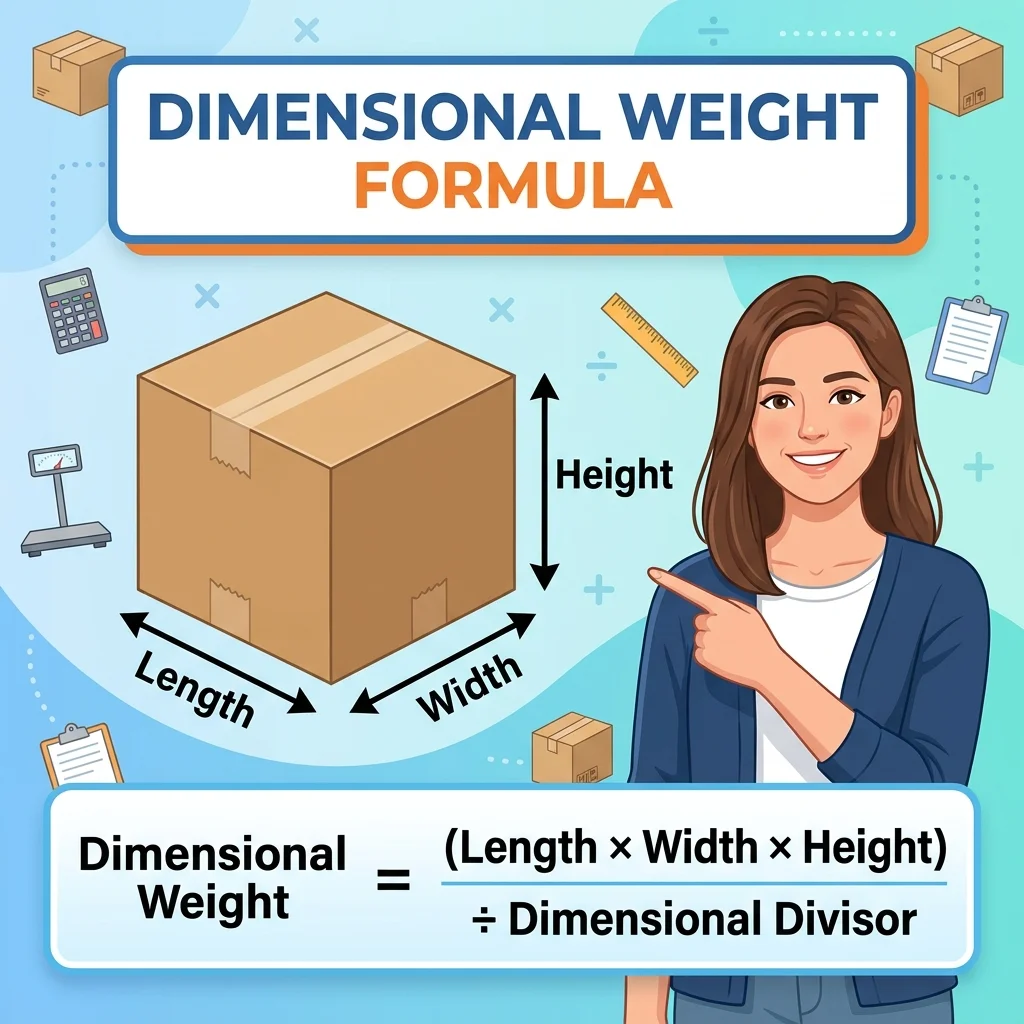
The basic dimensional weight formula is:
Dimensional Weight = (Length × Width × Height) ÷ Divisor
The calculation depends on the measurement system you use.
Dimensional Weight Formula in Inches
When dimensions are measured in inches and the result is required in pounds, use:
[
\text{DIM Weight (lb)} =
\frac{L \times W \times H}{\text{Divisor}}
]
For example, suppose a package measures:
- Length: 18 inches
- Width: 14 inches
- Height: 10 inches
- Divisor: 139
First, calculate the cubic volume:
18 × 14 × 10 = 2,520 cubic inches
Next, divide by 139:
2,520 ÷ 139 = 18.13 pounds
If the carrier requires rounding up to the next whole pound, the dimensional weight becomes 19 pounds.
The rounding rule matters. Do not assume every carrier or service handles fractions in exactly the same way.
Dimensional Weight Formula in Centimeters
For measurements in centimeters and a result in kilograms, a commonly used formula is:
[
\text{Volumetric Weight (kg)} =
\frac{L \times W \times H}{5000}
]
For example, imagine a parcel measuring:
- Length: 40 cm
- Width: 30 cm
- Height: 20 cm
- Divisor: 5,000
Calculate its volume:
40 × 30 × 20 = 24,000 cubic centimeters
Divide by 5,000:
24,000 ÷ 5,000 = 4.8 kg
The result is a volumetric weight of 4.8 kg before any carrier-specific rounding.
DHL Express Pakistan’s 2026 service and rate guide describes this calculation using centimeters and a divisor of 5,000. It also explains that DHL may reweigh or remeasure a shipment to verify the information supplied by the sender.
How to Use a Dimensional Weight Calculator

You only need a few details to calculate DIM weight.
Measure the Package
Measure the outside of the fully packed box. Include any bulges, protruding packaging, or other parts that affect its overall size.
Record the length, width, and height. Use the measurement unit required by your carrier.
For a rectangular box, length is usually the longest side. Width and height describe the other two sides.
Select the Measurement Unit
Choose inches if you are calculating in pounds. Choose centimeters if you are calculating in kilograms and using a compatible metric divisor.
Do not mix measurement systems. For example, do not enter dimensions in centimeters and divide by a divisor intended for cubic inches.
Choose the Correct Divisor
The divisor depends on the carrier and service.
Some commonly published examples include:
| Carrier or calculation method | Example divisor | Measurement system |
| FedEx U.S. dimensional weight | 139 | Cubic inches ÷ pounds |
| UPS Daily Rates | 139 | Cubic inches ÷ pounds |
| UPS Retail Rates | 166 | Cubic inches ÷ pounds |
| DHL Express | 5,000 | Cubic centimeters ÷ kilograms |
These figures are examples from published carrier guidance, not a universal list of rates for every shipment. UPS specifically states that its divisor varies by rate type. FedEx publishes a divisor of 139 for its U.S. dimensional weight calculation. DHL Express Pakistan’s 2026 guide uses 5,000 for measurements in centimeters. Check the rules for your exact service and account before relying on a result.
Enter the Package Dimensions
Enter the length, width, and height into the calculator.
Check that you have entered the outside dimensions rather than the product’s measurements before packaging.
Calculate the DIM Weight
Multiply the three measurements and divide the result by the selected divisor.
For example:
22 × 16 × 14 = 4,928 cubic inches
4,928 ÷ 139 = 35.45 pounds
If the applicable rule requires rounding up to the next whole pound, the result is 36 pounds.
Compare DIM Weight With Actual Weight
Weigh the fully packed parcel on a suitable scale.
Suppose the actual weight is 12 pounds and the calculated dimensional weight is 36 pounds. The dimensional weight is higher, so it may become the billable weight under the carrier’s rules.
This comparison is the most important part of the process.
Dimensional Weight vs. Actual Weight
Actual weight and dimensional weight measure two different things.
Actual weight is how much the package physically weighs on a scale. It includes the product, box, protective materials, and other packing supplies.
Dimensional weight estimates the package’s weight based on the space it occupies.
Here is a simple comparison:
| Measurement | Example result |
| Package dimensions | 22 × 16 × 14 inches |
| Actual weight | 12 lb |
| Cubic volume | 4,928 cubic inches |
| Divisor | 139 |
| Dimensional weight before rounding | 35.45 lb |
| Example rounded DIM weight | 36 lb |
The actual weight is 12 pounds, but the dimensional weight is approximately 36 pounds before carrier rounding.
A carrier that uses the greater of actual and dimensional weight may charge based on 36 pounds.
However, the exact billable weight depends on the carrier’s service rules, account agreement, and any applicable minimums or adjustments.
What Is Billable Weight?
Billable weight is the weight a carrier uses to calculate a shipment’s transportation charge.
For many parcel services, the carrier compares actual weight with dimensional weight and uses the higher figure.
A simplified formula is:
[
\text{Billable Weight} =
\max(\text{Actual Weight}, \text{Dimensional Weight})
]
Consider two packages:
| Detail | Package A | Package B |
| Actual weight | 8 lb | 30 lb |
| DIM weight | 20 lb | 18 lb |
| Higher weight | 20 lb | 30 lb |
| Likely billable weight | 20 lb | 30 lb |
Package A is light but takes up considerable space. Package B is heavier but more compact.
This explains why a small package can sometimes cost less to ship than a larger package with the same actual weight.
Remember that this is a simplified comparison. Some services have special rules for minimum billable weight, rounding, package dimensions, or additional handling.
Dimensional Weight Rules for Major Shipping Carriers
Different carriers use different rules. Even when two companies use similar formulas, their measurement and rounding requirements may not match.
FedEx Dimensional Weight Calculator
FedEx uses dimensional weight to account for the space a package occupies. Its U.S. guidance explains that customers calculate cubic inches and divide by 139. FedEx also says to round each dimension to the nearest whole inch before calculating the package’s cubic size.
For example, consider a box measuring 20 × 15 × 12 inches.
20 × 15 × 12 = 3,600 cubic inches
3,600 ÷ 139 = 25.90 pounds
If the applicable rule requires rounding up, the DIM weight is 26 pounds.
Compare this result with the actual weight. If the package weighs 10 pounds, the dimensional weight may be used for rating.
FedEx advises shippers to include all package dimensions when creating a shipment. It also reserves the right to reweigh and remeasure packages. The final rated weight and charge should be checked against the applicable FedEx Service Guide and customer agreement.
UPS Dimensional Weight Calculator
UPS calculates dimensional weight by multiplying the package’s length, width, and height, then dividing by the applicable divisor.
Its U.S. guidance identifies different divisors for different rate types:
- Daily Rates: 139
- Retail Rates: 166
UPS instructs customers to measure from the longest points and round each measurement to the nearest whole inch. It also says to increase a fractional dimensional weight to the next whole pound.
For example, a 24 × 18 × 16-inch package has a volume of:
24 × 18 × 16 = 6,912 cubic inches
Using a divisor of 139:
6,912 ÷ 139 = 49.73 pounds
Using a divisor of 166:
6,912 ÷ 166 = 41.64 pounds
The results differ because the divisor differs. The correct calculation depends on the UPS rate type that applies to the shipment.
USPS Dimensional Weight
USPS dimensional weight rules are service-specific. They should not be treated as identical to the rules used by FedEx, UPS, or DHL.
USPS explains that dimensional weight pricing can apply to qualifying domestic packages larger than one cubic foot (1,728 cubic inches). Its published guidance describes using a divisor of 139 and rounding measurements up to whole inches for the applicable services and conditions.
For example, a package measuring 24 × 18 × 16 inches has a volume of:
24 × 18 × 16 = 6,912 cubic inches
6,912 ÷ 139 = 49.73 pounds
Under a rule requiring the dimensional result to be rounded up, that would be 50 pounds.
However, do not assume this rule applies to every USPS package. Check the current USPS service, package size, destination, and pricing conditions before calculating postage.
DHL Express Volumetric Weight
DHL Express commonly uses a divisor of 5,000 when calculating volumetric weight in kilograms from centimeters.
The formula is:
[
\text{Volumetric Weight (kg)} =
\frac{L \times W \times H}{5000}
]
Suppose a parcel measures 45 × 35 × 25 centimeters.
45 × 35 × 25 = 39,375 cubic centimeters
39,375 ÷ 5,000 = 7.875 kg
If the package’s actual weight is 5 kg, the volumetric weight is higher. The shipment may therefore be rated using its volumetric weight, subject to DHL’s applicable rules.
DHL’s 2026 Pakistan guide uses the 5,000 divisor and states that shipments may be reweighed or remeasured. Always check the guide for the origin country and service you plan to use.
Practical Dimensional Weight Calculation Examples
The following examples show how package size affects dimensional weight. They use illustrative divisors and rounding assumptions to demonstrate the mathematics. They are not shipping quotes.
Example: Small Lightweight Package
Suppose a parcel measures 12 × 10 × 8 inches.
Actual weight: 4 pounds
Assumed divisor: 139
First, calculate the volume:
12 × 10 × 8 = 960 cubic inches
Then divide:
960 ÷ 139 = 6.91 pounds
If the applicable rule rounds up to the next whole pound, the dimensional weight is 7 pounds.
Since 7 pounds is greater than the actual weight of 4 pounds, the carrier may use 7 pounds as the billable weight.
Example: Medium-Sized Package
Imagine a box with these measurements:
- Length: 18 inches
- Width: 14 inches
- Height: 12 inches
- Actual weight: 15 pounds
- Assumed divisor: 139
18 × 14 × 12 = 3,024 cubic inches
3,024 ÷ 139 = 21.76 pounds
With upward rounding, the dimensional weight is 22 pounds.
The package’s actual weight is 15 pounds, so its dimensional weight is higher.
Example: Large but Lightweight Package
A large box measures 30 × 20 × 15 inches and weighs 20 pounds.
Using a divisor of 139:
30 × 20 × 15 = 9,000 cubic inches
9,000 ÷ 139 = 64.75 pounds
If the carrier rounds up, the DIM weight becomes 65 pounds.
The box physically weighs only 20 pounds. However, its size may cause the carrier to rate it at 65 pounds.
This is why oversized packaging can increase shipping expenses.
Example: International Shipment in Centimeters
Suppose you are sending a package measuring 60 × 40 × 30 centimeters.
Actual weight: 10 kg
Assumed divisor: 5,000
60 × 40 × 30 = 72,000 cubic centimeters
72,000 ÷ 5,000 = 14.4 kg
The volumetric weight is 14.4 kg. Since it is higher than the actual weight of 10 kg, the shipment may be rated using the volumetric weight.
Confirm the divisor and rounding policy with the carrier before booking.
How to Measure a Package Correctly
Accurate measurements are essential for a reliable dimensional weight calculation.
A small mistake can change the calculated weight, especially when a package is close to a rounding threshold.
Follow these steps:
Measure the outside of the packed box. Do not measure only the product. Include the packaging materials and any protruding sections.
Find the longest side. Use this as the length.
Measure the other two sides. Record the width and height.
Check unusual shapes. If the package is irregular, follow the carrier’s instructions for measuring its extreme points or enclosing dimensions.
Use the correct unit. Record inches or centimeters according to the formula and divisor.
Measure every parcel separately. For a shipment containing several boxes, do not assume all packages have the same dimensions.
UPS specifically instructs customers to measure irregular packages as if they were inside a rectangular box, using their extreme points.
Common Dimensional Weight Calculation Mistakes
Even a good calculator cannot produce a reliable result when the measurements or divisor are wrong.
Using the Wrong Divisor
This is one of the most important mistakes to avoid.
A divisor of 139 does not automatically apply to every carrier or service. UPS, for example, publishes different divisors for Daily and Retail Rates.
Always confirm the applicable divisor before calculating.
Mixing Inches and Centimeters
The formula must match the measurement system.
For example, dividing cubic centimeters by 139 will not produce a correct kilogram result. The commonly used metric calculation with DHL Express uses centimeters and a divisor of 5,000.
Measuring the Product Instead of the Box
Carriers rate the package they handle, not just the item inside it.
If a product measures 10 × 8 × 5 inches but its packed box measures 14 × 12 × 9 inches, use the larger outside measurements.
Ignoring Rounding Rules
Carriers may require dimensions or calculated weight to be rounded in specific ways.
UPS, for example, says to round each dimension to the nearest whole inch and increase a fractional DIM weight to the next whole pound. Other carriers may use different instructions.
Follow the relevant service guide rather than applying one rounding rule to every shipment.
Using the Same Measurements for Every Box
Two packages containing the same product may have different dimensions because of different packaging materials or box sizes.
Measure each packed parcel separately.
Forgetting to Compare Actual and Dimensional Weight
Calculating DIM weight is only one part of the process.
You also need the actual weight to estimate which figure the carrier may use for billing.
How to Reduce Dimensional Weight and Shipping Costs
You cannot always change a product’s size, but you can often reduce unnecessary packaging space.
Choose the Right Box Size
Use a box that fits the product without leaving excessive empty space.
A box that is much larger than its contents can increase dimensional weight. However, do not choose packaging so small that it fails to protect the product.
Use Protective Materials Efficiently
Bubble wrap, paper, foam, and air pillows protect products during transportation. Use enough to prevent damage, but avoid adding unnecessary layers.
The goal is to balance protection with package size.
Consider Custom Packaging
If you regularly ship products with unusual dimensions, custom-sized packaging may reduce unused space.
For an online store that ships the same product many times, even a small reduction in box dimensions can make a meaningful difference across a large number of orders.
Review Product Packaging
Some products come in oversized retail boxes. If the packaging can be changed without affecting product safety, consider a more compact design.
Check whether removing or changing retail packaging affects warranties, presentation, or product protection.
Compare Carrier Services
Different services may use different DIM factors, pricing structures, and package limits.
Compare the final quotes rather than choosing a carrier based only on its advertised base rate.
Test Several Package Sizes
Calculate the dimensional weight of different box options before choosing one.
For example, a product may fit safely in either a 20 × 15 × 12-inch box or an 18 × 14 × 10-inch box. The smaller option has a lower cubic volume and may produce a lower dimensional weight.
Never sacrifice safe packaging just to reduce shipping costs.
Why Dimensional Weight Matters for eCommerce Businesses
Dimensional weight is especially important for online stores because shipping costs directly affect profit margins.
A seller may price a product based on its physical weight and overlook the cost of the packaging. That can lead to inaccurate shipping estimates and lower profits.
For example, a store selling lightweight home accessories may ship products in large boxes. The actual weight might be low, but the DIM weight could be much higher.
A dimensional weight calculator helps sellers:
- Estimate shipping costs before listing a product.
- Choose more efficient packaging.
- Compare courier services.
- Set more realistic delivery charges.
- Reduce unexpected carrier adjustments.
- Review the profitability of different product sizes.
If you ship orders regularly, record the dimensions and actual weight of your most common packages. This makes it easier to estimate costs when customers place orders.
Dimensional Weight for International Shipping
International shipments often travel by air, where cargo space is limited. As a result, volumetric weight can play an important role in determining shipping charges.
For many international express shipments, carriers compare actual weight with volumetric weight and use the applicable chargeable-weight rules.
For example, a parcel measuring 50 × 40 × 30 centimeters has a volume of:
50 × 40 × 30 = 60,000 cubic centimeters
Using a divisor of 5,000:
60,000 ÷ 5,000 = 12 kg
If its actual weight is 8 kg, the volumetric weight is higher.
However, international shipping prices can also depend on destination, service level, customs requirements, fuel surcharges, duties, and other fees. DIM weight is only one part of the final cost.
For international shipments from Pakistan, check the current service and rate guide for the carrier and route you intend to use. DHL Express Pakistan publishes a country-specific 2026 guide with its shipment preparation and volumetric-weight instructions.
Dimensional Weight vs. Volumetric Weight vs. Cubic Weight
These terms are closely related and are often used to describe the same basic concept: calculating a shipment’s weight from the space it occupies.
| Term | Meaning |
| Dimensional weight | A calculated weight based on package dimensions |
| DIM weight | Short form of dimensional weight |
| Volumetric weight | Common term for the same type of calculation |
| Cubic weight | A term that may describe volume-based weight, depending on the carrier or service |
| Actual weight | The physical weight measured on a scale |
| Billable weight | The weight used to calculate the shipping charge |
Although the terminology can overlap, a carrier may define particular services or rating methods differently. Use the terminology and formula in the carrier’s current shipping guide.
When Should You Use a Dimensional Weight Calculator?
A dimensional weight calculator is useful whenever package size could affect the price of delivery.
You should consider using one when:
- Shipping large, lightweight products.
- Comparing courier prices.
- Preparing international parcels.
- Selling products through an online store.
- Estimating fulfillment costs.
- Choosing between different box sizes.
- Reviewing unexpected shipping adjustments.
- Planning packaging for a new product.
It is particularly useful before you publish shipping rates on an eCommerce website. You can estimate the likely shipping weight for common package sizes instead of relying only on the product’s actual weight.
Frequently Asked Questions
What Is the Formula for Dimensional Weight?
The general formula is length multiplied by width multiplied by height, divided by the carrier’s dimensional weight divisor.
For inches and pounds, one commonly used formula is:
DIM weight = (L × W × H) ÷ 139
For centimeters and kilograms, a commonly used express-shipping formula is:
Volumetric weight = (L × W × H) ÷ 5,000
The correct divisor depends on the carrier and service.
How Do I Calculate Dimensional Weight in Pounds?
Measure the package in inches. Multiply length by width by height, then divide the result by the applicable divisor.
For example, a 20 × 15 × 12-inch package has a volume of 3,600 cubic inches.
Using a divisor of 139:
3,600 ÷ 139 = 25.90 pounds.
If the applicable carrier rule requires rounding up, the result is 26 pounds.
How Do I Calculate Dimensional Weight in Kilograms?
Measure the package in centimeters. Multiply the three dimensions and divide by the applicable metric divisor.
For example:
40 × 30 × 20 = 24,000 cubic centimeters
24,000 ÷ 5,000 = 4.8 kg
This divisor is used in DHL Express Pakistan’s 2026 guide. Confirm the correct factor for your carrier and service.
Is Dimensional Weight Always Higher Than Actual Weight?
No. It depends on the size and physical weight of the package.
A compact, heavy parcel may have a higher actual weight. A large, lightweight box may have a higher dimensional weight.
The carrier’s billable-weight rules determine which figure is used.
What Is a Dimensional Weight Divisor?
A dimensional weight divisor is the number used to convert package volume into a calculated weight.
For example, dividing 3,600 cubic inches by 139 gives approximately 25.90 pounds.
Different carriers and services may use different divisors.
Does UPS Use 139 or 166 for Dimensional Weight?
UPS’s U.S. guidance identifies 139 for Daily Rates and 166 for Retail Rates. The applicable divisor depends on the rate type and shipment details. Check the current UPS guidance before booking.
Does FedEx Use Dimensional Weight?
Yes. FedEx uses dimensional weight to account for the space a package occupies. Its U.S. guidance explains the calculation using a divisor of 139 and instructs customers to round each measurement to the nearest whole inch.
Does USPS Charge by Dimensional Weight?
USPS applies dimensional-weight pricing to qualifying packages under specific services and conditions. Its guidance describes a one-cubic-foot threshold for applicable domestic packages and a divisor of 139. Check the current USPS rules for the exact service and shipment.
What Is the Difference Between DIM Weight and Billable Weight?
DIM weight is calculated from package dimensions. Billable weight is the figure used to calculate the shipping charge.
For services that compare actual and dimensional weight, the higher figure generally determines the billable weight, subject to the carrier’s rating rules.
Can I Reduce Dimensional Weight?
Yes, in some cases. Choose a smaller box, remove unnecessary empty space, and use protective materials efficiently.
The package must still protect its contents and meet the carrier’s packaging requirements.
Do I Need to Calculate Every Package Separately?
If a shipment contains multiple packages, calculate the dimensions and weight of each piece separately when the carrier’s rules require per-piece rating. Do not assume that every box has the same DIM weight.
Final Thoughts
A dimensional weight calculator helps you understand how package size can affect shipping costs. It uses length, width, height, and a carrier-specific divisor to estimate dimensional weight. You then compare that result with the package’s actual weight to estimate the weight that may be used for billing.
The most important steps are simple: measure the fully packed parcel, choose the correct measurement system, confirm the carrier’s divisor, and follow its rounding rules. For online sellers, regular shippers, and international customers, these calculations can help prevent surprises and identify opportunities to use more efficient packaging. Before paying for a shipment, confirm the final price and billable weight with the carrier’s official shipping tool.

I am Daniel Scott, a passionate writer dedicated to creating meaningful and engaging content that informs, inspires, and connects with readers worldwide. I am passionate about exploring ideas, sharing knowledge, and presenting stories with clarity and creativity. My writing focuses on delivering valuable insights through well-researched articles and thoughtful perspectives. I am committed to maintaining accuracy, originality, and a reader-first approach in every piece I create.