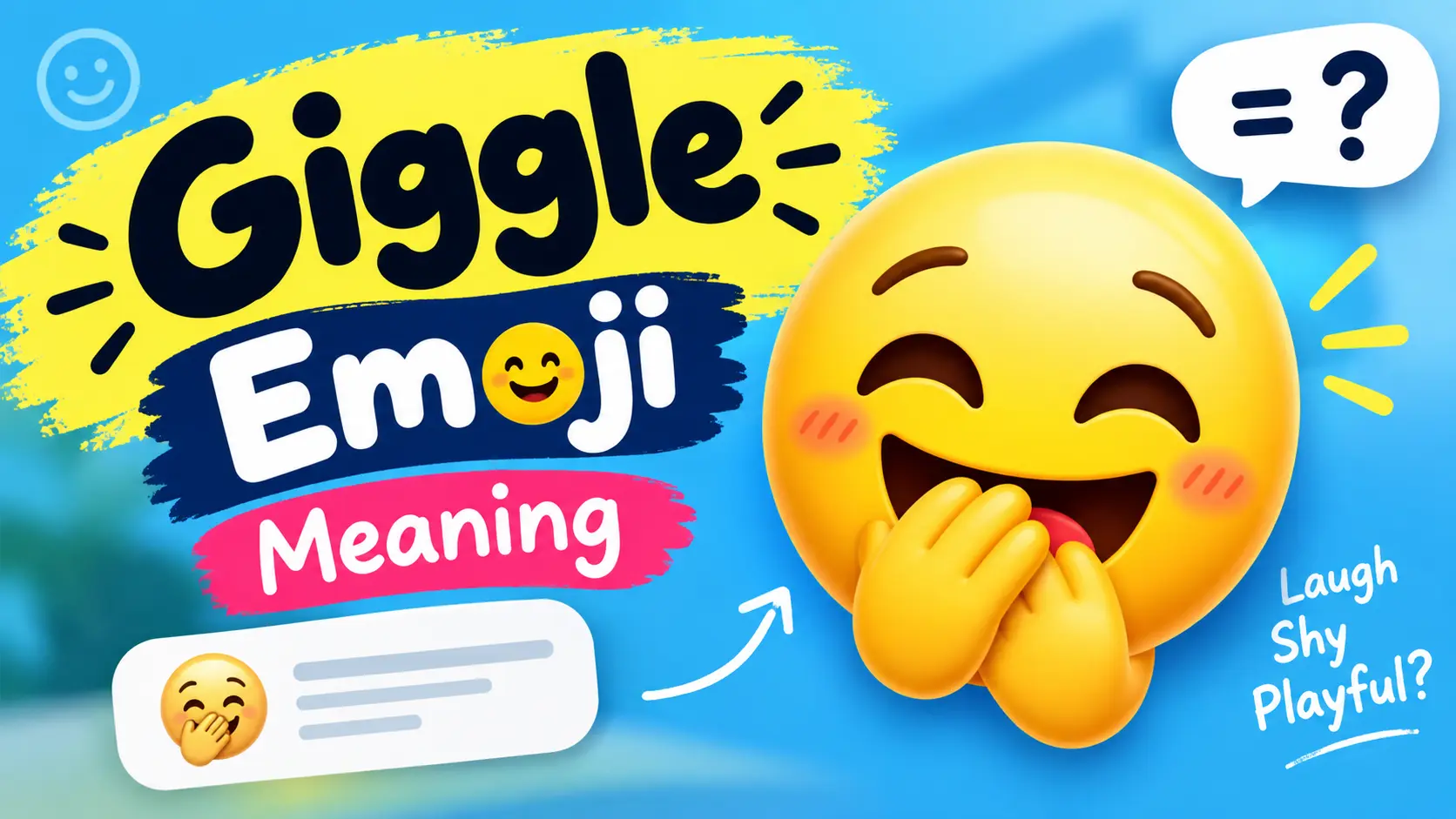
A small giggle emoji can completely change the feeling of a text message. Instead of sounding too serious or straightforward, it can make a conversation feel lighter, funnier, or more playful.
The giggle emoji meaning usually depends on the emoji being used and the situation around it. Someone may send it because they found your message funny, feel a little shy, or want to show that they are joking.
You might see a giggle-style emoji in texts, WhatsApp chats, Instagram messages, Snapchat, TikTok comments, or casual conversations with friends. Its meaning can also change when it comes from a guy, girl, friend, crush, or someone you have just started talking to.
Meaning & Definition
The giggle emoji is officially called Face with Hand Over Mouth (Unicode name: Smiling Face with Smiling Eyes and Hand Covering Mouth). It shows a yellow face with smiling or slightly squinted eyes and a hand covering the mouth.
Its primary meaning in texting and social media is coy, suppressed laughter or a playful “teehee” / “oops” reaction. It signals light amusement you’re trying (or pretending) to hide, mild embarrassment, or something cheeky you almost shouldn’t say out loud.
Secondary meanings include:
- Feigned innocence or “Who, me?”
- Sharing gossip (“spilling the tea”)
- Soft flirting or teasing
- Light shade or polite mockery
- Keeping a secret or reacting to something slightly naughty
Examples in messages:
- “You will never guess who I saw at the club last night 🤭”
- “Oops, did I just say that out loud? 🤭”
- “Who me? I have no idea what you’re talking about 🤭”
Background & Origin
The giggle emoji was approved as part of Unicode 10.0 and added to Emoji 5.0 in June 2017. It joined a wave of more nuanced face emojis designed to capture subtle social emotions beyond basic happiness or sadness.
It became popular because the hand-over-mouth gesture is almost universal: people cover their mouths when laughing politely, feeling shy, or trying not to burst out. Early platform designs varied a lot. Apple’s version originally showed open eyes (more like shock or “oh my”), while most others showed smiling eyes (true giggle energy). This mismatch caused real confusion, most famously in 2020 when a celebrity post was read as mocking on non-Apple devices. In 2022, Unicode introduced a separate emoji (🫢 Face with Open Eyes and Hand Over Mouth) for pure shock, and Apple updated 🤭 to the smiling/giggling look that most people now expect.
Usage in Different Contexts
Texting or chat messages
Perfect for soft reactions. It softens a statement or shows you’re amused without full-on laughing.
Example: “I almost texted my boss the wrong name 🤭”
Social media platforms
Used in captions, comments, and Stories for gossip, coquette vibes, or playful shade. Often paired with ☕ for “tea.”
Example: “Not them thinking nobody noticed 🤭☕”
Professional or technical settings
Rare and risky. It can come across as unprofessional or dismissive in work chats. Use only in very casual team spaces if the culture is light.
Example (casual Slack only): “I may have replied-all by accident 🤭”
Platform-Specific Meanings
| Platform | Common Meaning | Example Use |
| Coy laugh, mild embarrassment, teasing | “Forgot to mute myself on the call 🤭” | |
| Gossip, coquette energy, soft shade | Story reply: “The tea is piping 🤭” | |
| TikTok | Playful reaction, “teehee,” meme replies | Comment: “This is so me 🤭” |
| Snapchat | Flirty or secretive reaction | Snap caption: “Don’t tell anyone 🤭” |
| Twitter/X | Shade, irony, or light mockery | “Interesting take 🤭” |
Other Fields Using the Abbreviation
While 🤭 is primarily a digital emoji, the concept of a “giggle” appears elsewhere:
- Streaming and Discord culture (related emotes like “gigl” from Peepo/Apu variants for wholesome chuckles)
- Kaomoji and text art: ( ˶ˆ꒳ˆ˵ ), teehee, hehe
- No major technical, medical, or official abbreviations directly use “giggle emoji,” but the gesture itself shows up in design and accessibility descriptions as “face with hand over mouth”
Common Misconceptions & Mistakes
People often confuse 🤭 with 🫢 (the open-eyed shock version). One is giggly and coy; the other is pure gasp or disbelief. Older users sometimes read it as pure laughter (like 😂), while younger users may see shade or irony. Using it in serious or sympathetic messages can land wrong, someone might think you’re laughing at them instead of with them. Platform design differences used to cause major mix-ups, so context still matters.
Similar Terms & Alternatives
- 😂 Face with Tears of Joy , Full, loud laughter
- 🤣 Rolling on the Floor Laughing , Even more intense hilarity
- 😆 Grinning Squinting Face , Open, happy chuckle
- 🙊 Speak-No-Evil Monkey , Similar “keeping quiet” or embarrassed vibe
- 🤐 Zipper-Mouth Face , Stronger “I won’t say anything”
- Text versions: “teehee,” “hehe,” “lolz,” “( ˶ˆ꒳ˆ˵ )”
How to Respond , Chat Examples
With a friend:
Them: “I just walked into the wrong meeting room 😭”
You: “No way 🤭 Tell me everything”
With a crush:
Them: “You looked cute today btw”
You: “Stoppp 🤭 You’re making me blush”
With a colleague (casual chat):
Them: “I may have accidentally hit reply-all…”
You: “We’ve all been there 🤭 Hope it wasn’t too bad”
Differences from Similar Words
Unlike saying something is “secret,” “private,” or “confidential,” the giggle emoji doesn’t claim actual privacy. It performs the idea of holding something back while still sharing the vibe. It’s lighter and more social than serious secrecy, more “I’m pretending to hide this laugh” than “this stays between us.” The nuance is playful performance rather than real restriction.
Relevance in Online Conversations & Dating Apps
On dating apps the giggle emoji is gold for soft flirting. It signals interest without being too intense: a gentle “teehee” that invites more conversation. In casual social media it keeps tone light, helps gossip feel fun rather than mean, and lets people react without full commitment to a stronger laugh emoji.
Example on a dating app:
“Your dog is honestly the cutest 🤭”
Or: “Okay that was smooth 🤭”
Popularity & Trends Over Time
Since its 2017 debut the giggle emoji has stayed steadily useful rather than exploding like 😂 once did. It fits Gen Z and millennial styles of soft irony, coquette aesthetics, and “mean girl but make it cute” energy. Search interest for its meaning remains consistent because new users keep discovering the subtle difference from louder laugh faces. Meme culture and TikTok keep it relevant for reactions that need a little mystery.
FAQs
What does the giggle emoji really mean?
It usually means coy or suppressed laughter, mild embarrassment, playful teasing, or “oops I said that.”
Is 🤭 the same as laughing out loud?
No. It’s quieter and more restrained than 😂 or 🤣. Think polite or mischievous giggle, not full hysterics.
Can I use the giggle emoji at work?
Only in very casual settings. In formal messages it can seem unprofessional or sarcastic.
What’s the difference between 🤭 and 🫢?
🤭 = smiling eyes, giggle/coy energy. 🫢 = wide open eyes, pure shock or gasp.
Why do people use it when sharing gossip?
The hand-over-mouth look matches the feeling of “I shouldn’t say this… but here it is anyway.”
Conclusion
The giggle emoji (🤭) is the digital version of covering your mouth while you laugh or almost say something you shouldn’t. It works for soft amusement, light embarrassment, flirty teasing, and gentle shade across texting, social media, and dating apps.
Context is everything, read the conversation around it and you’ll almost always land on the right vibe. Next time it shows up, you’ll know exactly what kind of playful energy is being sent your way.

I am James Carter, a passionate writer dedicated to creating informative, engaging, and valuable content for readers. I enjoy exploring different topics, researching new ideas, and sharing knowledge through clear and meaningful writing. I am committed to providing accurate information, helpful insights, and well-crafted articles that inspire and educate audiences. With a strong focus on quality and creativity, I aim to connect with readers and deliver content that adds real value.