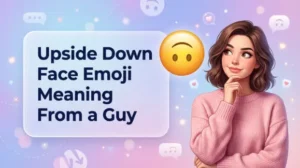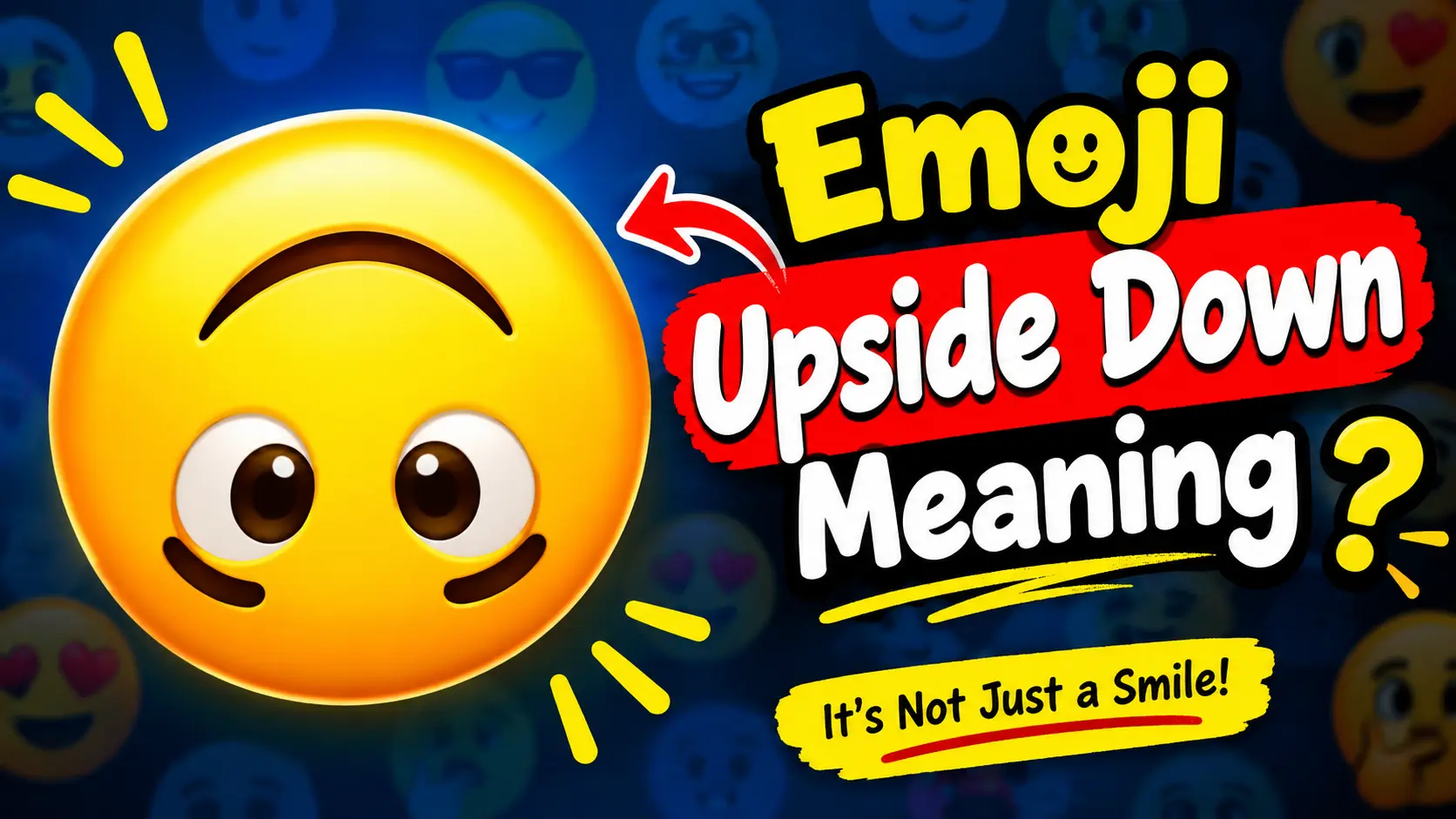
Sometimes, a single emoji can say what several sentences cannot. The upside-down face 🙃 is a perfect example because its meaning can change depending on the mood and situation.
If someone sends you this emoji, they may be joking, feeling awkward, hiding frustration, or simply trying to make a strange situation sound less serious. This is why understanding the Emoji Upside Down Meaning requires a little context.
You may notice 🙃 in text messages, WhatsApp chats, Instagram comments, Snapchat conversations, and other social media posts. A friend might use it after making a sarcastic comment, while someone else could send it when things are not going as planned but they are trying to laugh about it.
Meaning & Definition
The 🙃 Upside-Down Face (also called the upside-down smiley) is a classic yellow smiling face turned completely upside down. Its primary meaning in texting and social media is sarcasm, irony, or playful silliness. It often signals that the words before it should not be taken at face value.
Secondary meanings include mild frustration, awkwardness, resignation (“oh well”), passive-aggression, or “smiling through the pain.” It can also simply mark goofiness or a light “just kidding” tone.
Examples:
- “Can’t wait for another 8 a.m. meeting 🙃” (pure sarcasm)
- “I just walked into the wrong Zoom room 🙃” (embarrassed humor)
Background & Origin
The 🙃 emoji was officially approved as part of Unicode 8.0 in 2015 and added to Emoji 1.0 the same year. Early versions appeared on Google platforms (including Gmail) as far back as 2008, inspired by Japanese kaomoji and existing smiley designs. Once smartphones made emoji standard, the upside-down face quickly filled a gap: it let people show that a statement was the opposite of sincere without typing “/s” or “jk.” Its popularity grew with the rise of dry internet humor and meme culture.
Usage in Different Contexts
Texting or chat messages
People use it to soften complaints or add dry humor.
Example: “My package got delayed again 🙃”
Social media platforms
It appears in captions and comments to flag irony or self-deprecation.
Example: “Just spent $40 on coffee this week 🙃 #priorities”
Professional or technical settings
It is less common in formal emails but shows up in Slack or Teams among close colleagues to express resigned frustration.
Example: “The client moved the deadline to Friday 🙃”
Platform-Specific Meanings
| Platform | Common Meaning | Example Use |
| Sarcasm or light frustration | “Traffic is amazing today 🙃” | |
| Ironic or self-deprecating caption | “Another failed recipe attempt 🙃” | |
| TikTok | Playful chaos or “this is fine” energy | Comment on a messy video: “Me every morning 🙃” |
| Snapchat | Awkwardness or teasing | After a blurry selfie: “Peak content 🙃” |
| Twitter/X | Dry sarcasm or resignation | “The algorithm is working perfectly 🙃” |
Other Fields Using the Abbreviation
While 🙃 is almost exclusively an emoji, the phrase “upside down” appears in other contexts:
- Literal descriptions (something physically inverted)
- Figurative language (“my world is upside down”)
- Technical design or UI discussions about flipped elements
It has no widespread official abbreviation use in medicine, law, or tech beyond the emoji itself.
Common Misconceptions & Mistakes
Many people first assume 🙃 is just a happy face turned the wrong way and means genuine positivity. In reality, it frequently means the opposite. Confusing it with a regular 🙂 can lead to missing sarcasm or passive-aggression. Another pitfall is using it in very formal or serious conversations where it may come across as unprofessional or dismissive.
Similar Terms & Alternatives
- 🙂 Slightly Smiling Face , neutral or polite positivity
- 😏 Smirking Face , smug or flirtatious
- 😅 Grinning Face with Sweat , nervous relief
- 🤷 Person Shrugging , “whatever / I don’t know”
- ¯\_(ツ)_/¯ (shruggie kaomoji) , similar resigned tone
How to Respond , Chat Examples
With a friend
Friend: “I burned dinner again 🙃”
You: “Classic. Pizza it is 😂”
With a crush
Crush: “You left me on read for 3 hours 🙃”
You: “Worth the wait though? 😉”
With a colleague
Colleague: “They just added three more items to the agenda 🙃”
You: “Of course they did. Coffee run after?”
Differences from Similar Words
Unlike saying something is “secret,” “private,” or “confidential,” the 🙃 emoji does not hide information. It flips the emotional tone. A regular smile suggests goodwill; the upside-down version often suggests the goodwill is ironic or forced. It sits closer to dry humor or quiet frustration than to genuine secrecy or formality.
Relevance in Online Conversations & Dating Apps
On dating apps the 🙃 emoji keeps conversations light and playful. It can signal teasing, mild embarrassment, or “I’m joking but also kind of serious.”
Example: “I’d never steal the blankets… 🙃”
It helps people test the waters without sounding too intense, which is why it shows up frequently in early chats and Stories.
Popularity & Trends Over Time
Since its 2015 debut, 🙃 has remained consistently popular. It thrives in meme culture and “this is fine” style posts. Search interest stays steady whenever people encounter the emoji in group chats or viral captions, reflecting its role as a go-to tool for digital irony.
FAQs
What does the upside down emoji mean in text?
It usually means sarcasm, irony, silliness, or mild frustration depending on context.
Is 🙃 flirty?
It can be, especially when paired with teasing or self-deprecating messages.
Does 🙃 mean someone is mad?
Not always angry, but often annoyed or resigned while still smiling on the surface.
Can I use 🙃 at work?
Only with people who know your sense of humor; otherwise it may read as passive-aggressive.
What’s the difference between 🙂 and 🙃?
🙂 is generally sincere or polite. 🙃 often signals the opposite of the words it follows.
Conclusion
The emoji upside down meaning centers on irony, sarcasm, silliness, and that familiar feeling of smiling while everything feels slightly off. Whether it appears in a late-night text, an Instagram caption, or a Slack reply, context is everything.
Next time you see 🙃, read the words around it, then decide if the sender is joking, coping, or quietly saying “this is fine.” Understanding the flip helps you keep online conversations clear, funny, and a little more human.

I am Daniel Scott, a passionate writer dedicated to creating meaningful and engaging content that informs, inspires, and connects with readers worldwide. I am passionate about exploring ideas, sharing knowledge, and presenting stories with clarity and creativity. My writing focuses on delivering valuable insights through well-researched articles and thoughtful perspectives. I am committed to maintaining accuracy, originality, and a reader-first approach in every piece I create.