
Hiroshi Mikitani and James Gorman are two influential figures in international business whose careers demonstrate different approaches to leadership, innovation, and organizational growth. Hiroshi Mikitani is best known for founding Rakuten Group, a Japanese digital services company, while James Gorman is recognized for his leadership of Morgan Stanley, one of the world’s major financial services firms.
Although their professional backgrounds differ, both executives have helped shape major organizations through long-term strategic decisions. Mikitani built a business around online commerce and expanded it into financial technology, mobile communications, travel, and digital services. Gorman led an established financial institution through a period of strategic development, emphasizing wealth management, business diversification, and organizational stability.
Their careers provide useful lessons for entrepreneurs, corporate executives, business students, and readers interested in international business leadership. By examining their backgrounds, achievements, challenges, and management philosophies, it becomes possible to understand how successful leaders adapt their strategies to different industries.
Who Is Hiroshi Mikitani?
Hiroshi Mikitani is a Japanese entrepreneur and business executive who founded Rakuten in February 1997. He serves as the company’s chairman and chief executive officer. Before establishing Rakuten, he worked at the Industrial Bank of Japan and earned an MBA from Harvard Business School in 1993. His professional background combined financial experience with an interest in entrepreneurship and emerging technology. Source: Rakuten’s official leadership biography.
During the 1990s, commercial internet services were still developing, and many businesses were only beginning to understand the potential of online shopping. Mikitani recognized that the internet could help smaller merchants reach customers beyond their immediate communities.
His idea was not simply to create another online retailer. Instead, he wanted to build a marketplace where different merchants could establish their own digital stores and develop relationships with customers.
This approach became the foundation of Rakuten’s business model. By providing a shared platform, the company gave merchants opportunities to sell products online without having to build an entire e-commerce system independently.
Mikitani’s entrepreneurial journey demonstrates how identifying an underserved market can create opportunities for business growth. His experience also shows that successful entrepreneurship requires more than an original idea. It involves understanding customers, developing a sustainable business model, investing in technology, and adapting to changing market conditions.
How Hiroshi Mikitani Built Rakuten
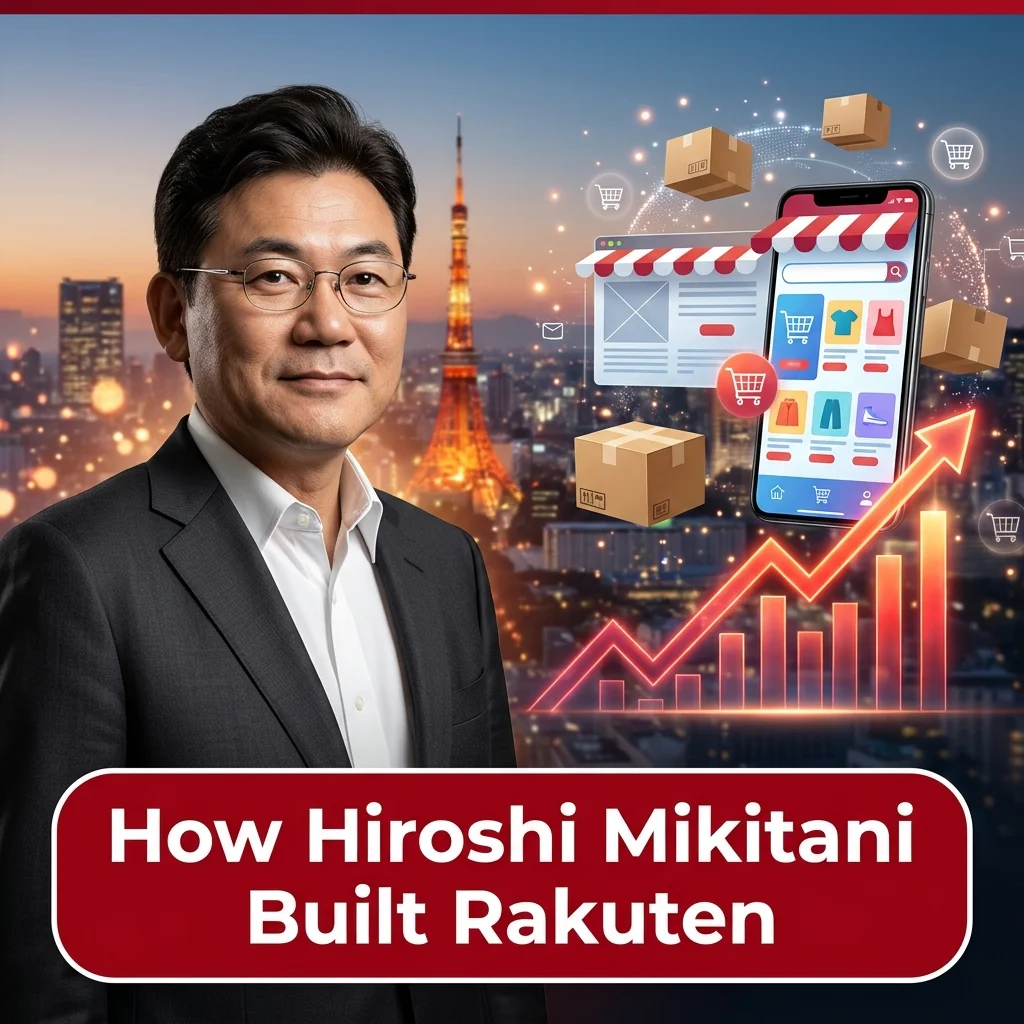
Rakuten began as an online shopping marketplace and gradually developed into a broader digital business group. Its marketplace connected merchants and consumers, while its expansion into related services created additional ways to serve customers.
One important feature of Rakuten’s approach was its emphasis on individual merchants. Rather than treating every seller as an identical supplier, the platform allowed businesses to develop distinctive online storefronts and communicate their products’ value to shoppers.
This model helped differentiate Rakuten from more standardized approaches to online retail. It also created opportunities for businesses of different sizes to participate in digital commerce.
Over time, Rakuten expanded into financial technology, banking, travel, digital content, and mobile telecommunications. Its ecosystem includes services such as Rakuten Ichiba, Rakuten Card, Rakuten Bank, Rakuten Travel, and Rakuten Mobile.
The strategy aims to connect services and encourage customers to use more than one part of the business. For example, a customer might shop through Rakuten Ichiba, use a Rakuten payment service, and earn benefits through the company’s loyalty ecosystem.
However, operating across several industries creates significant management challenges. Each business faces different competitors, investment requirements, customer expectations, and regulatory conditions. Expansion can create opportunities, but it also requires financial discipline and careful coordination.
Rakuten’s Recent Business Performance
Rakuten’s reported financial results help illustrate both the scale of the business and the challenges associated with its expansion.
In its February 2026 announcement covering the 2025 fiscal year, Rakuten Group reported consolidated revenue of approximately ¥2.5 trillion, an increase of 9.5% compared with the previous year. The company also reported IFRS operating income of ¥14.4 billion and consolidated non-GAAP operating income of ¥106.3 billion. These are different accounting measures and should not be treated as interchangeable. Source: Rakuten’s FY2025 financial results.
The company’s mobile business illustrates the balance between growth and financial performance. Rakuten Mobile reported revenue growth and achieved full-year EBITDA profitability for 2025, although it continued to report a non-GAAP operating loss. EBITDA profitability therefore did not mean that every measure of the mobile business had become profitable.
These results offer an important lesson about business growth: increasing revenue does not automatically eliminate operating challenges. A company must also manage investment costs, financing requirements, competition, and the time needed for new services to become sustainable.
For Mikitani, the challenge is to strengthen the relationships among Rakuten’s businesses while improving the financial performance of individual operations.
Hiroshi Mikitani’s Leadership Style
The Hiroshi Mikitani leadership style is associated with entrepreneurship, technological innovation, international ambition, and a willingness to challenge traditional practices.
1. Entrepreneurial Vision
Mikitani identified the potential of online commerce before it became a normal part of everyday retail.
His decision to establish Rakuten required a willingness to invest in an emerging market without certainty about how quickly consumer behavior would change.
Entrepreneurs can learn from this example by looking for unmet customer needs rather than simply copying established competitors. A useful business idea often begins with a practical question: What problem can be solved more conveniently, affordably, or effectively?
2. Innovation and Experimentation
Rakuten’s expansion into multiple digital services demonstrates a willingness to explore opportunities beyond its original marketplace.
Innovation does not always mean inventing a completely new technology. It can also involve improving existing services, connecting separate products, or developing a business model that better serves customers.
However, experimentation must be accompanied by evaluation. Businesses need to determine whether new initiatives attract customers, generate sustainable revenue, and support their wider strategy.
3. International Communication
One of Mikitani’s best-known organizational initiatives was Rakuten’s adoption of English as its official internal business language in 2010, a policy commonly known as Englishnization.
The initiative aimed to reduce language barriers and support international expansion. It required employees to adapt to a different way of communicating at work, demonstrating how leadership decisions can influence an organization’s culture.
The broader lesson is that international growth often requires changes in communication, recruitment, training, and management practices not simply opening offices in additional countries. Background: Council on Foreign Relations discussion of Rakuten’s English-language policy.
4. Long-Term Thinking
Mikitani’s strategy has focused on developing a connected digital ecosystem rather than relying exclusively on online shopping.
This approach can create opportunities for cross-service benefits and stronger customer relationships. However, diversification works best when new businesses complement the organization’s capabilities and have realistic paths toward sustainable performance.
His career illustrates the importance of balancing ambition with financial and operational discipline.
Who Is James Gorman?
James P. Gorman is an Australian-born business executive best known for his leadership at Morgan Stanley. He studied law at the University of Melbourne and earned an MBA from Columbia Business School.
Before joining Morgan Stanley in 2006, Gorman worked at McKinsey & Company and held senior executive positions at Merrill Lynch. His experience in consulting and financial services prepared him for senior leadership at a complex international institution.
Gorman became Morgan Stanley’s chief executive officer in January 2010, following a leadership succession process announced in 2009. He served as CEO through December 2023 and as chairman from January 2012 through December 2023. He then served as executive chairman during 2024 and became chairman emeritus in January 2025. Source: Morgan Stanley’s official James Gorman biography.
Gorman’s career is an important example of corporate leadership within an established financial institution. Unlike Mikitani, who founded the company he leads, Gorman became responsible for an organization with existing clients, employees, operations, and governance structures.
His task was to guide Morgan Stanley’s strategic development while maintaining the confidence of clients, employees, shareholders, and regulators.
James Gorman and Morgan Stanley’s Transformation
Morgan Stanley operates across several major financial services businesses, including institutional securities, wealth management, and investment management.
When Gorman became CEO, the financial industry was still dealing with the consequences of the global financial crisis. Financial institutions faced heightened attention to risk, capital strength, regulatory compliance, and the sustainability of their business models.
Gorman’s leadership emphasized the development of a more balanced organization. Wealth management became an increasingly important part of Morgan Stanley’s strategy, complementing its traditional institutional securities and investment banking operations.
Wealth management provides financial advice and investment services to individuals and families, while institutional securities serves corporations, governments, and financial market participants. Investment management offers investment products and services to clients.
These businesses respond differently to market conditions. A more diversified business model can broaden revenue sources, although it does not eliminate financial risk or guarantee stable performance.
Gorman’s approach required the company to invest in client relationships, technology, talent, and business capabilities while maintaining appropriate controls.
His experience illustrates how corporate executives can transform an established institution without abandoning the expertise and relationships that made it successful.
Morgan Stanley’s Financial Performance
Morgan Stanley’s official 2025 annual report provides a recent indication of the company’s scale following Gorman’s tenure as CEO.
For the 2025 fiscal year, Morgan Stanley reported net revenues of $70.6 billion and net income applicable to the company of $16.9 billion. Its wealth management business generated $31.8 billion in net revenues. These figures describe the company’s reported performance in 2025; they should not be interpreted as results produced solely by Gorman, who had left the CEO role in 2023. Source: Morgan Stanley’s 2025 Form 10-K.
The distinction matters when evaluating executive achievements. Corporate performance depends on decisions made by many leaders and employees, as well as market conditions, economic trends, and developments that occur after a CEO’s departure.
Gorman’s contribution is best understood through the strategic changes implemented during his tenure and the direction in which he helped guide the company.
James Gorman’s Leadership Style
The James Gorman leadership style is associated with strategic focus, business diversification, risk awareness, and organizational development.
1. Strategic Discipline
Large financial institutions must make decisions about where to invest resources, which businesses to prioritize, and how to manage competing objectives.
Gorman’s leadership at Morgan Stanley illustrates the importance of maintaining a clear strategy while adapting to changes in the financial industry.
Strategic discipline involves evaluating opportunities according to their long-term value, financial requirements, and potential risks. It also means recognizing that a company cannot pursue every opportunity successfully at the same time.
2. Business Diversification
The development of Morgan Stanley’s wealth management business was a major element of the firm’s strategic direction during Gorman’s tenure.
Diversification can help organizations reduce reliance on a single business line. It can also allow them to serve clients through several related services.
However, diversification requires investment, specialized knowledge, effective management, and strong controls. Expanding into a new area without the necessary capabilities can create additional costs rather than sustainable growth.
3. Risk Management
Risk management is essential in financial services because decisions can affect clients, investors, counterparties, and the broader financial system.
Financial institutions must assess market fluctuations, credit exposure, operational weaknesses, legal responsibilities, and reputational risks.
Gorman’s career highlights the importance of incorporating risk considerations into strategic planning. Growth is most sustainable when business opportunities are supported by appropriate oversight and responsible decision-making.
4. Leadership Succession
Gorman’s transition from CEO to executive chairman and later chairman emeritus demonstrates the importance of leadership succession.
Large organizations need a process for preparing new executives, transferring responsibilities, and maintaining strategic continuity.
A successful transition can help employees and investors understand the company’s future direction. It also reduces the risk that the organization becomes overly dependent on one individual.
For business leaders, succession planning should be part of long-term governance rather than a decision made only when a departure becomes imminent.
Hiroshi Mikitani vs James Gorman: Key Differences
The comparison of Hiroshi Mikitani vs James Gorman reveals how successful leadership depends on the nature of a business, its competitive environment, and its long-term objectives.
Although both executives have led major organizations, their professional responsibilities and management priorities differ in several important ways.
1. Entrepreneur Versus Corporate Executive
Mikitani founded Rakuten and helped establish its original business model, company culture, and long-term ambitions. As a founder, he had the opportunity to shape the organization from its earliest stages.
Gorman, by contrast, joined Morgan Stanley after building a career in consulting and financial services. His role involved guiding an established institution through strategic change.
Entrepreneurs often focus on identifying opportunities, developing products, and building new markets. Corporate executives must also consider existing systems, shareholder expectations, regulatory responsibilities, and organizational continuity.
Both paths require strong leadership, but the challenges are different.
2. Technology Versus Financial Services
Mikitani’s career centers on e-commerce, technology, telecommunications, and interconnected digital services.
Gorman’s career centers on investment banking, wealth management, financial markets, and institutional strategy.
Technology companies must respond to rapidly changing customer expectations and competitive innovation. Financial institutions must balance commercial opportunities with financial risks, regulatory requirements, and client trust.
This difference explains why their approaches to business growth cannot be compared using exactly the same standards.
3. Different Growth Strategies
Rakuten’s strategy emphasizes expanding its digital ecosystem and connecting services that customers may use together.
Morgan Stanley’s development under Gorman emphasized a broader financial services model, including the growth of wealth management alongside institutional securities and investment management.
Mikitani’s approach illustrates how companies can seek growth by expanding into related markets. Gorman’s approach demonstrates how an established institution can strengthen its business mix and develop complementary capabilities.
Neither strategy is automatically superior. The appropriate approach depends on the company’s resources, market position, and ability to execute its plans.
4. Different Measures of Success
Rakuten’s performance can be evaluated through revenue growth, marketplace activity, customer engagement, profitability, and the financial sustainability of its various businesses.
Morgan Stanley’s performance involves financial measures such as net revenue, net income, returns on capital, client asset growth, and risk management.
These differences are important because comparing companies requires more than looking at their size or headline revenue.
A useful business analysis considers how effectively each organization converts its resources into sustainable results while managing the risks associated with its industry.
Hiroshi Mikitani and James Gorman: Leadership Similarities
Despite their different professional backgrounds, Hiroshi Mikitani and James Gorman share several important leadership themes.
1. Long-Term Strategic Thinking
Both executives have pursued strategies intended to strengthen their organizations over time.
Mikitani developed Rakuten beyond its original e-commerce business. Gorman worked to develop Morgan Stanley’s financial services model and strengthen its wealth management capabilities.
Their careers demonstrate that long-term planning requires leaders to identify which capabilities will matter in the future and invest in them before the benefits become fully apparent.
However, a long-term vision must be supported by measurable objectives. Without clear performance targets, ambitious plans can become difficult to evaluate.
2. Organizational Transformation
Both leaders guided significant changes in their organizations.
Mikitani expanded Rakuten into additional services and pursued a more international corporate culture. Gorman guided Morgan Stanley through strategic changes in a financial industry reshaped by the global financial crisis and subsequent regulatory developments.
Organizational transformation requires more than announcing a new direction. Leaders must align employees, technology, investment, and operational processes with the intended strategy.
3. Global Business Leadership
International growth has been an important element of both careers.
Rakuten’s global ambitions required Mikitani to consider language, culture, overseas markets, and international competition. Morgan Stanley’s global operations required Gorman to oversee businesses serving clients across different financial markets.
Global business leaders must understand that a strategy successful in one market may need adjustments elsewhere. Cultural awareness, communication, and local market knowledge are essential to international operations.
4. Building Trust
Trust is a fundamental part of both business models.
Rakuten relies on customers, merchants, and business partners who expect dependable services. Morgan Stanley relies on clients and investors who expect professional financial services and responsible management.
Trust is developed through consistent performance, transparency, sound decision-making, and accountability.
Both careers demonstrate that strong business relationships can become valuable organizational assets, but they must be supported by reliable service and responsible conduct.
Challenges Faced by Rakuten and Morgan Stanley
A balanced comparison of Hiroshi Mikitani and James Gorman should examine not only achievements but also the challenges associated with their industries.
Rakuten’s Challenge: Balancing Expansion and Profitability
Rakuten’s diversified ecosystem provides opportunities to connect different services, but it also creates financial and operational complexity.
Its investment in mobile telecommunications illustrates this challenge. Building a mobile network requires substantial infrastructure spending, customer acquisition, and ongoing operational investment.
The company’s FY2025 results showed progress in mobile EBITDA while also reporting a continuing non-GAAP operating loss for the mobile segment. This distinction demonstrates why individual financial measures must be interpreted carefully.
For Rakuten, the broader strategic challenge is to strengthen connections among its services while maintaining financial discipline and improving the performance of individual businesses. <Cite refs={[“turn506341search2”]}/>
Morgan Stanley’s Challenge: Managing Financial Risk
Morgan Stanley operates in an industry affected by market volatility, economic changes, regulation, competition, and client confidence.
Expanding wealth management can diversify revenue sources, but the business remains affected by market conditions, interest rates, client activity, and investment performance.
Financial institutions must also protect confidential information, maintain effective controls, and comply with extensive regulatory requirements.
The challenge for leadership is to pursue profitable growth without weakening the firm’s financial resilience or the trust of its clients.
A Broader Lesson About Leadership
These challenges reveal why business achievements should be evaluated alongside risks and trade-offs.
Expansion can create new revenue opportunities, but it can also increase costs. Diversification can reduce reliance on one business line, but it can make management more complicated.
Effective leaders must therefore ask two questions: What opportunities can the organization pursue, and what resources and controls are necessary to pursue them responsibly?
Business Lessons from Hiroshi Mikitani and James Gorman
The careers of these global business leaders provide useful lessons for entrepreneurs, managers, students, and corporate executives.
Lesson 1: Identify a Real Customer Need
Mikitani’s original marketplace concept addressed a practical need: helping merchants reach customers through the internet.
Businesses can apply this lesson by studying customer problems before investing heavily in a product or service.
Understanding the customer creates a stronger foundation for product development, marketing, and long-term growth.
Lesson 2: Match Strategy to the Organization
Rakuten’s digital ecosystem strategy reflects its technology-centered business model. Morgan Stanley’s focus on financial services and wealth management reflects its position in the financial industry.
Business leaders should not copy another company’s strategy simply because it appears successful.
Instead, they should consider their own organization’s capabilities, customers, resources, and competitive environment.
Lesson 3: Measure Performance Carefully
Revenue growth can indicate that a business is attracting customers, but revenue alone does not establish whether the business is profitable or financially sustainable.
Rakuten’s mobile results demonstrate why EBITDA and operating income should be distinguished. Morgan Stanley’s financial results likewise need to be evaluated using appropriate measures of profitability, capital, and business performance.
Managers should select meaningful performance indicators and interpret them in context.
Lesson 4: Treat Innovation as an Ongoing Process
Innovation is not limited to startups or technology companies.
Established financial institutions also need to adapt their services, technology, and business models to changing customer needs.
The careers of Mikitani and Gorman demonstrate that innovation can involve creating a new business, expanding an existing service, improving operations, or changing the way an organization serves customers.
Lesson 5: Develop Strong Teams
A business cannot depend entirely on one executive.
Employees, managers, technical specialists, financial professionals, and other teams must work together to turn strategic plans into results.
Leaders should establish clear responsibilities, communicate priorities, and create systems that allow people to make informed decisions.
Lesson 6: Plan for Leadership Transitions
Gorman’s transition from CEO to executive chairman and chairman emeritus illustrates the importance of succession planning.
Organizations benefit when they prepare future leaders, document important processes, and build institutional knowledge that extends beyond any one individual.
For entrepreneurs, this lesson becomes especially important as a company grows and requires more formal management structures.
Why Hiroshi Mikitani and James Gorman Matter in Modern Business
Modern organizations face technological disruption, international competition, changing consumer behavior, economic uncertainty, and growing expectations around responsible management.
The careers of Hiroshi Mikitani and James Gorman provide two perspectives on responding to these challenges.
Mikitani demonstrates how entrepreneurial thinking can create a business around an emerging opportunity and how that business can expand into related services.
Gorman demonstrates how a corporate executive can guide an established financial institution through strategic development while balancing growth, risk, and organizational stability.
Their careers also illustrate the importance of distinguishing personal leadership from collective business performance. A company’s results depend on its employees, management team, customers, partners, competitors, and the broader economic environment.
Studying their experiences helps readers understand that business success is rarely the result of one decision or one individual. It generally develops through a series of strategic choices, operational improvements, investments, and responses to changing circumstances.
Are Hiroshi Mikitani and James Gorman Business Partners?
Hiroshi Mikitani and James Gorman are associated with different companies and professional backgrounds. Mikitani is the founder and leader of Rakuten, while Gorman is known for his former leadership of Morgan Stanley.
Their careers can be compared because both have influenced major international organizations. However, their shared prominence in business discussions does not establish that they are formal business partners.
When researching Hiroshi Mikitani and James Gorman, it is important to distinguish between documented professional relationships and comparisons of their leadership styles.
The most useful connection for this article is the opportunity to examine how two leaders approached organizational growth, business transformation, and long-term strategy in different industries.
Frequently Asked Questions
1. Who is Hiroshi Mikitani?
Hiroshi Mikitani is a Japanese entrepreneur who founded Rakuten in 1997. He is known for expanding the company from an online shopping marketplace into a diversified digital business group that includes e-commerce, financial services, and mobile telecommunications.
2. Who is James Gorman?
James Gorman is an Australian-born business executive who served as Morgan Stanley’s CEO from 2010 through 2023. He later served as executive chairman in 2024 and became chairman emeritus in January 2025.
3. What is Hiroshi Mikitani known for?
Mikitani is best known for founding Rakuten, developing its marketplace model, promoting international expansion, and building a broader ecosystem of digital services.
4. What did James Gorman do at Morgan Stanley?
Gorman led Morgan Stanley as CEO for nearly 14 years. His tenure included a strategic emphasis on wealth management, business diversification, and the development of the firm’s long-term financial services model.
5. What is the main difference between Hiroshi Mikitani and James Gorman?
Mikitani is an entrepreneur who founded a technology-centered business group. Gorman is a financial services executive who led an established global financial institution. Their careers represent different approaches to business growth and organizational leadership.
6. What leadership styles are associated with Hiroshi Mikitani and James Gorman?
The Hiroshi Mikitani leadership style is associated with entrepreneurship, innovation, and international expansion. The James Gorman leadership style is associated with strategic discipline, financial services diversification, risk management, and corporate governance.
These descriptions summarize prominent themes in their careers rather than claiming that either leader follows one fixed management style in every situation.
7. How successful is Rakuten?
Rakuten is a major Japanese digital services group. Its FY2025 results, announced in February 2026, reported consolidated revenue of approximately ¥2.5 trillion, with growth across its Internet Services, FinTech, and Mobile segments. Revenue growth should be considered alongside profitability and investment requirements when assessing the company’s overall performance.
8. Why is James Gorman important in the financial industry?
Gorman is recognized for his leadership at Morgan Stanley and the strategic development of its financial services businesses, particularly wealth management. His career also illustrates the importance of risk management, corporate governance, and leadership succession.
9. What can entrepreneurs learn from Hiroshi Mikitani?
Entrepreneurs can learn the importance of identifying customer needs, developing a distinctive business model, adapting to new technology, and preparing an organization for international growth. His experience also shows that expansion should be balanced with financial discipline.
10. What can managers learn from James Gorman?
Managers can learn the importance of strategic focus, diversification, responsible risk management, and preparing future leaders. His career illustrates how an established organization can evolve while maintaining its core capabilities and client relationships.
11. Did Hiroshi Mikitani and James Gorman lead the same type of company?
No. Mikitani built Rakuten around digital commerce and related technology services, while Gorman led Morgan Stanley, a global financial services firm. Their careers are comparable in terms of leadership and strategy, not because they operated identical businesses.
12. What is the biggest lesson from comparing Hiroshi Mikitani and James Gorman?
The central lesson is that effective leadership depends on the organization’s circumstances. Entrepreneurs may focus on developing new markets and building innovative services, while executives at established institutions may prioritize strategic balance, financial resilience, and organizational continuity.
Both approaches require sound judgment, capable teams, clear priorities, and the ability to adapt to changing conditions.
Conclusion
Hiroshi Mikitani and James Gorman represent two distinct approaches to international business leadership. Mikitani’s entrepreneurial journey shows how a clear vision, an understanding of customer needs, and investment in technology can transform an online marketplace into a diversified digital business. Rakuten’s development also illustrates the challenges of managing multiple businesses and balancing expansion with profitability.
Gorman’s career at Morgan Stanley demonstrates how strategic discipline, business diversification, risk awareness, and leadership succession can influence an established financial institution. His tenure offers valuable lessons about managing complexity and preparing organizations for their next stage of development.

I am James Carter, a passionate writer dedicated to creating informative, engaging, and valuable content for readers. I enjoy exploring different topics, researching new ideas, and sharing knowledge through clear and meaningful writing. I am committed to providing accurate information, helpful insights, and well-crafted articles that inspire and educate audiences. With a strong focus on quality and creativity, I aim to connect with readers and deliver content that adds real value.