The Cadillac LYRIQ offers several driving modes that change how the electric SUV responds to acceleration, steering, and different road conditions. These settings include Tour, Sport, Snow/Ice, and My Mode on applicable configurations. Although each mode provides a different driving experience, they do not give the vehicle a different battery capacity or a separate official driving-range rating.
So, do the driving modes in Cadillac LYRIQ offer different ranges or battery usages? Yes, they can indirectly affect real-world energy consumption, but the difference depends heavily on how you drive. Sport Mode may use more electricity when you accelerate aggressively, while Tour Mode offers balanced driving characteristics. Snow/Ice Mode focuses on traction, and My Mode lets you customize selected settings.
It is important to understand that selecting a driving mode does not automatically add or remove miles from your battery. Speed, acceleration, outside temperature, heating, air conditioning, tire pressure, and road conditions also influence the distance you can travel.
This guide explains how each Cadillac LYRIQ driving mode works, how battery consumption is measured, what affects real-world range, and which settings make sense for everyday efficiency.
What Are the Different Driving Modes in the Cadillac LYRIQ?
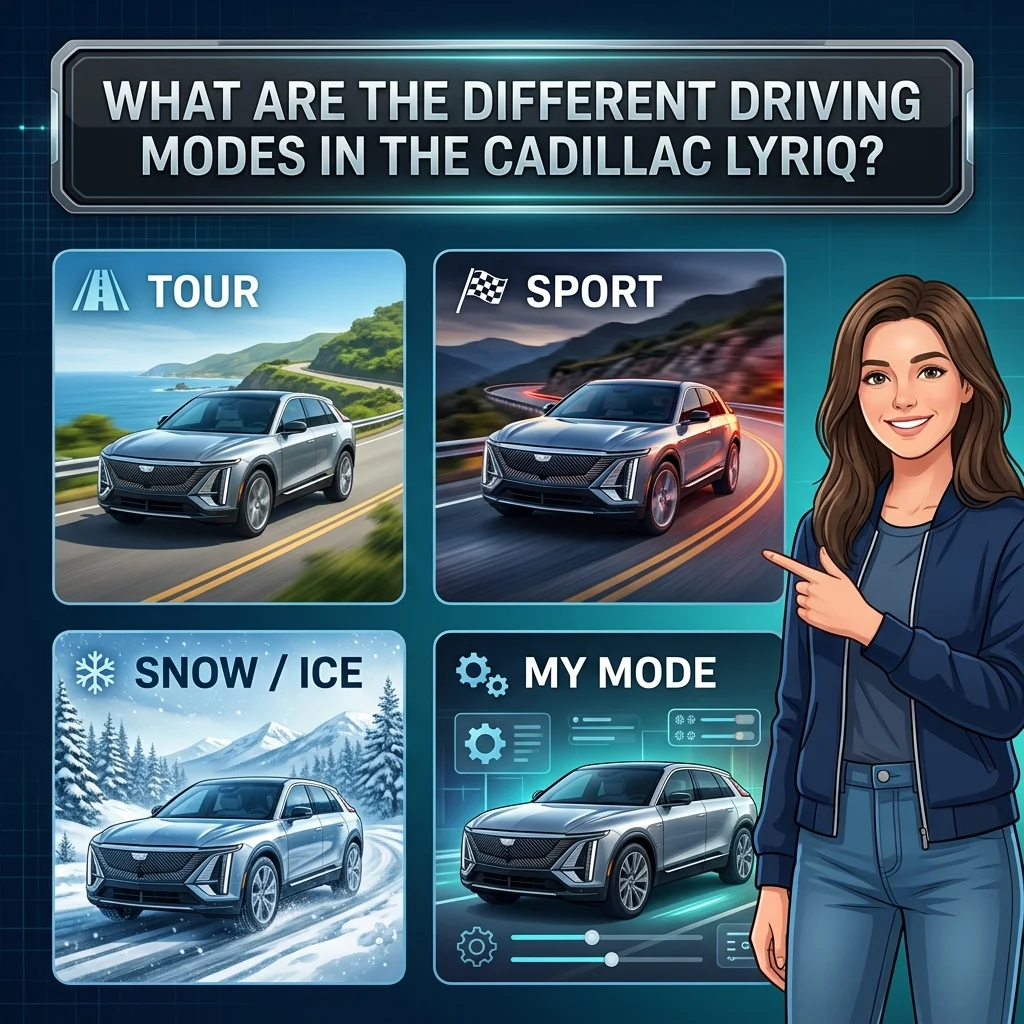
The Cadillac LYRIQ uses Driver Mode Control to adjust selected vehicle systems according to driving preferences and road conditions. The exact features available depend on the model year, trim level, and installed equipment.
The 2025 LYRIQ owner’s manual describes four commonly available modes: Tour, Sport, Snow/Ice, and My Mode. These settings do not all serve the same purpose.
Tour Mode: Balanced Everyday Driving
Tour Mode is intended for normal city and highway journeys. It provides a smooth ride and balances comfort with handling.
For drivers concerned about Cadillac LYRIQ energy consumption, Tour Mode is a sensible starting point. Its normal accelerator response can make gradual acceleration easier than a more performance-focused setting.
For example, imagine commuting through city traffic. You approach traffic lights, accelerate smoothly, and maintain a consistent speed. Tour Mode provides a comfortable setup for this type of journey.
Battery and range considerations:
- Provides normal acceleration characteristics.
- Offers comfortable everyday driving.
- Can support smoother driving habits.
- Does not guarantee a particular range improvement.
- Remains dependent on speed, traffic, weather, and climate-control usage.
Tour Mode is generally the most practical choice when you want predictable everyday performance without additional sporty responsiveness.
Sport Mode: Responsive Acceleration and Handling
Sport Mode is designed for drivers who prefer a more controlled and responsive driving experience.
According to Cadillac’s owner’s manual, it can modify steering effort, accelerator pedal tuning, electric vehicle sound enhancement, adaptive cruise control, and suspension tuning when equipped.
These adjustments make the vehicle feel more responsive, particularly during acceleration and cornering.
However, Sport Mode does not automatically consume a fixed additional amount of battery power.
Consider two different driving situations:
- You select Sport Mode and accelerate gently while maintaining a steady speed.
- You select Sport Mode and repeatedly accelerate hard from traffic lights.
The second situation is more likely to increase electricity consumption because stronger acceleration requires additional energy.
Battery and range considerations:
- Provides more responsive accelerator characteristics.
- Adjusts selected handling-related systems.
- Can encourage higher energy consumption through aggressive acceleration.
- Does not have a separate EPA driving-range rating.
- Can still be driven efficiently when you maintain a smooth pace.
Sport Mode is useful when you want a more engaging experience on dry roads. However, it is not the most obvious choice when your priority is relaxed everyday driving.
Snow/Ice Mode: Better Control on Slippery Roads
Snow/Ice Mode is designed for roads covered with snow or ice. It adjusts accelerator pedal tuning to help optimize traction and reduce unwanted wheelspin.
The mode also changes certain all-wheel-drive and steering characteristics when supported by the vehicle’s equipment.
Unlike Sport Mode, Snow/Ice Mode is not designed to improve acceleration performance on dry roads. Its purpose is to make power delivery more appropriate for slippery conditions.
Battery and range considerations:
- Helps manage acceleration on slippery surfaces.
- Supports traction management.
- Does not provide a dedicated battery-saving function.
- Does not guarantee additional driving range.
- Cold temperatures and winter conditions can independently increase energy consumption.
For example, driving through snow may require more energy because of road resistance, tire conditions, and low temperatures. Snow/Ice Mode helps manage vehicle response, but it cannot eliminate these efficiency challenges.
Use this mode when road conditions require it rather than choosing another setting simply to save electricity.
My Mode: Personalized Driving Settings
My Mode allows drivers to personalize selected vehicle characteristics.
Depending on the LYRIQ’s equipment, the available settings can include:
| Customization | Available settings |
| Acceleration Feel | Relaxed, Tour, Sport |
| Brake Feel | Tour, Sport |
| Steering | Tour, Sport |
| Suspension | Tour, Sport |
| Motor Sound | Tour, Sport |
This feature is useful when you want a combination of settings rather than relying entirely on one predefined driving mode.
For example, you could choose a relaxed accelerator response while selecting your preferred steering and brake feel.
This may help you maintain a smoother driving style, although it does not guarantee better battery efficiency.
Battery and range considerations:
My Mode can indirectly influence electricity consumption through acceleration settings and driving behaviour. However, changing steering feel or motor sound does not create additional battery capacity.
For drivers who want personalized comfort and responsiveness, My Mode offers useful flexibility.
Cadillac LYRIQ Driving Modes Comparison: Which Uses Less Battery?
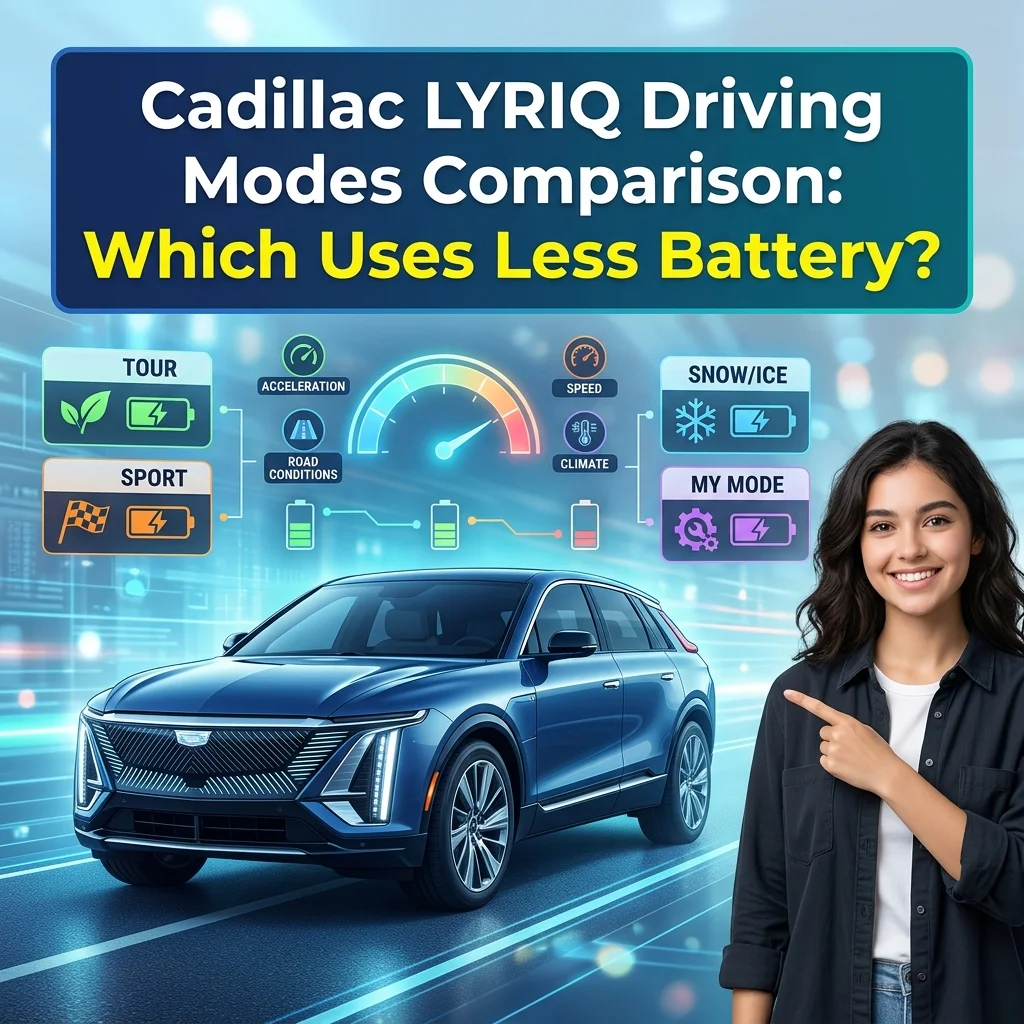
The following table summarizes the main differences between the four driving modes.
| Feature | Tour | Sport | Snow/Ice | My Mode |
| Main purpose | Everyday comfort | Performance feel | Slippery-road traction | Personalization |
| Acceleration | Normal | Responsive | Traction-focused | Adjustable |
| Steering | Balanced | Sport-oriented | Adjusted for conditions | Adjustable |
| Battery impact | Depends on driving | May rise with hard acceleration | Depends on conditions | Depends on settings |
| Best use | Daily driving | Dry roads | Snow and ice | Customized driving |
Which mode is the most efficient?
Tour Mode is a sensible everyday choice, particularly when you want smooth and predictable acceleration. However, there is no official Cadillac test establishing a fixed battery-consumption advantage for Tour Mode over every other mode.
A driver using Sport Mode gently may consume less electricity than someone driving aggressively in Tour Mode.
The difference comes down to actual energy demand rather than the mode name alone.
Cadillac LYRIQ Battery Capacity and Official Driving Range
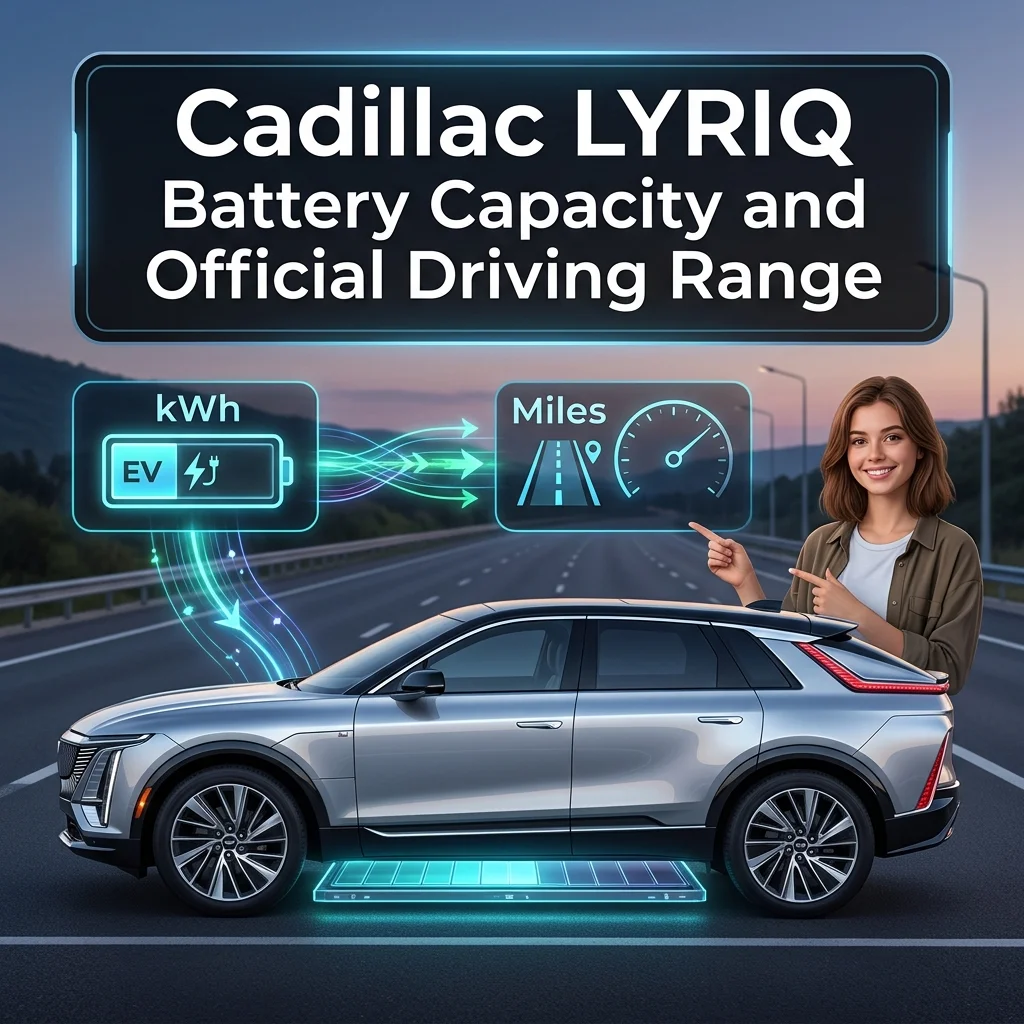
To understand how driving modes affect battery usage, you first need to understand the vehicle’s battery specifications.
The 2026 Cadillac LYRIQ uses a battery platform with a rated energy capacity of 102 kWh, according to Cadillac’s published specifications. This is the battery’s rated energy capacity, not a promise that all 102 kWh will be available for normal driving.
Cadillac+1
The vehicle is available in different powertrain configurations, and their official range and efficiency figures vary.
For the US-market 2026 model, published EPA-related figures include:
| Configuration | Estimated range | Combined electricity use |
| LYRIQ RWD | 326 miles | Approximately 37 kWh/100 miles |
| LYRIQ AWD | 303 miles | 40 kWh/100 miles |
| LYRIQ Performance AWD | 319 miles | 38 kWh/100 miles |
| LYRIQ-V AWD | 285 miles | 42 kWh/100 miles |
These figures refer to different powertrain configurations, not Tour, Sport, Snow/Ice, or My Mode settings. Equipment and charging-system specifications can also affect the official ratings. Check the exact EPA listing and window sticker for your trim before comparing vehicles.
DriveClean+4
Why do these figures matter?
They show that drivetrain and vehicle configuration can make a measurable difference in rated efficiency.
For example, an RWD LYRIQ and an AWD LYRIQ may have different official range figures even when both are driven in Tour Mode.
This is an important distinction: the drivetrain configuration affects the vehicle’s overall efficiency, while driving modes primarily adjust selected driving characteristics.
What Does kWh Mean in Cadillac LYRIQ Battery Consumption?
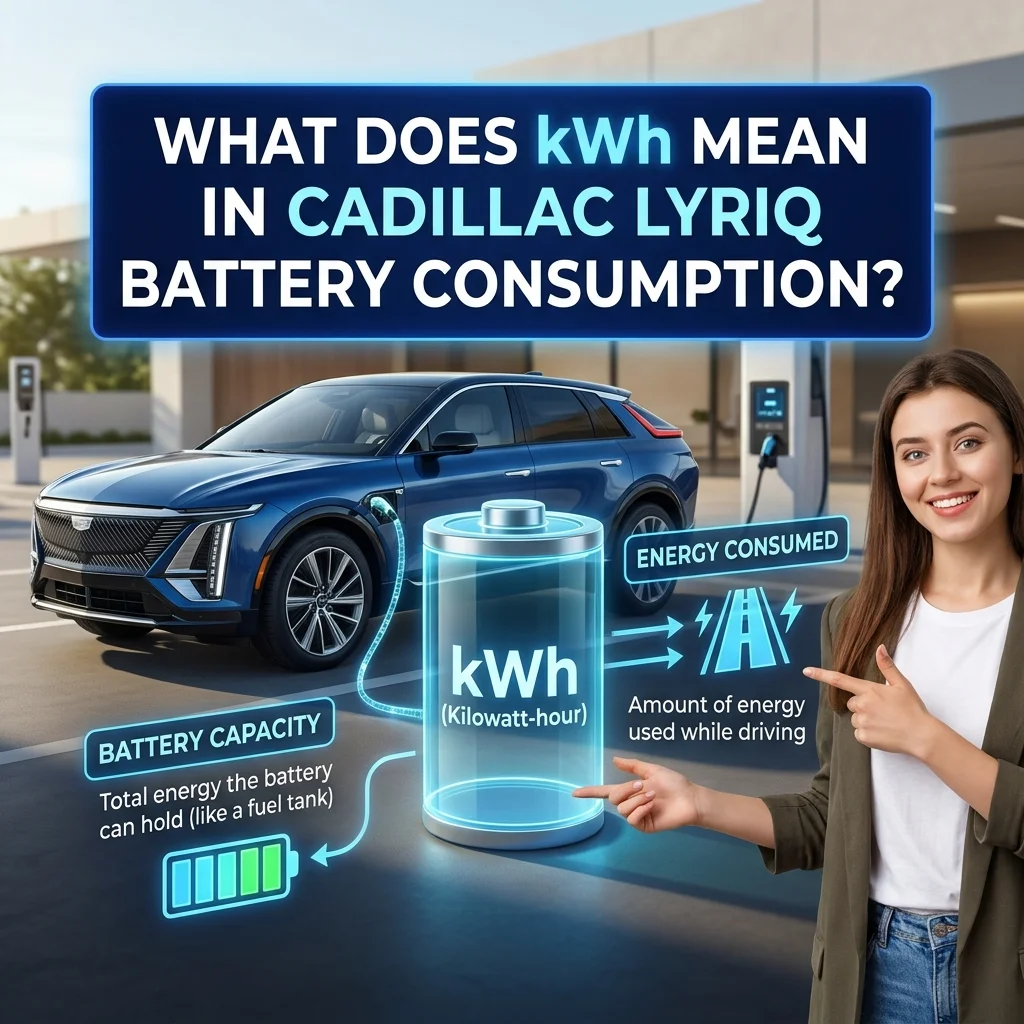
One of the most useful ways to understand electric vehicle efficiency is to learn what kWh means.
kWh stands for kilowatt-hour. It measures the amount of electrical energy consumed or stored.
In the Cadillac LYRIQ, the battery stores electrical energy that powers the electric motors, climate-control system, and other vehicle components.
You may also see an energy-consumption figure expressed as kWh per 100 miles. This tells you how much electricity the vehicle uses to travel 100 miles.
For example:
| Energy consumption | Distance travelled | Electricity used |
| 30 kWh/100 miles | 100 miles | 30 kWh |
| 35 kWh/100 miles | 100 miles | 35 kWh |
| 40 kWh/100 miles | 100 miles | 40 kWh |
| 45 kWh/100 miles | 100 miles | 45 kWh |
The difference is straightforward. A vehicle that consumes 30 kWh over 100 miles uses less electricity than one that consumes 40 kWh over the same distance.
How to Calculate Cadillac LYRIQ Energy Consumption
You can calculate electricity consumption using this simple formula:
\[ \text{Energy Used}= \frac{\text{kWh per 100 miles}\times\text{Miles Driven}}{100} \]
Suppose your LYRIQ averages 37 kWh per 100 miles and you travel 150 miles.
37150100=55.5kWh
Your vehicle would use approximately 55.5 kWh for that journey at the assumed consumption rate.
This is an illustrative calculation, not a prediction of what every LYRIQ will consume.
How Does Higher Electricity Consumption Affect Driving Range?
Higher energy consumption generally means fewer miles from the same amount of usable battery energy.
For example, imagine a vehicle has 90 kWh of usable energy available.
- At 30 kWh/100 miles, the theoretical distance is 300 miles.
- At 35 kWh/100 miles, the theoretical distance is approximately 257 miles.
- At 40 kWh/100 miles, the theoretical distance is 225 miles.
These calculations demonstrate the relationship between energy consumption and range. They are not official Cadillac range estimates because actual usable battery energy, temperature, driving conditions, and energy reserves can differ.
Does Sport Mode Use More Battery Than Tour Mode?
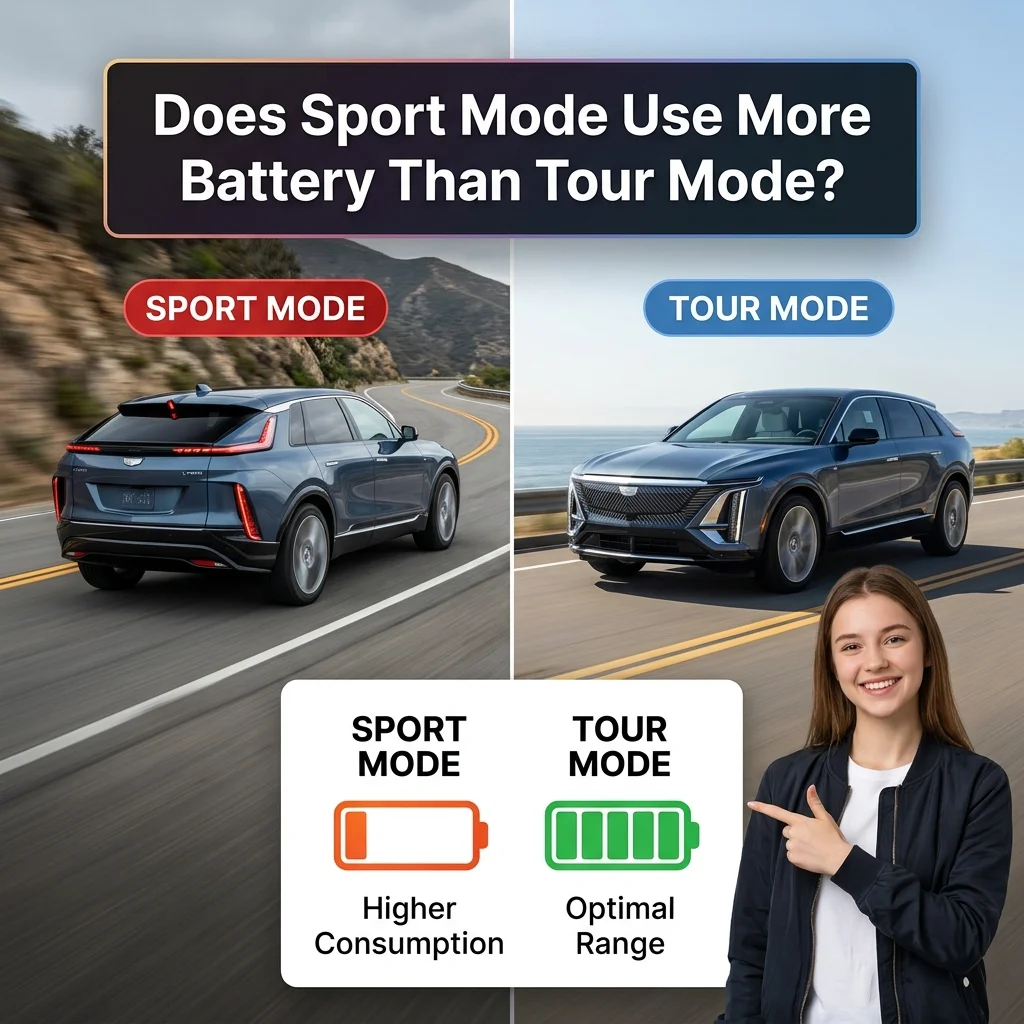
This is one of the most common questions among Cadillac LYRIQ owners.
Sport Mode can increase battery consumption, but the effect is not automatic or identical for every driver.
The main reason is accelerator response. Sport Mode makes the vehicle feel more responsive, which can encourage stronger acceleration.
Electric motors can deliver substantial torque quickly. When you demand stronger acceleration, the vehicle needs more electrical power.
Consider two examples.
Example 1: Driving in Tour Mode
You accelerate gradually, maintain a steady speed, and anticipate traffic. Your driving style keeps unnecessary acceleration to a minimum.
Example 2: Driving in Sport Mode
You accelerate quickly, frequently change speeds, and use the vehicle’s performance more often.
The second example is likely to consume more electricity.
However, if you drive smoothly in Sport Mode and avoid unnecessary acceleration, the difference may be relatively small.
There is no reliable universal percentage that tells you exactly how much additional battery Sport Mode consumes.
The important factor is how much energy your driving demands.
Does Tour Mode Improve Cadillac LYRIQ Efficiency?
Tour Mode is a sensible choice for everyday efficiency because it provides balanced acceleration and comfortable driving characteristics.
However, it is important to distinguish between a mode designed for normal driving and a mode that has been independently proven to increase range.
Cadillac does not provide a separate EPA range rating for Tour Mode.
You can still experience different electricity consumption in Tour Mode depending on:
- Your average driving speed.
- How frequently you accelerate.
- Traffic conditions.
- Outside temperature.
- Climate-control settings.
- Tire pressure.
- Road elevation.
For example, a LYRIQ travelling at a steady highway speed may use less electricity than one repeatedly accelerating and braking in congested traffic.
Therefore, Tour Mode is a practical recommendation, not a guaranteed battery-saving feature.
How Does Snow/Ice Mode Affect Cadillac LYRIQ Range?
Snow/Ice Mode is designed to improve vehicle response on slippery surfaces.
It adjusts accelerator pedal tuning to help manage wheelspin. On equipped all-wheel-drive models, it can also modify certain drivetrain and steering characteristics.
However, winter driving conditions can create additional energy demands.
Several factors contribute to this:
Cold battery temperatures: A cold high-voltage battery can have reduced performance and regenerative-braking availability.
Cabin heating: Heating the interior requires electrical energy.
Snow-covered roads: Driving through snow can increase rolling resistance.
Winter tires: Tire design and road contact conditions can influence efficiency.
Reduced traction: Slippery surfaces may require more careful acceleration and speed adjustments.
The mode helps manage vehicle behaviour, but it does not remove these environmental factors.
If you drive in snowy conditions, prioritize traction and safety instead of selecting a different mode to chase additional miles.
Can My Mode Improve Cadillac LYRIQ Battery Efficiency?
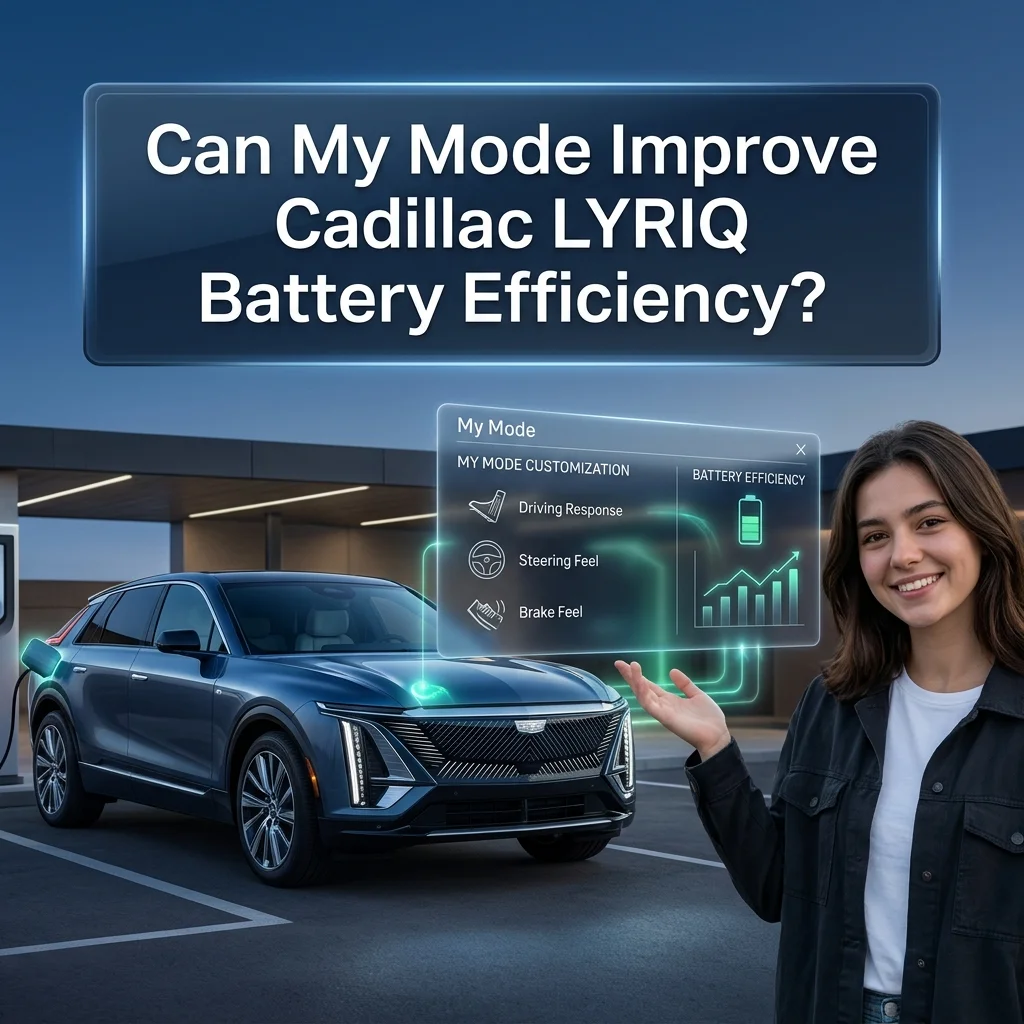
My Mode can help you create a driving setup that matches your preferences.
One useful approach is to select a relaxed acceleration feel. This may make it easier to accelerate gradually rather than demanding strong power immediately.
You can also personalize other available settings, including brake feel, steering, suspension, and motor sound.
However, not every customization affects electricity consumption in the same way.
For example:
- Acceleration settings can influence how you apply power.
- Steering settings mainly change steering response.
- Brake settings change the braking feel.
- Suspension settings influence ride and handling characteristics.
- Motor sound changes the vehicle’s sound experience.
Do not assume that every Relaxed or Tour setting directly reduces energy consumption.
My Mode is best understood as a customization feature that may support efficient driving habits when configured appropriately.
Does Regenerative Braking Increase Cadillac LYRIQ Driving Range?
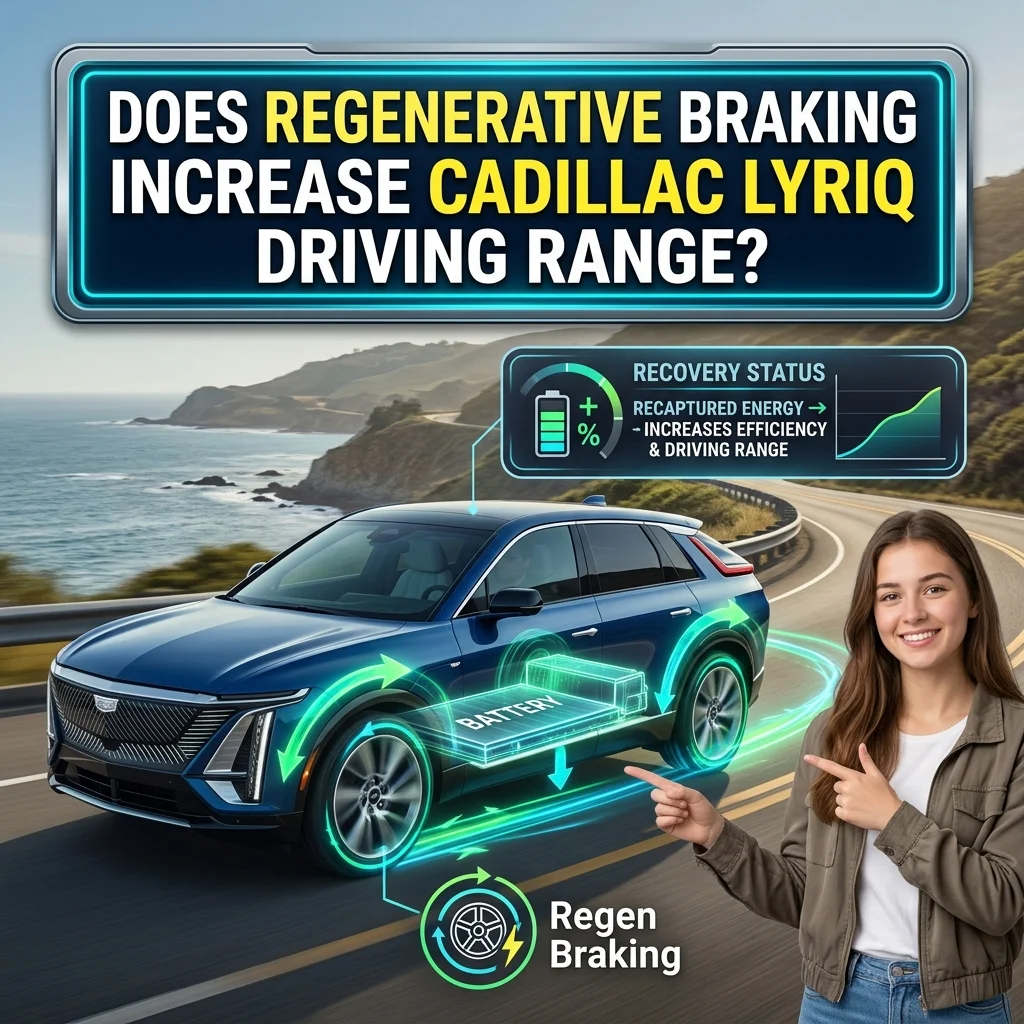
Regenerative braking can help improve electric vehicle efficiency by recovering some of the energy produced during deceleration.
When a conventional vehicle slows down, much of its movement energy is converted into heat through the braking system.
An electric vehicle can recover some of that energy through its motor, which operates as a generator during deceleration.
The recovered electricity returns to the high-voltage battery.
How Regen on Demand Works
Cadillac provides a feature called Regen on Demand on the LYRIQ.
The driver can pull and hold the paddle behind the steering wheel to request regenerative deceleration.
This feature can be useful when approaching traffic or slowing down gradually.
However, regenerative braking has limitations.
It may be reduced when:
- The battery is close to full charge.
- The battery is very cold.
- Regenerative power is restricted by vehicle conditions.
- Traction or braking conditions require different vehicle behaviour.
Cadillac’s convenience guide specifically identifies cold and nearly full battery conditions as situations in which regenerative braking may be limited.
GM Answers+1
Does One-Pedal Driving Save More Battery?
One-Pedal Driving allows you to control acceleration and much of the deceleration using the accelerator pedal.
When you release the accelerator, the vehicle slows through regenerative braking according to the selected settings and operating conditions.
Potential benefits include:
- Recovering some energy during deceleration.
- Making stop-and-go driving more convenient.
- Reducing reliance on conventional friction brakes.
- Encouraging drivers to anticipate traffic.
However, One-Pedal Driving does not automatically guarantee more range.
On slippery roads, Cadillac’s European owner’s manual advises switching One-Pedal Driving off and avoiding the Regen on Demand paddle while following its winter-driving guidance. Always follow the instructions for your specific model.
cadillaceurope.com
What Factors Affect Cadillac LYRIQ Battery Consumption?
Driving modes are only one part of the overall efficiency picture. Several other factors can influence how much electricity your vehicle uses.
Understanding these factors is essential if you want to maximize Cadillac LYRIQ driving range.
1. Driving Speed and Aerodynamic Resistance
Higher speeds generally require more energy because aerodynamic resistance increases as speed rises.
This is particularly noticeable during highway driving.
For example, maintaining a reasonable and consistent speed may use less electricity than repeatedly travelling at high speeds.
You do not need to drive unusually slowly. Simply avoid unnecessary speeding and follow appropriate road conditions.
2. Acceleration and Braking Habits
Aggressive acceleration increases energy demand.
Repeatedly accelerating quickly and braking suddenly can also reduce efficiency because regenerative braking cannot recover all the energy used to accelerate.
Try to anticipate traffic, maintain a safe following distance, and apply the accelerator gradually.
3. Cold and Hot Weather
Temperature affects battery performance and climate-control energy requirements.
During winter, the battery may need temperature management, while cabin heating adds another electrical load.
During summer, air conditioning can increase consumption.
This explains why your Cadillac LYRIQ real-world range may differ between seasons even if you use the same driving mode.
4. Heating and Air Conditioning
The climate-control system draws electricity from the vehicle’s energy supply.
Using heating or cooling at high settings for extended periods can increase consumption.
To manage energy usage:
- Avoid unnecessarily extreme temperature settings.
- Use available seat and steering-wheel heating sensibly.
- Precondition the cabin while connected to a charger, where supported.
- Avoid leaving climate control running unnecessarily while parked.
5. Tire Pressure and Tire Condition
Underinflated tires increase rolling resistance.
This means the vehicle requires additional energy to move.
Check tire pressure regularly and follow the recommended figures in your owner’s manual or vehicle information label.
Also pay attention to tire condition and seasonal tire choices.
6. Road Surface and Elevation
Driving uphill requires energy to overcome gravity.
Descending a hill can allow regenerative braking to recover some of that energy.
However, the energy recovered will not necessarily equal the energy used during the climb.
Rough roads, gravel, mud, and snow can also increase resistance.
7. Vehicle Weight and Accessories
Extra passengers, luggage, and cargo increase vehicle weight.
External accessories can also affect aerodynamics.
For example, roof-mounted equipment may increase wind resistance, especially during highway driving.
Removing unnecessary cargo and accessories can help support better efficiency.
Does AWD Consume More Battery Than RWD in the Cadillac LYRIQ?
Generally, the official efficiency figures show differences between rear-wheel-drive and all-wheel-drive configurations.
The reason is that drivetrain design, additional motor hardware, vehicle weight, and power delivery characteristics can influence total energy consumption.
For the 2026 US-market LYRIQ, published ratings show differences between the RWD and AWD versions. For example, the EPA-related listings report approximately 37 kWh/100 miles for the RWD version and 40 kWh/100 miles for one AWD configuration. Other AWD variants have different ratings.
Edmunds+2
This comparison should not be confused with switching between Tour and Sport Mode.
RWD and AWD describe drivetrain configurations. Tour and Sport describe driving settings.
The two can influence vehicle efficiency in different ways.
How to Monitor Cadillac LYRIQ Energy Consumption and Estimated Range
The LYRIQ provides energy-related information through its instrument cluster.
This information can help you understand how driving conditions and habits affect battery usage.
Pay attention to the following:
Battery state of charge: Shows the remaining charge available in the battery.
Estimated driving range: Displays an estimate of how far the vehicle may travel before requiring another charge.
Energy information: Helps you understand vehicle energy usage on equipped configurations.
Driving efficiency: Observe how consumption changes when you adjust your speed, acceleration, or climate settings.
Remember that estimated range is not a fixed measurement.
For example, your dashboard might display 200 miles of estimated range before a journey. After driving at high speed with the cabin heater operating, the estimate may decrease more quickly than expected.
On another journey with smoother driving and moderate temperatures, the vehicle may use less electricity.
This does not mean the battery capacity has changed. The vehicle is adjusting its estimate according to expected energy demand.
How to Maximize Cadillac LYRIQ Driving Range
If you want to travel farther on a single charge, focus on practical efficiency improvements rather than constantly changing driving modes.
Here are some useful habits.
Select Tour Mode for Normal Journeys
Tour Mode provides balanced driving characteristics and is a sensible everyday setting.
It can help you maintain a comfortable driving style without emphasizing performance-oriented acceleration.
Maintain a Consistent Speed
Avoid unnecessary high-speed driving and frequent speed changes.
A steady pace can help reduce energy demand, particularly on longer journeys.
Accelerate Gradually
Strong acceleration requires more power.
Apply the accelerator smoothly and anticipate traffic so you do not need to brake suddenly.
Use Regenerative Braking Appropriately
Take advantage of regenerative braking when slowing down.
However, do not accelerate unnecessarily just to recover energy through braking. Avoiding the initial energy demand is usually better than trying to recover part of it later.
Precondition the Cabin While Charging
Where supported, preconditioning can help bring the cabin to a comfortable temperature while the vehicle is plugged in.
This can reduce the energy needed from the battery for initial cabin heating or cooling after departure.
Check Tire Pressure Regularly
Maintain the recommended tire pressure to avoid unnecessary rolling resistance.
Remove Unnecessary Cargo
Extra weight and external accessories can affect efficiency.
Keep the vehicle’s load reasonable, particularly before long journeys.
Monitor Energy Consumption Over Time
Compare energy usage across similar journeys.
For example, compare two trips with similar distances and road conditions. Observe whether changes in speed, weather, and climate-control settings affect your consumption.
This provides more useful information than judging efficiency from a single trip.
Does Highway Driving Use More Battery Than City Driving?
Not always. Highway and city driving create different energy demands.
At highway speeds, aerodynamic resistance becomes more significant. This can increase electricity consumption, particularly when driving quickly.
City driving involves more frequent stopping and starting. However, regenerative braking can recover some energy during deceleration.
The actual difference depends on traffic, speed, temperature, road conditions, and driving habits.
This is why the same LYRIQ can achieve different real-world efficiency on two journeys of equal distance.
Does Changing Driving Modes While Driving Drain the Battery?
Simply switching between available driving modes does not automatically cause a significant battery drain.
However, each mode can change selected vehicle characteristics.
For example, switching from Tour to Sport changes the accelerator response and other performance-related settings. If you use the more responsive acceleration frequently, energy consumption may increase.
Similarly, Snow/Ice Mode changes vehicle behaviour to help manage traction.
Choose the setting that matches the road conditions rather than switching modes repeatedly to search for a guaranteed range improvement.
Can Driving Modes Affect Cadillac LYRIQ Battery Temperature?
Driving modes are not battery-temperature controls.
Battery temperature is influenced by factors such as outside temperature, charging activity, driving conditions, and the vehicle’s battery thermal-management system.
More demanding driving can increase power demand and battery activity. However, selecting Sport Mode does not automatically mean the battery will overheat.
The vehicle manages battery operating conditions through its thermal-management systems.
If you notice a battery-temperature warning, follow the instructions displayed by the vehicle rather than attempting to solve the issue by changing driving modes.
Frequently Asked Questions About Cadillac LYRIQ Driving Modes and Battery Usage
Do the driving modes in Cadillac LYRIQ offer different ranges or battery usages?
They can indirectly influence real-world battery consumption, but Cadillac does not publish separate official range ratings for individual driving modes. Your driving habits and road conditions have a significant influence on actual range.
Which Cadillac LYRIQ driving mode offers the best range?
Tour Mode is a sensible everyday option because it provides balanced acceleration and handling. However, it does not guarantee the longest range in every situation.
Does Sport Mode use more battery in Cadillac LYRIQ?
It can use more electricity when you frequently accelerate aggressively. However, driving smoothly in Sport Mode may produce similar consumption to driving smoothly in Tour Mode.
Does Tour Mode improve Cadillac LYRIQ efficiency?
Tour Mode offers balanced driving characteristics that can support smoother driving. Actual efficiency still depends on speed, acceleration, weather, and other operating conditions.
How does Snow/Ice Mode affect Cadillac LYRIQ range?
Snow/Ice Mode adjusts accelerator response and traction-related systems to help manage slippery road conditions. It does not provide a dedicated range improvement.
Can My Mode improve Cadillac LYRIQ battery efficiency?
My Mode allows you to customize acceleration and other driving characteristics. A relaxed acceleration setting may encourage smoother driving, but Cadillac does not guarantee a specific efficiency improvement.
Does AWD consume more battery than RWD in Cadillac LYRIQ?
Official efficiency ratings differ between RWD and AWD configurations. However, the exact difference depends on the model year, trim, and equipment.
Does highway driving use more battery than city driving?
Highway driving can use more electricity at higher speeds because aerodynamic resistance increases. City driving involves frequent acceleration and braking, although regenerative braking can recover some energy.
Can regenerative braking increase Cadillac LYRIQ driving range?
Yes. Regenerative braking recovers some energy during deceleration and returns it to the battery. The amount depends on battery temperature, charge level, speed, and operating conditions.
Does One-Pedal Driving save more battery?
One-Pedal Driving can recover some energy through regenerative braking. However, it does not guarantee better efficiency in every situation.
Does cold weather reduce Cadillac LYRIQ range?
Yes. Cold temperatures can affect battery performance and increase heating requirements. Both factors can reduce real-world driving range.
Does changing driving modes damage the Cadillac LYRIQ battery?
No. Using the available driving modes as intended is normal vehicle operation. These settings adjust selected driving characteristics rather than directly changing the battery’s physical capacity.
What is the battery capacity of the 2026 Cadillac LYRIQ?
Cadillac lists a rated battery energy capacity of 102 kWh for the 2026 LYRIQ. Usable energy and actual driving range should not be assumed to equal the full rated capacity.
How can I maximize Cadillac LYRIQ driving range?
Use smooth acceleration, maintain reasonable speeds, check tire pressure, manage climate-control settings, and use regenerative braking appropriately. These habits can help reduce unnecessary electricity consumption.
Final Thoughts
The Cadillac LYRIQ’s driving modes offer different experiences, but they do not provide separate official driving-range ratings. Tour Mode is a practical choice for everyday journeys, Sport Mode delivers more responsive performance, Snow/Ice Mode supports traction on slippery roads, and My Mode lets you personalize selected settings.
The biggest factor affecting battery consumption is not simply which mode you select. Your acceleration habits, driving speed, temperature, climate-control usage, and road conditions all influence real-world efficiency.

I am James Carter, a passionate writer dedicated to creating informative, engaging, and valuable content for readers. I enjoy exploring different topics, researching new ideas, and sharing knowledge through clear and meaningful writing. I am committed to providing accurate information, helpful insights, and well-crafted articles that inspire and educate audiences. With a strong focus on quality and creativity, I aim to connect with readers and deliver content that adds real value.