High school wrestling is a competitive sport that requires strength, speed, discipline, and proper physical preparation. One of the most important things athletes, parents, and coaches need to understand is high school wrestling weight classes. These divisions organize competitors according to their weight, helping create fairer matchups and more balanced competitions.
In the United States, high school wrestling follows weight-classification rules established by the National Federation of State High School Associations (NFHS). The organization provides three approved systems containing 12, 13, or 14 weight classes. Individual state athletic associations select the system used for boys’ and girls’ competitions.
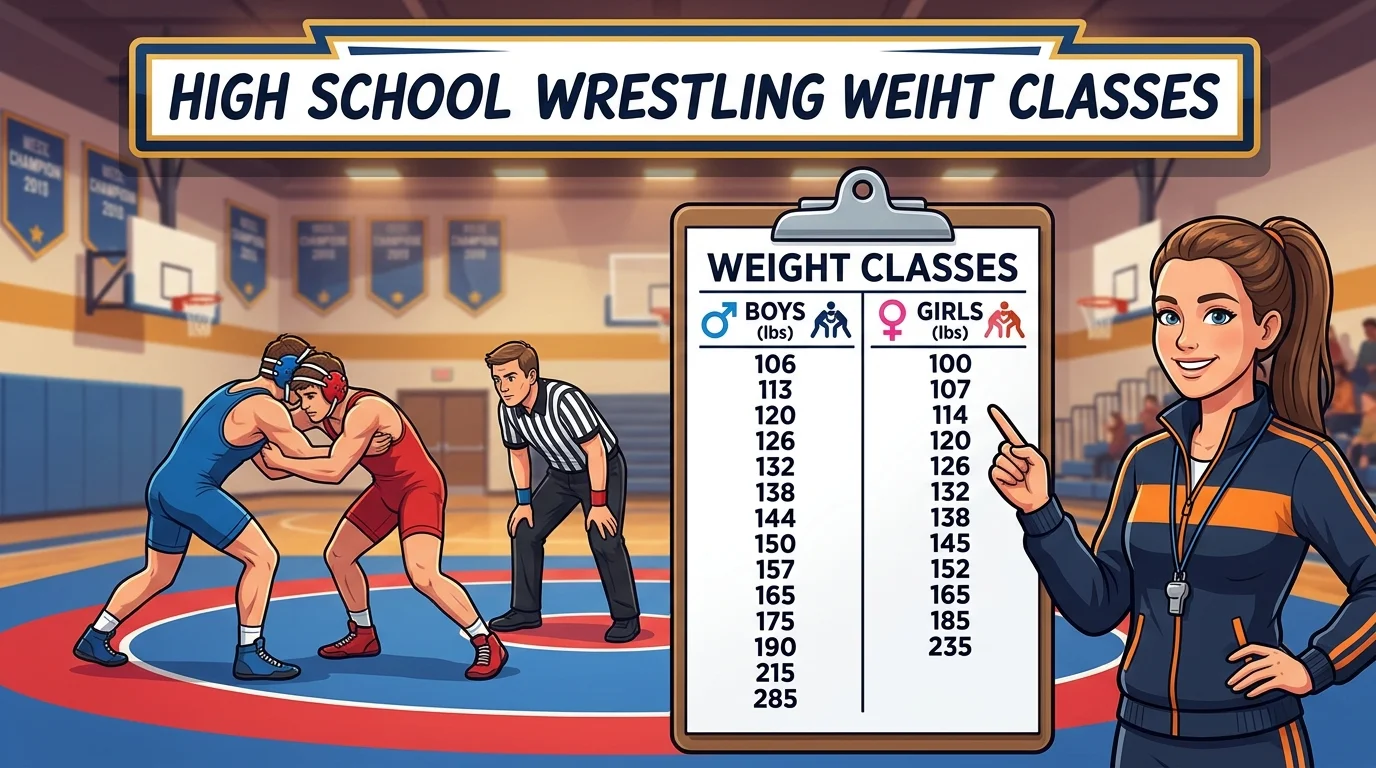
Under the standard 14-class system, boys compete in divisions ranging from 106 to 285 pounds, while girls compete in divisions ranging from 100 to 235 pounds.
However, the number of divisions is not the only thing athletes need to understand. Weight certification, official weigh-ins, minimum weight requirements, growth allowances, and state-specific eligibility rules also determine where a wrestler can compete.
This guide explains the complete boys’ and girls’ wrestling weight charts for the 2026–2027 season. It also covers the differences between the 12-, 13-, and 14-class systems, how wrestlers choose their divisions, and what students should know before entering a competition.
What Are High School Wrestling Weight Classes?
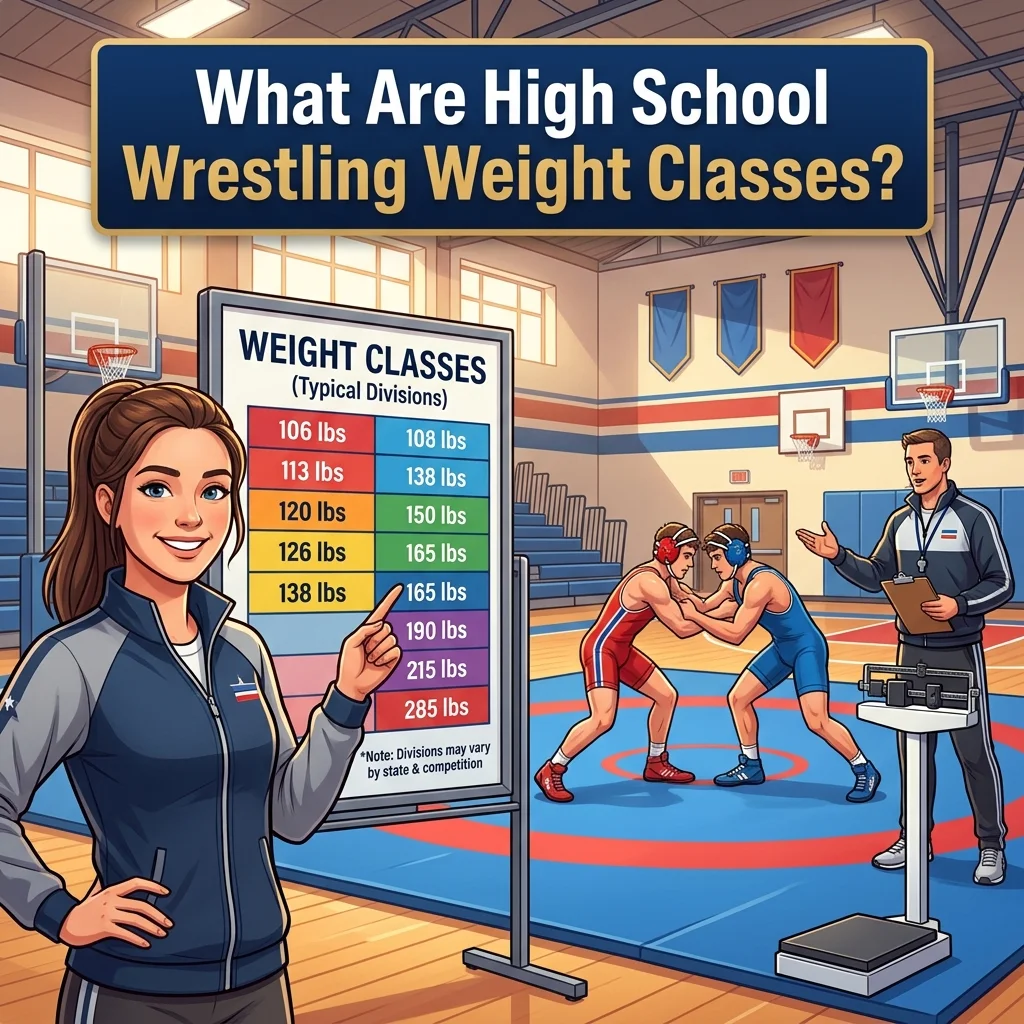
High school wrestling weight classes are competition divisions that group athletes according to their body weight. Each division has an established weight limit, allowing wrestlers of relatively similar sizes to compete against one another.
For example, a student who weighs 120 pounds may compete in the 120-pound division if they meet the official eligibility requirements.
Without weight classifications, a smaller wrestler might have to compete against an opponent who weighs significantly more. That difference could create an unfair physical advantage.
Weight classes help address this problem by organizing competitions into specific categories.
The National Federation of State High School Associations establishes approved weight-class options for American high school wrestling. State athletic associations choose which option their schools will follow.
Children have separate weight-classification systems. This gives schools the flexibility to organize competitions according to the approved divisions for each category.
It is important to understand that a wrestler’s natural body weight and their certified minimum wrestling weight are not necessarily the same. An athlete must satisfy both the competition’s weigh-in requirements and the applicable weight-management rules.
High School Wrestling Weight Classes for 2026–2027
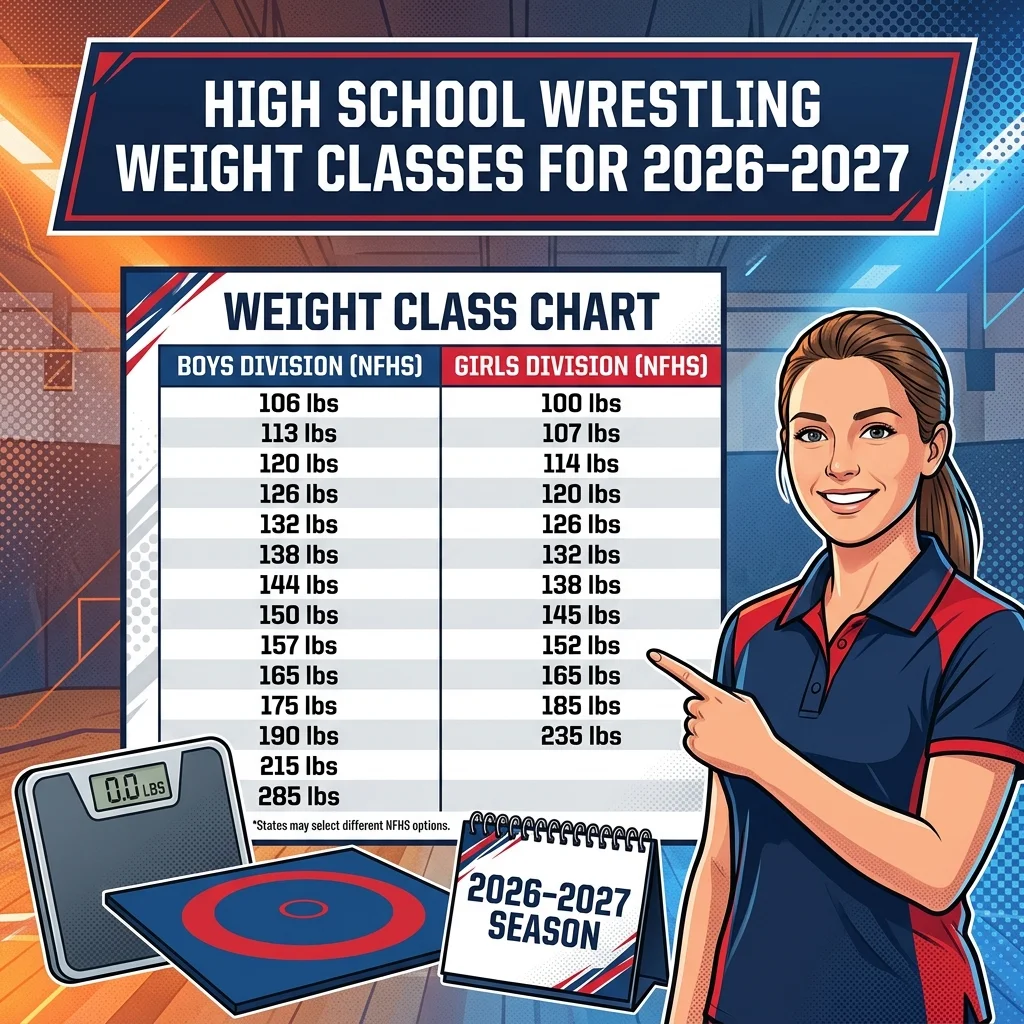
The NFHS provides three approved weight-class systems for the 2026–2027 season:
- 12 weight classes
- 13 weight classes
- 14 weight classes
The standard 14-class system is used by many high school wrestling programs. However, the correct system for an athlete depends on the state association.
Below are the complete weight charts for children.
Boys High School Wrestling Weight Classes
The standard 14-class boys’ system contains divisions from 106 pounds through 285 pounds.
Boys High School Wrestling Weight Chart
| Weight Class | Weight Limit |
| 106 lbs | 106 pounds |
| 113 lbs | 113 pounds |
| 120 lbs | 120 pounds |
| 126 lbs | 126 pounds |
| 132 lbs | 132 pounds |
| 138 lbs | 138 pounds |
| 144 lbs | 144 pounds |
| 150 lbs | 150 pounds |
| 157 lbs | 157 pounds |
| 165 lbs | 165 pounds |
| 175 lbs | 175 pounds |
| 190 lbs | 190 pounds |
| 215 lbs | 215 pounds |
| 285 lbs | 285 pounds |
These boys’ wrestling weight classes cover a wide range of body sizes.
For example, a wrestler weighing 132 pounds may qualify for the 132-pound division if their official weight does not exceed the applicable limit and they satisfy their weight certification requirements.
Similarly, an athlete weighing 185 pounds may be eligible for the 190-pound division.
The 285-pound division is the highest standard boys’ weight class. It is commonly called the heavyweight division.
Girls High School Wrestling Weight Classes
Girls’ wrestling has its own 14-class system, beginning at 100 pounds and extending to 235 pounds.
Best Girls High School Wrestling Weight Chart
| Weight Class | Weight Limit |
| 100 lbs | 100 pounds |
| 105 lbs | 105 pounds |
| 110 lbs | 110 pounds |
| 115 lbs | 115 pounds |
| 120 lbs | 120 pounds |
| 125 lbs | 125 pounds |
| 130 lbs | 130 pounds |
| 135 lbs | 135 pounds |
| 140 lbs | 140 pounds |
| 145 lbs | 145 pounds |
| 155 lbs | 155 pounds |
| 170 lbs | 170 pounds |
| 190 lbs | 190 pounds |
| 235 lbs | 235 pounds |
The girls’ wrestling weight chart provides separate divisions for female high school athletes.
Girls’ wrestling has grown considerably across the United States. More schools now offer dedicated girls’ teams, individual tournaments, and state championship opportunities.
The weight differences between divisions are not always identical. For example, several lower divisions increase in five-pound steps, while the upper divisions have larger gaps.
These classifications allow schools to organize girls’ wrestling competitions using a consistent structure.
What Are the 12 High School Wrestling Weight Classes?
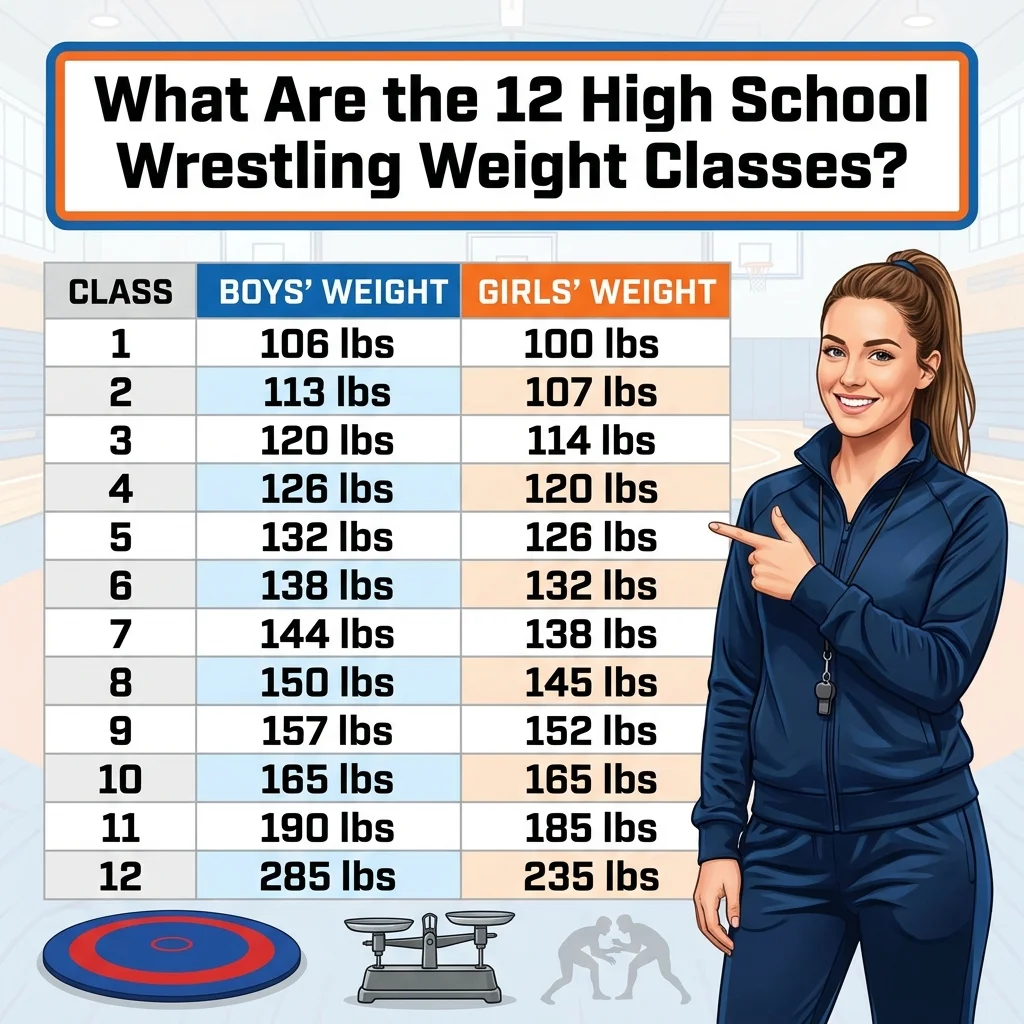
The 12-class system is one of the three approved NFHS options. It provides fewer divisions than the standard 14-class arrangement.
This system combines certain weight ranges into larger categories. State associations can choose it when organizing their high school wrestling programs.
Boys’ 12-Class Weight Chart
| Weight Class | Maximum Weight |
| 108 lbs | 108 pounds |
| 116 lbs | 116 pounds |
| 124 lbs | 124 pounds |
| 131 lbs | 131 pounds |
| 138 lbs | 138 pounds |
| 145 lbs | 145 pounds |
| 152 lbs | 152 pounds |
| 160 lbs | 160 pounds |
| 170 lbs | 170 pounds |
| 190 lbs | 190 pounds |
| 215 lbs | 215 pounds |
| 285 lbs | 285 pounds |
Girls’ 12-Class Weight Chart
| Weight Class | Maximum Weight |
| 100 lbs | 100 pounds |
| 107 lbs | 107 pounds |
| 114 lbs | 114 pounds |
| 120 lbs | 120 pounds |
| 126 lbs | 126 pounds |
| 132 lbs | 132 pounds |
| 138 lbs | 138 pounds |
| 145 lbs | 145 pounds |
| 152 lbs | 152 pounds |
| 165 lbs | 165 pounds |
| 185 lbs | 185 pounds |
| 235 lbs | 235 pounds |
The 12-class option gives schools a smaller number of divisions while still providing opportunities for athletes across different weight ranges.
What Are the 13 High School Wrestling Weight Classes?
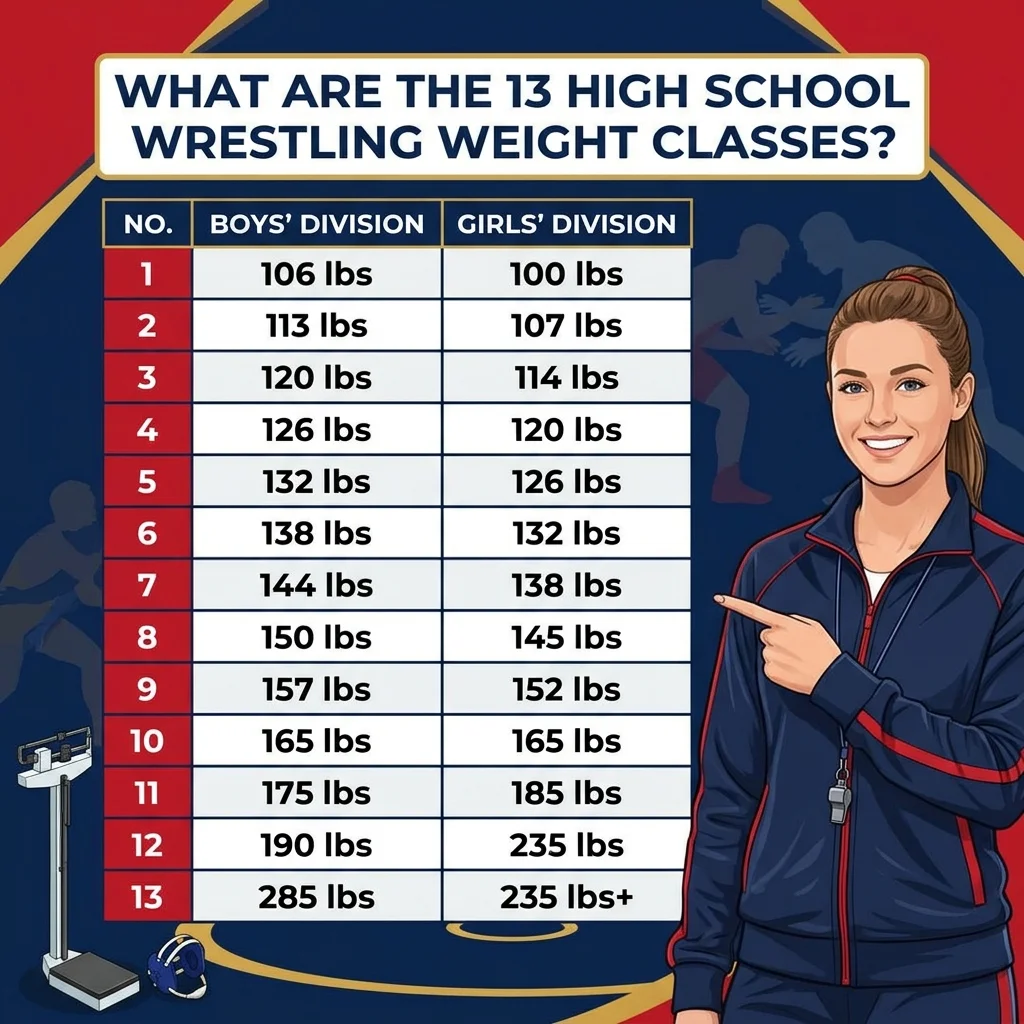
The 13-class system offers a middle option between the 12- and 14-class arrangements.
It provides one additional division compared with the 12-class system while maintaining fewer divisions than the standard 14-class system.
Boys’ 13-Class Weight Chart
| Weight Class | Maximum Weight |
| 107 lbs | 107 pounds |
| 114 lbs | 114 pounds |
| 121 lbs | 121 pounds |
| 127 lbs | 127 pounds |
| 133 lbs | 133 pounds |
| 139 lbs | 139 pounds |
| 145 lbs | 145 pounds |
| 152 lbs | 152 pounds |
| 160 lbs | 160 pounds |
| 172 lbs | 172 pounds |
| 189 lbs | 189 pounds |
| 215 lbs | 215 pounds |
| 285 lbs | 285 pounds |
Girls’ 13-Class Weight Chart
| Weight Class | Maximum Weight |
| 100 lbs | 100 pounds |
| 106 lbs | 106 pounds |
| 112 lbs | 112 pounds |
| 118 lbs | 118 pounds |
| 124 lbs | 124 pounds |
| 130 lbs | 130 pounds |
| 136 lbs | 136 pounds |
| 142 lbs | 142 pounds |
| 148 lbs | 148 pounds |
| 155 lbs | 155 pounds |
| 170 lbs | 170 pounds |
| 190 lbs | 190 pounds |
| 235 lbs | 235 pounds |
These divisions provide another option for state associations organizing their wrestling competitions.
Difference Between the 12-, 13-, and 14-Class Systems
All three systems organize athletes according to body weight. The main difference is the number of available divisions and their individual weight limits.
| Feature | 12 Classes | 13 Classes | 14 Classes |
| Number of divisions | 12 | 13 | 14 |
| Boys’ lowest class | 108 lbs | 107 lbs | 106 lbs |
| Boys’ highest class | 285 lbs | 285 lbs | 285 lbs |
| Girls’ lowest class | 100 lbs | 100 lbs | 100 lbs |
| Girls’ highest class | 235 lbs | 235 lbs | 235 lbs |
A state association selects one approved system for boys and one for girls. It does not have to select the same system for both.
For example, a state may use 14 divisions for boys and 12 divisions for girls.
Once selected, the state cannot switch between the approved sets during the wrestling season.
This is why athletes should check their state association’s current handbook rather than relying entirely on a weight chart from another state.
How Many Weight Classes Are in High School Wrestling?
There are three approved options for high school wrestling: 12, 13, or 14 weight classes.
The exact number depends on the system selected by the state athletic association.
For example, a school using the standard 14-class boys’ system has divisions ranging from 106 to 285 pounds. A school using the 12-class system has divisions ranging from 108 to 285 pounds.
Girls’ competitions follow their own approved weight classifications.
The number of divisions is important because it affects team lineups, tournament brackets, and the available competition categories.
What Is the Lowest High School Wrestling Weight Class?
The lowest high school wrestling weight class depends on the selected classification system.
Under the standard 14-class system:
- Boys: 106 pounds
- Girls: 100 pounds
Under the 13-class system:
- Boys: 107 pounds
- Girls: 100 pounds
Best Under the 12-class system:
- Boys: 108 pounds
- Girls: 100 pounds
These are the lowest listed divisions in the three approved systems.
However, being light enough to enter a division does not automatically make an athlete eligible. The wrestler must also meet the minimum weight certification and other state requirements.
What Is the Highest High School Wrestling Weight Class?
The highest boys’ weight class in all three approved systems is 285 pounds.
For girls, the highest division is 235 pounds.
These divisions are generally known as heavyweight categories.
Heavyweight wrestlers often rely on strength, balance, positioning, and effective movement. However, technique remains important at every weight.
A heavyweight athlete still needs good conditioning, defensive skills, and the ability to perform controlled wrestling techniques.
The listed division is not the same as a universal minimum heavyweight weight. Athletes must follow their state’s eligibility and weight-management requirements.
High School Wrestling Weight Classes in Kilograms
Although American high school wrestling uses pounds, international readers may find kilograms easier to understand.
One pound is approximately 0.4536 kilograms.
Here are some common conversions from the standard 14-class system.
| Weight in Pounds | Approximate Weight in Kilograms |
| 100 lbs | 45.4 kg |
| 106 lbs | 48.1 kg |
| 113 lbs | 51.3 kg |
| 120 lbs | 54.4 kg |
| 126 lbs | 57.2 kg |
| 132 lbs | 59.9 kg |
| 138 lbs | 62.6 kg |
| 144 lbs | 65.3 kg |
| 150 lbs | 68.0 kg |
| 157 lbs | 71.2 kg |
| 165 lbs | 74.8 kg |
| 175 lbs | 79.4 kg |
| 190 lbs | 86.2 kg |
| 215 lbs | 97.5 kg |
| 235 lbs | 106.6 kg |
| 285 lbs | 129.3 kg |
These conversions are approximate. The official American competition weight classifications remain listed in pounds.
How Do High School Wrestling Weight Classes Work?
Understanding how the system works is important for students entering their first wrestling season.
A wrestler cannot simply select any division based on personal preference. Their competition eligibility depends on official weight limits, certification, and state-specific regulations.
The process generally involves the following steps.
Initial Weight Assessment
Before competing, wrestlers usually complete an approved weight assessment.
This process evaluates the athlete’s current weight and other information required by the state’s weight-management program.
It helps establish a safe competition plan and reduces the risk of unhealthy weight-loss practices.
High School Wrestling Weight Certification
Weight certification determines the minimum weight at which a wrestler may compete.
The process commonly includes an assessment of body composition and hydration under the applicable program.
For example, a wrestler might have a certified minimum weight of 126 pounds.
Even if that athlete later weighs less than 126 pounds, they cannot automatically enter the 120-pound division. They must follow their certification and applicable eligibility rules.
Choosing the Competition Division
After certification, the athlete and coach can identify suitable weight classes.
The decision should consider:
- Natural body weight.
- Certified minimum weight.
- Physical development.
- Strength and conditioning.
- Training schedule.
- Competition requirements.
The lowest available weight class is not necessarily the best choice.
Athletes should compete at a weight that supports their health, strength, and performance.
Official Weigh-In
Before a match or tournament, wrestlers complete an official weigh-in.
Officials check whether each athlete meets the applicable weight limit.
The 2026–2027 NFHS rules also include changes to the weigh-in process. Athletes should follow the current procedures provided by their school and state association.
If a wrestler does not make the required weight, the athlete may be ineligible for the selected division or face consequences under the event rules.
Competing in the Correct Division
Once the athlete meets the weight and eligibility requirements, they can compete in the appropriate category.
This process helps maintain consistent standards across wrestling programs.
What Is the Difference Between a Weight Class and Certified Minimum Weight?
These terms are related, but they mean different things.
A weight class identifies the competition division and its listed weight limit.
Certified minimum weight identifies the lowest division an athlete may enter under the applicable weight-management rules.
Consider this example:
A wrestler has a certified minimum weight of 126 pounds. Their state uses the standard 14-class system.
The athlete might be eligible for the 126-pound division or a higher division, subject to the applicable rules. They cannot simply enter the 120-pound division because they temporarily lose weight.
This distinction is important because a wrestler’s actual weight does not automatically determine competition eligibility.
Coaches and athletes should review the official certification record before choosing a division.
What Are High School Wrestling Weigh-In Rules?
Weigh-ins are official checks that determine whether wrestlers meet the requirements for their selected weight classes.
The exact procedures depend on the current NFHS rules and state athletic association policies.
Important considerations include:
Timing: Weigh-ins take place according to the competition schedule and applicable rules.
Clothing: Wrestlers must follow the prescribed uniform and undergarment requirements.
Equipment: Items such as shoes and ear guards are subject to the official weigh-in rules.
Eligibility: An athlete must meet the relevant weight and certification requirements.
Documentation: Schools maintain the information needed to establish competition eligibility.
The 2026–2027 NFHS rules include a modification to the weigh-in procedure. Therefore, wrestlers should use the current season’s handbook rather than relying on older instructions.
What Is a Growth Allowance in High School Wrestling?
A growth allowance is an approved increase in the permitted weigh-in limit during a designated part of the season.
High school athletes are still developing physically. Their body weight may naturally change throughout the wrestling season.
Some state associations provide additional weight allowances after a specific date.
For example, the Texas University Interscholastic League provides a two-pound growth allowance beginning December 27.
Under that policy, a wrestler in the 120-pound division may receive a two-pound adjustment after the effective date.
However, this is a Texas-specific example, not a universal rule for every state.
A growth allowance also does not allow an athlete to compete below their certified minimum weight.
Always check the current state handbook to confirm the amount, effective date, and eligibility conditions.
What Are the 2026–2027 High School Wrestling Weight Management Rules?
Weight management is an important part of high school wrestling because athletes need to compete safely while maintaining proper physical development.
The NFHS establishes rules that address weight certification and body composition.
One important change for the 2026–2027 season concerns minimum body-fat requirements for female wrestlers.
The NFHS increased the minimum body-fat percentage for female wrestlers from 12% to 19%, effective with the 2026–2027 season.
The male minimum remains 7% under the standard rule.
The 2026–2027 NFHS interpretations explain that a medical release signed by an appropriate healthcare professional is required for a female wrestler below 19% or a male wrestler below 7% to compete.
These requirements are part of the weight-management framework. They are not simply additional weight-class limits.
Athletes should work with their schools and qualified professionals to understand their individual certification results.
Is Weight Cutting Allowed in High School Wrestling?
Weight cutting means intentionally reducing body weight to qualify for a lower wrestling division.
Although wrestlers manage their weight throughout the season, extreme weight-loss practices can be dangerous.
High school athletes should avoid methods such as:
- Skipping meals to lose weight quickly.
- Dehydrating before a competition.
- Wearing excessive clothing to force sweating.
- Using saunas for rapid weight loss.
- Taking laxatives or diuretics.
- Following restrictive diets without professional supervision.
- Exercising excessively without proper hydration.
These methods can negatively affect energy, concentration, recovery, and physical health.
Teenagers need sufficient nutrition and hydration because their bodies are still developing.
A healthier approach includes balanced meals, adequate water intake, appropriate training, and sufficient rest.
Coaches, parents, and qualified healthcare professionals should support athletes when they make decisions about weight management.
Do Varsity and Junior Varsity Wrestlers Have Different Weight Classes?
Varsity and junior varsity are different levels of high school wrestling competition.
Varsity generally includes athletes competing at the school’s primary competitive level. Junior varsity provides additional competition opportunities for developing wrestlers.
However, varsity and JV do not automatically have separate national weight-class systems.
The weight classifications generally follow the system selected by the state association. Local schools and tournament organizers may establish additional participation and lineup requirements for JV events.
For example, a school may use the same standard weight categories for both varsity and junior varsity while allowing different athletes to compete in each lineup.
Students should ask their coaches about local rules before entering a competition.
Do High School Wrestling Weight Classes Depend on Grade or Age?
No. Standard NFHS high school wrestling weight classes are based on competition weight, not separate freshman, sophomore, junior, and senior divisions.
For example, a freshman weighing 132 pounds and a senior weighing 132 pounds may compete in the same weight category if both satisfy the eligibility requirements.
However, school-level and tournament policies may create separate events for different experience levels or age groups.
Middle school and junior high wrestling may also use different classifications.
The best way to confirm eligibility is to check the competition rules for the specific event.
What Happens If a Wrestler Does Not Make Weight?
A wrestler who exceeds the permitted limit during an official weigh-in may not be allowed to compete in the selected division.
The consequences depend on the event and applicable state rules.
Possible outcomes include:
- The wrestler may be ineligible for the selected weight class.
- The athlete may be allowed to move to another eligible division if the rules permit it.
- The school may need to change its lineup.
- The wrestler may be unable to participate in that particular competition.
In a dual meet, failing to make weight may leave the team without an eligible competitor in that division.
In an individual tournament, it may affect the athlete’s entry or participation.
The best way to avoid these problems is to monitor weight throughout the season and communicate with the coaching staff.
How Should Wrestlers Choose the Right Weight Class?
Choosing a suitable weight division is an important decision.
Athletes should not focus only on competing in the lightest possible category. They should consider their health, natural weight, certification, and physical performance.
Consider Natural Body Weight
A wrestler’s normal body weight provides a useful starting point.
Athletes should understand how their weight changes during training and different stages of physical development.
A stable and healthy weight makes preparation easier.
Review Certified Minimum Weight
Certification establishes an important eligibility boundary.
Even if a wrestler believes they can reach a lower weight, they must follow the official minimum established through the applicable program.
Maintain Strength and Conditioning
Wrestling requires energy, strength, endurance, and concentration.
An unsuitable weight target can negatively affect training and competition performance.
Athletes should prioritize proper nutrition, recovery, and conditioning.
Listen to Qualified Coaches
Experienced wrestling coaches can help athletes understand the competition system.
They can review certification information, training progress, and upcoming events.
Parents should also remain involved in decisions affecting younger athletes.
Think About Long-Term Development
High school students continue to grow throughout their teenage years.
A weight class that works during one season may not be suitable the next year.
Athletes should focus on long-term development rather than forcing their bodies to remain at an unnecessarily low weight.
High School Wrestling Weight Classes by State
Although the NFHS provides approved national weight-class options, individual states determine which system their schools use.
This means high school wrestling weight classes can vary depending on location.
Some states use 14 divisions for both children. Others may select 12 or 13 divisions for one or both categories.
States can also establish additional policies involving:
- Weight certification.
- Growth allowances.
- Weigh-in schedules.
- Minimum weight requirements.
- Tournament eligibility.
- Seasonal weight management.
For example, Texas uses 14 weight classes for both children and provides a two-pound growth allowance beginning December 27 under its UIL wrestling manual.
This demonstrates why checking the local rules is important.
Students should consult their state athletic association’s current wrestling handbook or speak with their school’s athletic director.
High School vs. College Wrestling Weight Classes
High school programs generally follow NFHS-approved weight classifications, while NCAA wrestling uses its own system.
NCAA men’s wrestling has 10 weight classes:
| Weight Class | Weight Limit |
| 125 lbs | 125 pounds |
| 133 lbs | 133 pounds |
| 141 lbs | 141 pounds |
| 149 lbs | 149 pounds |
| 157 lbs | 157 pounds |
| 165 lbs | 165 pounds |
| 174 lbs | 174 pounds |
| 184 lbs | 184 pounds |
| 197 lbs | 197 pounds |
| 285 lbs | 285 pounds |
The standard high school 14-class system has more divisions than NCAA men’s wrestling.
For example, a high school wrestler may compete in the 120-pound division, while the nearest NCAA men’s division is 125 pounds.
College athletes also follow different certification and weigh-in procedures.
Students interested in wrestling at the college level should understand these differences while preparing for recruitment and future competition.
Why Are High School Wrestling Weight Classes Important?
Weight classifications help organize competitions and give athletes a fairer opportunity to demonstrate their skills.
They provide several important benefits.
Fairer Matchups
Weight classes reduce major differences in body size between competitors.
This allows athletes to focus more on technique, positioning, strength, and strategy.
More Competition Opportunities
Different weight categories allow students with various body types to participate.
Schools can organize teams with athletes representing multiple divisions.
Organized Tournament Brackets
Weight classes help tournament organizers create brackets and schedule matches.
Athletes know which category they are entering, making the competition easier to organize.
Better Athlete Development
Weight-management procedures encourage athletes to understand their physical development.
With proper supervision, wrestlers can develop healthier habits involving nutrition, hydration, training, and recovery.
Clearer Competitive Goals
Each division provides athletes with specific competition opportunities.
Wrestlers can work toward team positions, tournament victories, regional championships, and state-level achievements.
Frequently Asked Questions About High School Wrestling Weight Classes
What are the high school wrestling weight classes for boys in 2026–2027?
The standard 14-class boys’ system includes 106, 113, 120, 126, 132, 138, 144, 150, 157, 165, 175, 190, 215, and 285 pounds.
What are the girls’ high school wrestling weight classes for 2026–2027?
The standard 14-class girls’ system includes 100, 105, 110, 115, 120, 125, 130, 135, 140, 145, 155, 170, 190, and 235 pounds.
How many weight classes are in high school wrestling?
There are three approved NFHS options: 12, 13, and 14 weight classes. Each state selects one system for boys and one for girls.
What is the lowest high school wrestling weight class?
The lowest division is 106 pounds for boys under the standard 14-class system and 100 pounds for girls.
What is the heaviest high school wrestling weight class?
The highest boys’ division is 285 pounds, while the highest girls’ division is 235 pounds.
Can a 128-pound wrestler compete in the 126-pound class?
Not if the athlete exceeds the applicable weigh-in limit. The wrestler must meet the official weight requirements and satisfy the applicable certification rules.
Can a wrestler compete in a higher weight class?
Generally, a wrestler may be permitted to compete in a higher division if they satisfy the relevant eligibility and competition requirements.
Do high school wrestling weight classes change every year?
The three NFHS-approved classification sets were introduced effective July 1, 2023. However, state policies and other wrestling rules can change. Athletes should check the current season’s handbook.
Are varsity and JV wrestling weight classes different?
They do not automatically have separate national weight-class systems. Both generally follow the state-approved classifications, although local competition rules may differ.
Do freshmen have different wrestling weight classes?
Not automatically. Standard high school weight divisions are based on weight rather than grade level. Separate freshman or age-group tournaments may have additional rules.
What is a certified minimum wrestling weight?
It is the lowest weight at which an athlete may compete under the applicable weight-management program.
Do girls have separate high school wrestling weight classes?
Yes. The NFHS provides separate approved weight-class systems for girls’ competitions, with 12, 13, or 14 divisions depending on the state’s selection.
What is the difference between a growth allowance and a minimum weight?
A growth allowance increases the permitted competition weight under an approved policy. A certified minimum weight establishes the lowest division an athlete may enter. A growth allowance does not automatically reduce the certified minimum.
Final Thoughts
Understanding high school wrestling weight classes makes it easier for athletes, parents, coaches, and fans to follow the sport. These divisions organize competitions according to body weight and provide opportunities for wrestlers of different sizes. For the 2026–2027 season, the standard 14-class system includes boys’ divisions from 106 to 285 pounds and girls’ divisions from 100 to 235 pounds. The NFHS also provides 12- and 13-class options.
The most important thing to remember is that individual states select their competition systems. Certification, official weigh-ins, and state-specific weight-management policies also determine where an athlete can compete. Before choosing a division, wrestlers should review their certified minimum weight, understand local rules, and work with qualified coaches. Proper nutrition, hydration, and healthy physical development should always come before trying to reach a lower weight.

I am Daniel Scott, a passionate writer dedicated to creating meaningful and engaging content that informs, inspires, and connects with readers worldwide. I am passionate about exploring ideas, sharing knowledge, and presenting stories with clarity and creativity. My writing focuses on delivering valuable insights through well-researched articles and thoughtful perspectives. I am committed to maintaining accuracy, originality, and a reader-first approach in every piece I create.