
Creatine is one of the most widely used supplements among people who want to improve strength, build muscle, and perform better during exercise. Despite its popularity, it raises a common concern: what happens to your body weight when you start taking it?
Can creatine cause weight gain? Yes. Creatine can increase your body weight, particularly during the first few weeks of supplementation. However, this increase does not necessarily mean you are gaining body fat. Much of the early change is associated with increased water stored in your muscles.
This distinction is important if you are trying to lose weight, maintain a healthy body composition, or improve your fitness. Seeing an extra two or three pounds on the scale can feel discouraging, especially when you are following a consistent diet and exercise routine.
However, creatine-related weight gain and fat gain are not the same thing. Creatine helps your muscles produce energy during intense physical activity. It can also support strength improvements and muscle development when combined with resistance training.
In this guide, you will discover how much weight creatine can make you gain, why water retention happens, whether creatine causes belly fat, and how long the extra weight lasts. You will also learn whether women, beginners, and people trying to lose weight can safely consider creatine supplementation.
What Is Creatine and How Does It Work?

Creatine is a naturally occurring compound that your body produces from amino acids. Most of your body’s creatine is stored in skeletal muscles, although smaller amounts are found in other tissues.
You also obtain creatine through certain foods, particularly animal-based products such as beef, pork, and fish.
Your muscles use creatine to help produce adenosine triphosphate (ATP), the primary energy source for muscle contractions. During activities such as weightlifting, sprinting, and jumping, your muscles use ATP quickly.
Creatine helps regenerate ATP through a system involving phosphocreatine. This allows your muscles to maintain energy availability during repeated, short bursts of intense activity.
Taking a creatine supplement increases the amount of creatine stored in your muscles. With higher muscle creatine levels, you may be able to perform additional repetitions, maintain strength across sets, and improve your training performance.
Creatine monohydrate is the most extensively researched form. It is commonly used by athletes, recreational gym-goers, and people following strength-training programs.
According to the National Institutes of Health (NIH), creatine can improve strength, power, and performance during repeated high-intensity activities. Its benefits are generally less noticeable for activities that depend primarily on prolonged endurance.
Can Creatine Cause Weight Gain?

Yes, creatine can cause weight gain. The most common explanation is increased water storage associated with higher creatine levels in your muscles.
However, the amount and timing of weight gain differ from person to person. Some people notice a change during the first week, while others experience little noticeable change.
There are three important factors to understand:
- Water weight: Your muscles may hold more water as creatine stores increase.
- Muscle development: Better training performance may support muscle growth over time.
- Body fat: Creatine does not directly cause fat accumulation, although your overall calorie intake still influences fat gain.
For example, imagine you weigh 150 pounds before starting creatine. A few weeks later, your scale shows 153 pounds.
That three-pound increase does not automatically mean you gained three pounds of fat. Some of the change may reflect additional water inside your muscles.
The best way to understand creatine weight gain is to examine how it affects your body.
Why Does Creatine Cause Weight Gain?

Creatine can influence body weight through several related processes. Understanding these processes helps explain why your weight might increase even when your diet has not changed significantly.
1. Increased Water Storage Inside Muscle Cells
Water retention is one of the main reasons people notice weight gain after starting creatine.
When creatine enters your muscle cells, it increases the amount of creatine available for energy production. Because creatine is osmotically active, changes in muscle creatine levels can also influence water distribution.
This can increase intracellular water, which means water stored inside cells.
Intracellular water is different from extracellular water, which is found outside cells. It is also different from swelling caused by certain medical conditions.
This explains why your muscles may look fuller after starting supplementation.
For example, someone who weighs 150 pounds might notice a small increase after taking creatine consistently. If their waist measurement remains stable while their muscles look fuller, additional muscle water may be contributing to the change.
However, not every person experiences the same response. The amount of water-related weight gain depends on factors such as initial creatine stores, dosage, and individual physiology.
2. Improved Workout Performance and Muscle Growth
Creatine can help you perform better during repeated high-intensity exercise.
For example, you might complete an additional repetition during a weightlifting set or maintain your strength across several exercises.
These small improvements can become valuable when repeated consistently.
Over time, better training performance may help you increase your training volume and provide a stronger stimulus for muscle development.
However, muscle growth does not happen automatically after taking creatine. It requires appropriate resistance training, sufficient nutrition, and recovery.
This distinction matters because early creatine weight gain and long-term muscle development happen through different processes.
3. Changes in Muscle Glycogen and Water
Glycogen is the stored form of carbohydrates found in your muscles and liver.
Your muscles use glycogen as an energy source during physical activity. When glycogen stores increase, the body also stores additional water.
This can contribute to changes in body weight and muscle fullness.
For example, someone who starts strength training while increasing carbohydrate intake may notice weight changes caused by glycogen and water storage.
These changes can occur alongside creatine supplementation, making it difficult to identify one single cause.
Glycogen-related water weight is not body fat. It is part of your body’s normal energy-storage process.
How Much Weight Does Creatine Make You Gain?

The amount of weight you gain from creatine depends on your body, supplement routine, and exercise habits.
The NIH reports that some studies involving creatine monohydrate and strength training have found approximately 1–2 kilograms (2.2–4.4 pounds) of additional body weight within a month.
This is an observed research finding, not a guaranteed result for everyone.
Some people gain less, while others experience a more noticeable increase, particularly when they begin with a loading phase.
Here is a general guide to possible changes:
| Time after starting creatine | What may happen |
| First 3–7 days | Water-related weight changes may appear, especially with loading |
| Week 2 | Muscle creatine stores continue increasing |
| Weeks 3–4 | Muscle stores may approach saturation with a daily maintenance dose |
| Weeks 4–8 | Training adaptations may begin contributing to body composition changes |
| After several months | Results depend on training, nutrition, and individual response |
These timeframes are approximate. They should not be treated as a personal weight-gain prediction.
How Much Weight Can You Gain From Creatine in a Month?
Some people gain around 2–4 pounds during the first month, although individual results vary.
A loading phase can make the initial increase happen more quickly because it raises muscle creatine stores faster.
Without loading, taking a smaller daily dose gradually increases muscle creatine levels over several weeks.
The most important point is that early weight gain is not necessarily fat gain.
If you notice a change in your weight, consider your waist measurement, training performance, and longer-term progress before drawing conclusions.
Creatine Water Weight vs. Fat Gain: What’s the Difference?
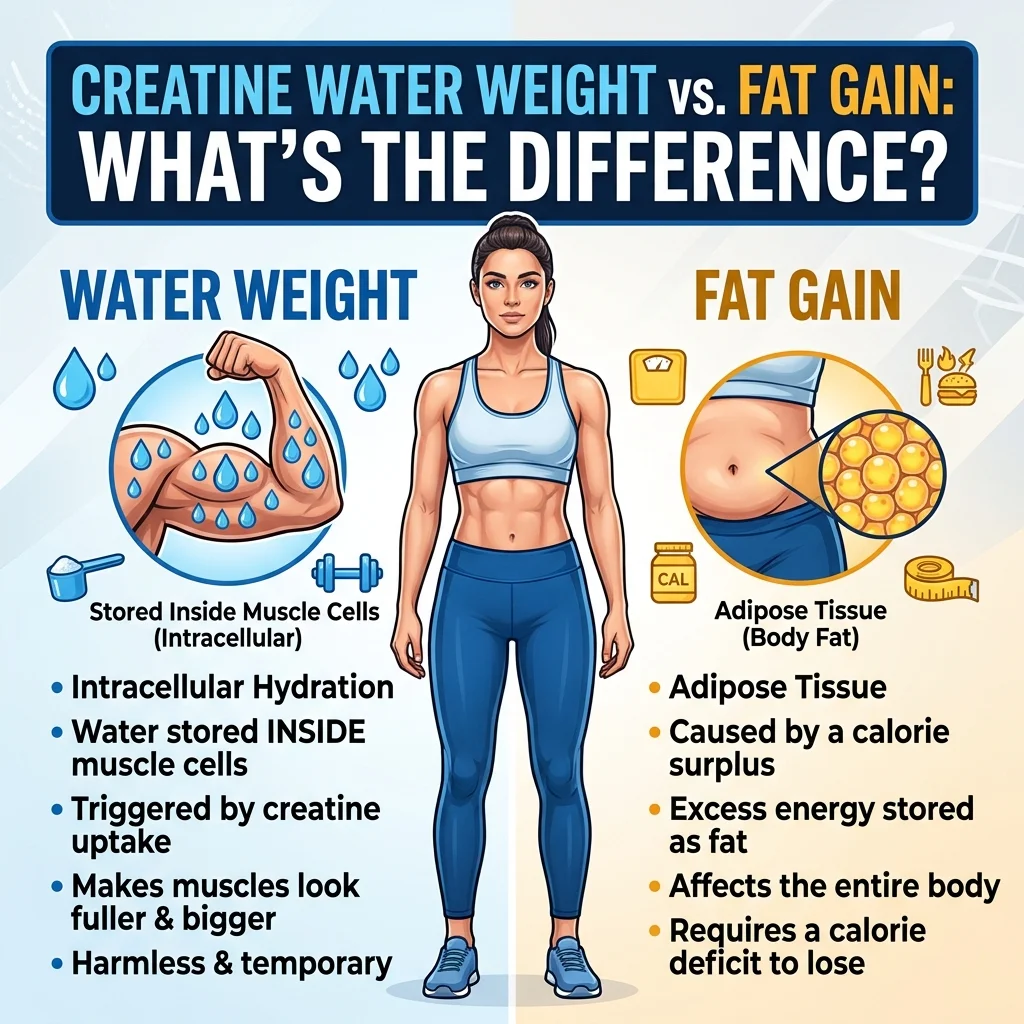
One of the biggest misunderstandings about creatine is that every increase on the scale represents additional body fat.
In reality, water weight, muscle tissue, and body fat are different components of total body weight.
| Feature | Creatine-related water weight | Muscle gain | Fat gain |
| Main cause | Changes in muscle water storage | Muscle adaptation to training | Excess energy stored as fat |
| Timing | Can appear relatively quickly | Usually develops over time | Develops over time |
| Appearance | Muscles may look fuller | Muscles may become larger and stronger | Body measurements may increase |
| Effect of stopping creatine | Associated water weight gradually decreases | Does not automatically disappear | Does not automatically disappear |
| Main influence | Creatine supplementation | Resistance training and nutrition | Long-term calorie balance |
Does Creatine Make You Gain Fat?
No. Creatine does not directly cause body fat gain.
Creatine is not a fat-producing ingredient, and it does not automatically increase your body fat percentage.
However, you can gain fat while taking creatine if you consistently consume more calories than your body uses.
Consider two situations.
Situation one: Water-weight increase
You start taking creatine and gain two pounds over several weeks. Your waist measurement remains relatively stable, and your muscles look slightly fuller.
The increase may be related to additional water stored inside your muscles.
Situation two: Body fat increase
You start taking creatine and also increase your daily calorie intake significantly. Over several months, your body weight and waist measurement both increase.
In this case, your calorie surplus may contribute to fat gain.
The scale cannot identify the exact type of weight you have gained. Looking at several measurements provides a more useful picture.
Does Creatine Cause Belly Fat or Make Your Stomach Bigger?

Creatine does not directly cause belly fat.
Its primary effects on body weight are associated with increased muscle creatine stores, water distribution, and exercise-related changes.
It does not specifically direct fat toward your stomach.
However, some people experience digestive discomfort after taking creatine, especially when consuming large amounts in one serving.
Possible symptoms include:
- Temporary abdominal bloating.
- Stomach discomfort.
- Nausea.
- Loose stools or diarrhea.
- Digestive irritation.
These symptoms are different from gaining belly fat.
If you experience digestive discomfort, consider dividing your daily amount into smaller servings or taking it with meals. Avoiding a loading phase may also help.
If abdominal swelling is persistent, painful, or accompanied by other concerning symptoms, seek medical advice rather than assuming creatine is responsible.
Does Creatine Make Your Face Look Bigger?
There is no good evidence that creatine specifically causes facial fat gain.
Creatine is mainly stored in muscle tissue, and its best-established effect on water balance is associated with muscle creatine storage.
If your face appears puffier after starting supplementation, other factors may be involved, including sleep, sodium intake, allergies, or general fluid changes.
Persistent facial swelling should be evaluated by a healthcare professional.
Does Creatine Cause Weight Gain Without Working Out?

Yes, you may experience some water-related weight gain even if you take creatine without exercising.
Creatine increases the availability of creatine in your muscles. This process does not require you to complete a workout every time you take the supplement.
However, taking creatine without resistance training does not provide the same muscle-building stimulus as combining it with regular exercise.
For example, imagine two people start taking creatine.
The first person takes it while following a consistent weightlifting program. They may experience increased muscle water and gradually develop more muscle through training.
The second person takes it but does not exercise regularly. They may experience some changes in water weight but should not expect comparable muscle growth.
If your goal is to build muscle, creatine should support an appropriate exercise program rather than replace it.
Does Creatine Cause Weight Gain in Beginners?

Beginners may notice weight changes after starting creatine, particularly when they combine supplementation with a new workout routine.
This can happen for several reasons.
First, creatine increases muscle creatine stores. Second, beginners may experience changes in muscle glycogen and water as their exercise and eating habits change. Third, consistent resistance training can gradually increase muscle mass.
However, not every weight increase in a beginner comes from creatine.
Changes in food intake, hydration, workout frequency, and recovery can also influence body weight.
If you are new to exercise, start with a manageable training routine and focus on developing consistent habits before worrying about small changes on the scale.
Does Creatine Weight Gain Go Away After Stopping?
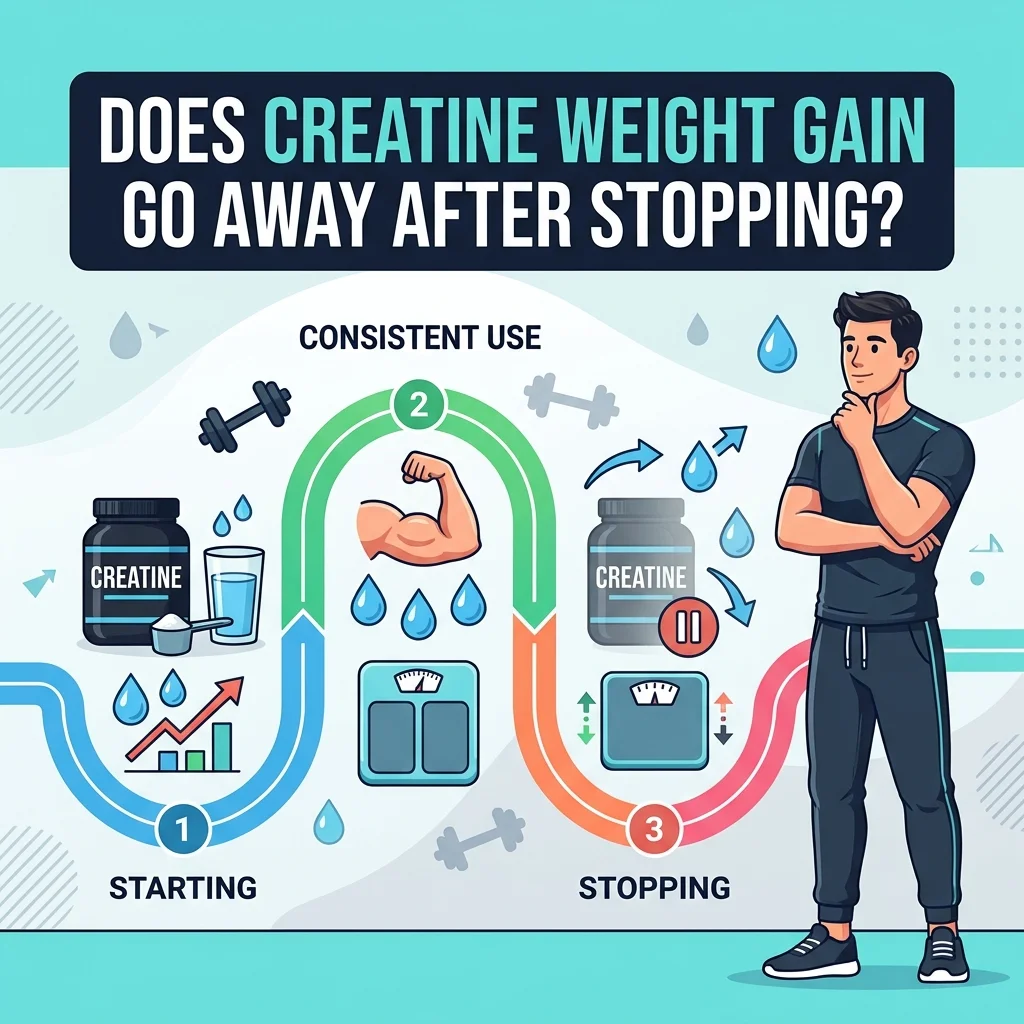
Yes. Creatine-related water weight generally decreases after you stop taking the supplement.
When you discontinue creatine, your muscle creatine stores gradually return toward their previous levels. The associated increase in body water and body weight also decreases over time.
The Australian Institute of Sport reports that this process generally takes around four to six weeks.
However, losing water weight does not mean you have lost all the muscle you developed while taking creatine.
Will You Lose Muscle If You Stop Taking Creatine?
No. Stopping creatine does not automatically cause muscle loss.
You might notice that your muscles look slightly less full because they no longer hold the same additional water.
Your actual muscle tissue is a separate matter. If you continue resistance training, eat enough protein, and maintain appropriate recovery habits, you can preserve much of your muscle development.
Your strength may also remain relatively stable, although individual exercise performance can change after discontinuing supplementation.
Can You Take Creatine While Losing Weight?
Yes. You can take creatine while following a weight-loss program.
Creatine does not directly prevent fat loss. However, additional water stored inside your muscles can temporarily increase your total body weight.
This can make your progress look slower on the scale than it really is.
Imagine you are following a calorie-controlled diet and lose two pounds of body fat over several weeks. During the same period, you gain two pounds of water weight after starting creatine.
Your scale may show no overall change, even though your body composition has improved.
This is why creatine users who want to lose weight should monitor more than one measurement.
Does Creatine Help With Fat Loss?
Creatine is not a fat-burning supplement.
It does not directly increase fat oxidation or guarantee weight loss. Its primary benefit is supporting energy production during repeated, high-intensity exercise.
However, creatine may indirectly support a weight-management routine by helping you maintain strength and training performance.
For example, someone following a calorie deficit may use resistance training to preserve muscle while losing body fat. Creatine can be a useful performance supplement in this situation.
For effective weight management, focus on:
- Maintaining a reasonable calorie deficit.
- Eating sufficient protein.
- Performing regular resistance training.
- Including cardiovascular activity.
- Getting enough sleep.
- Maintaining consistent eating habits.
Remember that creatine-related water weight can temporarily hide changes in body fat.
Creatine Weight Gain in Females: What Women Should Know
Women can experience weight gain after starting creatine, just like men.
The underlying process is similar. Creatine increases muscle creatine stores and may increase water held inside muscle cells.
This can make muscles appear fuller and increase total body weight.
Some women worry that creatine will make them look bulky or cause unwanted changes in their appearance. However, taking creatine does not automatically produce a bulky physique.
Muscle development depends on resistance training, nutrition, genetics, and individual hormonal and physiological factors.
Does Creatine Make Women Gain Weight?
Yes, women may experience increased body weight after starting creatine.
However, the increase is not necessarily body fat. It may reflect additional water stored inside muscles, particularly during the early stages of supplementation.
For women who are trying to lose weight, this distinction is important.
A small increase on the scale should not automatically be interpreted as a failed weight-loss routine.
Can Women Take Creatine During Weight Loss?
Women can consider creatine while following a weight-loss program if it is appropriate for their health circumstances.
Combining resistance training with adequate protein and a reasonable calorie deficit can help support muscle maintenance.
Creatine may also support exercise performance during strength training.
If you are pregnant, breastfeeding, have a medical condition, or take medication, consult a healthcare professional before starting supplementation.
Does Creatine Cause Weight Gain in Older Adults?
Older adults may also experience weight changes after starting creatine.
Creatine has been studied in combination with resistance training in different age groups, including older populations.
Its potential benefits include supporting strength and physical performance when combined with appropriate exercise.
However, age, muscle mass, activity level, diet, and health conditions can influence individual responses.
Older adults should not assume that creatine will automatically increase muscle mass or reverse age-related muscle loss.
A structured exercise routine, adequate nutrition, and professional guidance remain important.
People with kidney disease or other significant medical conditions should discuss supplementation with their healthcare provider.
Does Creatine Increase Appetite?
Creatine is not generally considered an appetite stimulant.
There is no established evidence that it directly makes everyone feel hungrier or causes weight gain by increasing food intake.
However, your appetite may change when you begin exercising more frequently or training at a higher intensity.
For example, if creatine helps you complete more demanding workouts, your overall energy needs may increase. You might feel hungrier because of your increased physical activity rather than the supplement itself.
If your goal is weight loss, monitor your food intake and focus on balanced meals that help you feel satisfied.
Does Creatine Affect Your Weight on Rest Days?
Creatine can continue influencing muscle creatine stores on rest days.
You do not need to exercise every day for your muscles to maintain elevated creatine levels.
That is why many supplementation routines recommend taking creatine consistently, including days when you do not work out.
Skipping exercise for one day does not automatically remove the additional water stored in your muscles.
Likewise, taking creatine on a rest day does not automatically cause extra body fat.
How to Take Creatine Without Unnecessary Weight Changes
You cannot completely prevent water-related weight changes if you respond to creatine supplementation. However, you can use a sensible approach to avoid unnecessary discomfort and excessive dosing.
1. Choose Creatine Monohydrate
Creatine monohydrate is the most researched form of creatine.
It has strong scientific support for improving high-intensity exercise performance and increasing muscle creatine stores.
You do not need an expensive supplement formula to experience its established benefits.
Look for a product with a clear ingredient list and reputable quality testing.
2. Take 3–5 Grams Daily
For most healthy adults, 3–5 grams of creatine monohydrate daily is a commonly used maintenance approach.
Taking a consistent daily amount helps gradually increase and maintain muscle creatine stores.
There is no need to consume excessive amounts in an attempt to build muscle faster.
3. Consider Skipping the Loading Phase
A creatine loading phase is an optional way to increase muscle creatine stores more quickly.
A commonly studied loading approach involves approximately 20 grams daily for five to seven days, divided into four smaller servings.
After loading, users typically reduce their intake to 3–5 grams daily.
However, loading is not necessary.
Taking 3–5 grams daily without loading can gradually increase muscle creatine stores over approximately four weeks.
Skipping loading may also make early weight changes less sudden and reduce digestive discomfort for some people.
4. Stay Properly Hydrated
Maintaining normal hydration is important when exercising and taking supplements.
Drink regularly throughout the day, and replace fluids lost through sweating.
Your individual hydration needs depend on your body size, activity level, exercise intensity, and surrounding temperature.
You do not need to force yourself to drink excessive amounts of water.
5. Eat a Balanced Diet
Creatine works best as part of an overall fitness routine.
Your body needs adequate energy, protein, carbohydrates, fats, vitamins, and minerals to support exercise and recovery.
Include a variety of foods such as:
- Eggs and dairy products.
- Chicken, fish, and lean meat.
- Beans and lentils.
- Rice, oats, and whole grains.
- Fruits and vegetables.
- Nuts and seeds.
You do not need an extremely high-protein diet to benefit from creatine.
6. Maintain a Consistent Workout Routine
If your goal is muscle development, combine creatine with resistance training.
Exercises such as squats, lunges, push-ups, rows, and weightlifting can help improve strength and stimulate muscle growth.
Start with a manageable routine and gradually increase the challenge as your fitness improves.
Is Creatine Safe to Take Every Day?
Creatine monohydrate has been extensively researched. Evidence generally supports its safety for healthy adults when used at appropriate amounts.
However, no supplement is suitable for everyone.
The NIH and Mayo Clinic report that creatine is generally considered safe for healthy adults when used appropriately, although individual circumstances and product quality matter.
What Are the Possible Side Effects of Creatine?
Some people experience unwanted effects after starting creatine.
These may include:
| Possible side effect | Explanation |
| Weight gain | Increased water storage and, over time, possible muscle development |
| Bloating | Temporary digestive discomfort |
| Nausea | Feeling sick after supplementation |
| Diarrhea | Loose or frequent bowel movements |
| Stomach discomfort | More likely with large servings in some people |
Many people tolerate creatine without significant problems.
If you experience digestive discomfort, consider smaller servings or taking creatine with meals. Stop using it and seek medical advice if symptoms persist or become severe.
Can Creatine Affect Your Kidneys?
Kidney health is an important consideration when choosing any supplement.
Research generally supports the safety of recommended creatine doses in healthy adults. However, evidence in people with existing kidney disease is more limited.
Creatine supplementation can also influence blood creatinine measurements.
Creatinine is a waste product that healthcare professionals commonly measure when evaluating kidney function. An increase in blood creatinine does not automatically mean that kidney damage has occurred.
However, it can complicate the interpretation of certain laboratory results.
If you take creatine, tell your healthcare professional before kidney-function testing.
People with kidney disease, reduced kidney function, or other relevant medical conditions should seek individual medical advice before using creatine.
Who Should Be Careful Before Taking Creatine?
Speak with a healthcare professional before starting creatine if you:
- Have existing kidney disease.
- Have a history of kidney-function problems.
- Take medications that may affect kidney function.
- Are pregnant or breastfeeding.
- Have a medical condition requiring supplement restrictions.
- Are considering creatine for a child or teenager.
How to Track Your Weight While Taking Creatine
If you are taking creatine, your usual weight-tracking routine may need a small adjustment.
A sudden increase in body weight does not necessarily mean your fitness progress has stopped.
Use the following methods to monitor changes more accurately.
Weigh Yourself Under Consistent Conditions
Use the same scale and weigh yourself under similar conditions.
A practical approach is to weigh yourself in the morning after using the bathroom and before eating breakfast.
This reduces some of the variation caused by food and fluid intake.
Compare Weekly Weight Averages
Daily body weight naturally fluctuates.
Instead of worrying about individual measurements, calculate your average weight over seven days.
Compare weekly averages to identify longer-term trends.
Measure Your Waist
Your waist measurement can provide additional information about changes in body composition.
If your weight increases while your waist measurement remains relatively stable, water storage or muscle development may contribute to the change.
However, waist measurements alone cannot determine exactly how much fat or muscle you have gained.
Monitor Strength and Exercise Performance
Pay attention to changes in your workouts.
You may notice that you can:
- Complete more repetitions.
- Maintain strength across several sets.
- Gradually increase resistance.
- Perform repeated high-intensity exercises more effectively.
These changes can help you evaluate your training progress.
Take Progress Photos
Progress photos provide another way to monitor physical changes.
Take pictures under similar lighting conditions and from the same angles.
Comparing pictures every four weeks can help you identify changes in muscle fullness and overall appearance.
Common Mistakes to Avoid When Taking Creatine
Although creatine is relatively straightforward to use, some mistakes can lead to unnecessary discomfort or unrealistic expectations.
Taking excessive amounts: More creatine does not automatically mean better results. Follow an appropriate daily dosage.
Expecting instant muscle growth: Creatine supports exercise performance, but muscle development requires consistent training.
Ignoring nutrition: Supplements cannot replace balanced meals and sufficient protein.
Panicking about the scale: Early weight gain may come from increased water storage rather than body fat.
Choosing unverified products: Buy from reputable manufacturers and look for independent quality testing.
Expecting creatine to burn fat: Creatine is a performance supplement, not a weight-loss medication.
Stopping exercise: Creatine cannot replace resistance training or regular physical activity.
Frequently Asked Questions About Creatine and Weight Gain
1. How much weight does creatine make you gain?
Some people experience approximately 2–4 pounds of additional body weight during the first month, although individual responses vary. Much of the early increase may be related to water stored inside muscles.
2. Does creatine cause weight gain in the first week?
Yes, some people notice weight changes during the first week, particularly when using a loading phase. Others experience a more gradual increase over several weeks.
3. Does creatine make you gain fat?
No. Creatine does not directly cause fat gain. Your overall calorie balance, rather than creatine itself, is the main factor influencing long-term body fat changes.
4. Does creatine cause belly fat?
No. Creatine does not specifically increase belly fat. It mainly influences muscle creatine stores and associated water changes.
5. Can creatine make your face look bigger?
There is no good evidence that creatine specifically causes facial fat gain. Persistent facial puffiness or swelling should be evaluated rather than automatically attributed to creatine.
6. Can creatine cause weight gain without working out?
Yes. You may experience water-related weight changes even without exercising. However, significant muscle development generally requires resistance training.
7. Does creatine weight gain go away after stopping?
Yes. Associated water weight gradually decreases after discontinuation as muscle creatine stores return toward their previous levels. This generally takes approximately four to six weeks.
8. Will I lose muscle if I stop taking creatine?
No. Stopping creatine does not automatically cause muscle loss. Your muscles may look slightly less full because of reduced water storage, but actual muscle maintenance depends on exercise and nutrition.
9. Can I take creatine while trying to lose weight?
Yes. Creatine can be used during a weight-loss program if appropriate for your health circumstances. Remember that temporary water-weight changes may hide progress on the scale.
10. Is 5 grams of creatine enough per day?
For most healthy adults, 3–5 grams of creatine monohydrate daily is a commonly used maintenance dose. A loading phase is optional.
11. Does creatine make women gain weight?
Yes, women can experience increased body weight from creatine, mainly because of changes in muscle water storage. Individual responses differ.
12. Does creatine increase appetite?
Creatine is not established as an appetite stimulant. However, increased exercise intensity may change your energy needs and hunger levels.
13. Does creatine affect weight on rest days?
Yes, creatine can continue influencing muscle creatine stores on rest days. You do not need to exercise every day to maintain elevated muscle creatine levels.
14. How long does creatine take to work?
With a loading phase, muscle creatine stores can increase substantially within approximately five to seven days. Without loading, taking a daily maintenance dose generally takes around four weeks to approach saturation.
15. Is creatine safe for long-term use?
Research generally supports appropriate creatine use in healthy adults, including longer-term use. However, people with kidney disease or other relevant medical conditions should seek professional advice.
Final Thoughts:
So, can creatine cause weight gain? Yes, but the increase does not necessarily represent additional body fat. The most common explanation for early weight gain is increased water storage associated with higher creatine levels in your muscles. Over time, improved workout performance and resistance training may also contribute to muscle development.
For most healthy adults, 3–5 grams of creatine monohydrate daily is a commonly used maintenance approach. You can skip the loading phase if you prefer a gradual increase in muscle creatine stores. If your goal is weight loss, do not let a small increase on the scale discourage you. Track your weekly weight averages, waist measurements, workout performance, and longer-term progress.

I am Daniel Scott, a passionate writer dedicated to creating meaningful and engaging content that informs, inspires, and connects with readers worldwide. I am passionate about exploring ideas, sharing knowledge, and presenting stories with clarity and creativity. My writing focuses on delivering valuable insights through well-researched articles and thoughtful perspectives. I am committed to maintaining accuracy, originality, and a reader-first approach in every piece I create.